What Is Anthurium balaoanum?
Anthurium balaoanum is a rare and spectacular tropical plant. It belongs to the Araceae family and is native to the lowland and premontane rainforests of Ecuador and Colombia. The species name “balaoanum” refers to Balao — a small town in southwestern Ecuador near the estuary of the Río Guayas. This is where the species was first formally recorded.
The plant was first described by botanist Engler in 1898. Additionally, it has been sold under several old names, including Anthurium dussii and Anthurium guildingii. Today, Anthurium balaoanum is the accepted scientific name. Consequently, collectors who know this plant by its older names may already understand its rarity and desirability.
Moreover, A. balaoanum grows as a hemiepiphyte — a plant that begins life on the forest floor and then climbs up trees. In its natural habitat, it can reach up to 30 meters in height. Indoors, it typically grows to around 2 meters. This dramatic growth habit makes it a truly impressive exotic plant for any serious collection.
Globally, demand for this rare exotic plant is growing fast. Collectors in Europe, the United States, Asia, and Australia actively seek this species. Furthermore, its limited availability in the international market makes every seed an opportunity not to be missed.
Aesthetic Features Anthurium balaoanum
The visual appeal of Anthurium balaoanum is extraordinary. Its dramatic foliage, unique texture, and elegant climbing habit set it apart from most exotic plants available today. Primarily, it is the leaves that make this plant unforgettable.
Anthurium belongs to one of the largest genera in the Araceae family, with over 1,000 recognized species. Among all of them, A. balaoanum stands out for its unique combination of size, texture, and shape.
Leaf Structure Anthurium balaoanum
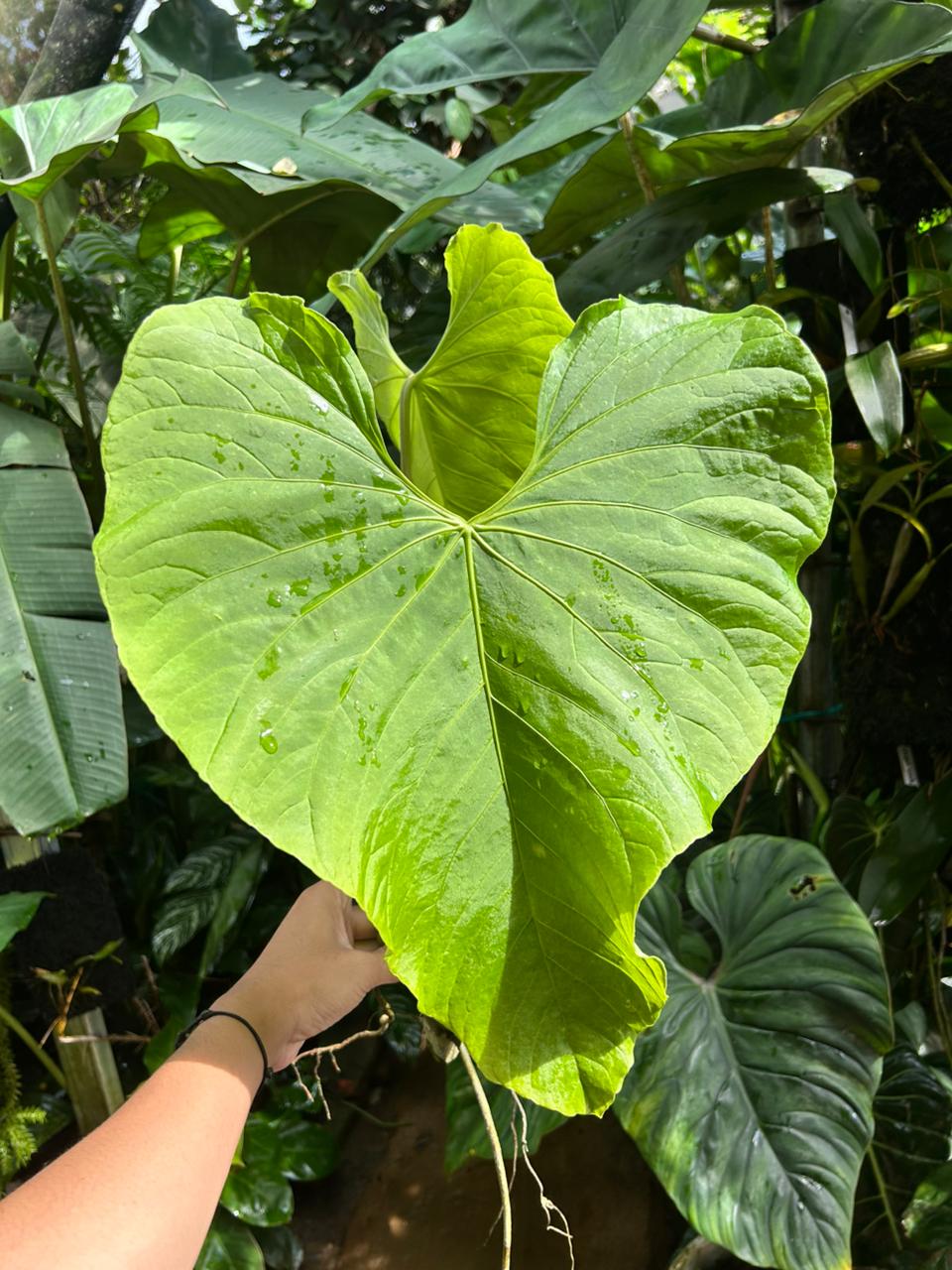
The leaves of Anthurium balaoanum are large, thin, and leathery in texture. They are broadly heart-shaped — also called cordate — with a pronounced sinus (the gap or notch at the base between the two lobes). Additionally, the edges of the leaves appear slightly wavy or ruffled, giving the plant a dynamic and sculptural quality.
New leaves emerge in a warm, translucent light green. They feel almost like thin tissue paper at first. Furthermore, as the leaves mature, they develop a firmer, coriaceous — or leather-like — feel. The upper surface is smooth and subtly glossy. The underside may show faint reddish tones, especially in younger growth.
Mature leaves can grow up to 90 cm long and 30 cm wide. Consequently, each individual leaf becomes a statement piece. The petioles — the slender stems that connect the leaf to the main stalk — are sturdy and ridged, adding extra structural elegance.
Flower and Spathe Anthurium balaoanum
Like all members of the Anthurium genus, A. balaoanum produces a spathe and a spadix. The spathe is a hood-like modified leaf that wraps around the flower structure. The spadix is a thin, finger-like spike that holds the tiny true flowers. Moreover, the flowers are small and understated, which ensures the dramatic foliage always remains the main attraction.
The blooms are not the primary reason collectors pursue this plant. However, a flowering specimen confirms the plant’s health and maturity. Consequently, seeing your A. balaoanum bloom is a rewarding milestone for any grower.
Growth Habit and Climbing Cycle
Anthurium balaoanum is a hemiepiphyte — it starts on the ground and then climbs upward toward light. In nature, it uses trees as support structures. Additionally, when grown indoors, it responds well to a moss pole or coco coir support structure. Providing climbing support encourages faster, larger leaf development.
Furthermore, the plant is an evergreen. It does not go through a seasonal dormancy cycle, meaning it retains its foliage year-round. Primarily, this makes it a low-effort, high-impact display plant for indoor tropical gardens and collectors’ greenhouses.
Global Seed Delivery & Phytosanitary Certification
At Induare Agro, we are committed to responsible, professional, and fully legal global plant seed exports. Every seed we ship meets the highest export standards. Moreover, we understand that international buyers require complete confidence in every purchase.
Packaging and Shipping
We ship all seeds via Global Express courier services. Additionally, each order includes full export documentation. The seeds are carefully packed to preserve freshness and viability throughout transit. Furthermore, we use moisture-protective materials to ensure the seeds arrive in optimal planting condition.
Induare Agro has experience shipping rare exotic seeds and Indonesian plants to buyers in Europe, the Americas, Asia, and beyond. Consequently, our packaging process reflects years of hands-on export expertise.
Buyer Peace of Mind
Every shipment from Induare Agro includes a Phytosanitary Certificate. This is an official government-issued plant health document. Additionally, it confirms that your seeds have been inspected, are free from pests and diseases, and comply with the import regulations of your country.
Moreover, the Phytosanitary Certificate protects you as a buyer. It ensures smooth clearance through customs in your destination country. Primarily, this gives you the confidence to order rare exotic seeds from Indonesia without worry. Furthermore, Induare Agro remains available to assist buyers with any documentation queries before and after purchase.
How to Grow Anthurium balaoanum
Anthurium balaoanum is one of the more forgiving species in the genus. Additionally, it tolerates a wider range of indoor conditions than many other rare exotic plants. Follow these steps for the best results.
Step 1 — Prepare Your Growing Medium Use a chunky, well-draining mix of orchid bark, perlite, and a small amount of peat or coco coir. This mimics the loose, airy forest floor substrate where the plant grows naturally. Avoid dense, compacted soils.
Step 2 — Germinate the Seed Place the seed on moist sphagnum moss inside a small sealed container or humidity dome. Keep the temperature between 22–28°C (72–82°F). Additionally, maintain humidity above 70% during germination for best results.
Step 3 — Provide Bright Indirect Light Place your seedling in a spot with bright, filtered light. Avoid harsh direct sunlight, which can scorch the thin young leaves. Furthermore, a north- or east-facing window works well in most homes.
Step 4 — Water Correctly Water only when the top 2–3 cm of substrate feels dry. Water thoroughly and allow full drainage. Consequently, this prevents root rot — the most common issue with aroids grown in containers.
Step 5 — Add a Climbing Support As the plant grows, provide a moss pole or coco coir totem for support. Primarily, this encourages the plant to produce larger, more impressive leaves. Additionally, misting the support structure keeps aerial roots healthy.
Step 6 — Fertilize Lightly Feed every three months with a liquid fertilizer high in phosphorus, diluted to three-quarter strength. Moreover, during the growing season you may increase feeding frequency to once per month for faster growth.
Step 7 — Repot as Needed Repot every one to two years, or once roots begin to escape the drainage holes. Primarily, choose a pot only one size larger. Furthermore, always use fresh substrate when repotting to refresh nutrient levels.
