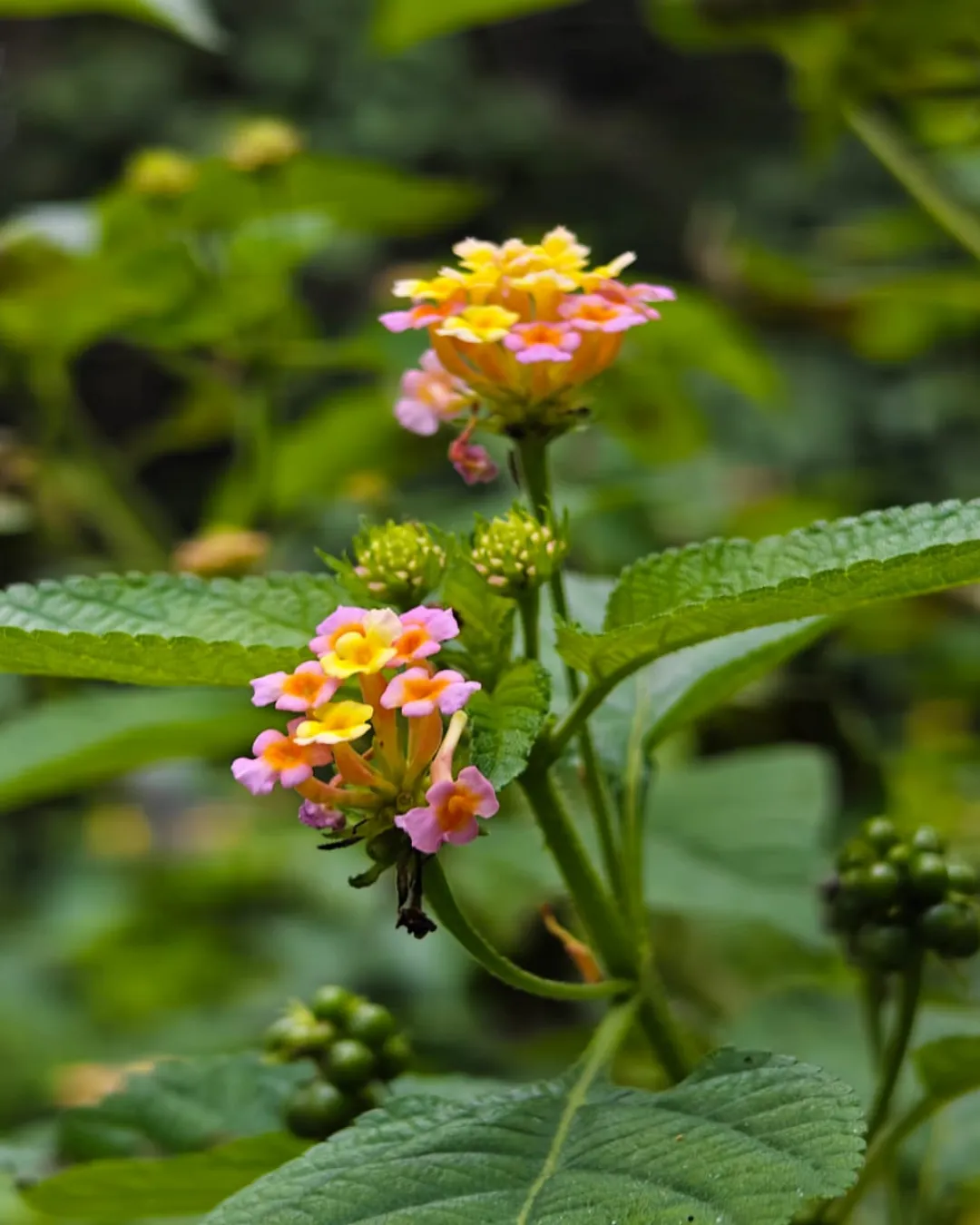
What Is Lantana camara?
Lantana camara — commonly called Common Lantana, Wild Sage, or Spanish Flag — is a perennial flowering shrub with origins in the tropical Americas. It is native to Central and South America, where it thrives in open woodlands, forest edges, and disturbed sunny habitats. Furthermore, it has naturalized across more than 60 tropical and subtropical countries worldwide. This global reach proves just how adaptable and resilient this plant truly is.
Collectors and horticulturists prize Lantana camara for one extraordinary trait: its flowers change color as they mature. A single flower cluster can display yellow, orange, pink, and red simultaneously. Consequently, each plant becomes a living, shifting work of art. Additionally, the shrub attracts butterflies, hummingbirds, and other pollinators — making it a powerful choice for wildlife-friendly gardens.
Dutch explorers first introduced Lantana camara to Europe in the mid-17th century as an exotic hothouse specimen. Since then, centuries of selective breeding have produced hundreds of cultivars. Moreover, traditional medicine communities across Africa, India, and Southeast Asia have long valued this plant for its antimicrobial and anti-inflammatory properties. Primarily, however, it is grown for its breathtaking ornamental display.
Induare Agro supplies fresh, organically grown Lantana camara seeds sourced to export-quality standards. Each seed ships with a Phytosanitary Certificate for safe, legal delivery anywhere in the world. This is the botanical treasure your collection deserves.
Aesthetic Features Lantana camara
Lantana camara delivers one of the most visually dynamic appearances of any flowering shrub in the tropics. Every part of this plant — from its rough-textured leaves to its jewel-toned fruit — contributes to a striking and memorable presence.
Leaf Structure Lantana camara
The leaves of Lantana are broadly oval in shape, roughly 5 to 10 cm long, and arranged in opposite pairs along the stem. Furthermore, the surface feels rough and sandpaper-like to the touch because of dense, fine hairs covering each leaf. The edges are serrated — meaning they have small, tooth-like notches along the margins. Additionally, crushing the leaves releases a strong, pungent fragrance. Some growers describe the scent as sharp and herbal. The color is a rich, deep green throughout the growing season and remains evergreen in tropical climates.
The stems are semi-woody and may carry small, hooked spines depending on the variety. Consequently, mature plants can form dense, impenetrable thickets. This makes Lantana camara an excellent choice for garden borders and natural hedging.
Flower and Fruit Lantana camara
The flowers are the crown jewel of Lantana camara. They are small and tubular, each with four petals, and they grow in tight, flat-topped clusters called umbels — meaning rounded flower heads where all the individual blooms radiate from a central point. Moreover, these clusters appear at the ends of stems and bloom throughout the year in tropical climates.
The most remarkable feature is color change. Younger flowers in the center of each cluster open in pale yellow or white. Primarily, as they mature toward the outer edge, they shift to orange, pink, red, or lavender. Consequently, a single cluster can display three or four colors at once. This is why collectors call it “Ham and Eggs,” “Spanish Flag,” and dozens of other colorful nicknames.
The fruit that follows is equally striking. Small, round berries appear in dense clusters. They shift from green to deep purple or black as they ripen — closely resembling tiny blackberries. Additionally, each ripe fruit holds one to two seeds. Birds are highly attracted to the berries. Furthermore, this is exactly how Lantana camara spreads so effectively across tropical landscapes.
Growth Habit and Resilience
Lantana camara grows as an upright, spreading shrub reaching 1.5 to 3 meters in height at maturity. Additionally, it achieves this height within just two to five years under good conditions. The plant thrives in full sun and tolerates heat, drought, and poor soils with remarkable ease. Moreover, it recovers quickly after pruning or cutting, pushing out vigorous new growth from the base.
This resilience makes Lantana camara an ideal choice for collectors in tropical and subtropical regions. Primarily, it needs at least six hours of direct sunlight per day. It performs equally well in garden beds, large containers, and as a mixed hedge specimen.
Global Seed Delivery & Phytosanitary Certification
Induare Agro is committed to delivering rare and exotic plant seeds to collectors, researchers, and growers worldwide. Every shipment meets strict international phytosanitary standards. Furthermore, all seeds leave our facility with the proper documentation required for legal import in most countries.
Packaging and Shipping
Induare Agro packages every seed order with care to protect viability during long-distance transport. Seeds are sealed in moisture-resistant packaging and clearly labeled with all required botanical and customs information. Additionally, each package includes a Phytosanitary Certificate — an official government-issued document that certifies the seeds are free from pests and diseases.
We use Global Express courier services for all international orders. Consequently, delivery times are fast and reliable. Furthermore, tracking information is provided for every shipment so buyers always know where their order is.
Buyer Peace of Mind
Induare Agro follows all export regulations set by Indonesian agricultural authorities. Moreover, every batch of seeds is inspected before packaging to verify freshness and viability. Primarily, our goal is to ensure each seed arrives in the best possible condition for planting.
Additionally, our team is available to assist with any import documentation questions. We understand that international plant purchases can feel complex. Consequently, we make the process straightforward and transparent for every buyer. Furthermore, this commitment to professionalism is what sets Induare Agro apart from generic seed suppliers.
How to Grow Lantana camara
Step 1 — Seed Preparation Soak the seeds in warm water for 24 hours before sowing. This softens the outer seed coat and speeds up germination.
Step 2 — Choose Your Container Fill a seedling tray or small pot with moist, well-draining seedling mix. Use a mix with good aeration — compact or waterlogged soil will slow germination.
Step 3 — Sow the Seeds Place each seed shallowly on the surface of the mix, then cover lightly with a thin layer of soil. Press gently to ensure good contact between seed and soil.
Step 4 — Provide Warmth and Light Place the tray in a warm spot with diffused light — not direct harsh sunlight at this stage. Maintain a temperature of 22–25°C for best results.
Step 5 — Keep Soil Moist Water gently and consistently to keep the soil slightly moist at all times. Avoid waterlogging, as excess moisture can cause seed rot.
Step 6 — Wait for Germination Seedlings typically emerge within 2 to 8 weeks. Furthermore, patience is key — some seeds may take a little longer depending on temperature and humidity.
Step 7 — Transplant to Full Sun Once seedlings reach 5–7 cm tall, transplant them to a larger pot or directly into the garden. Primarily, choose a location with at least 6 hours of direct sunlight daily.
Step 8 — Ongoing Care Water deeply but allow the soil to dry out between waterings. Moreover, light pruning of stem tips encourages bushier growth and more blooms. Avoid over-fertilizing — too many nutrients can reduce flowering.
All seeds are supplied by Induare Agro — your trusted source for rare, exotic, and export-quality botanical seeds from Indonesia.
