
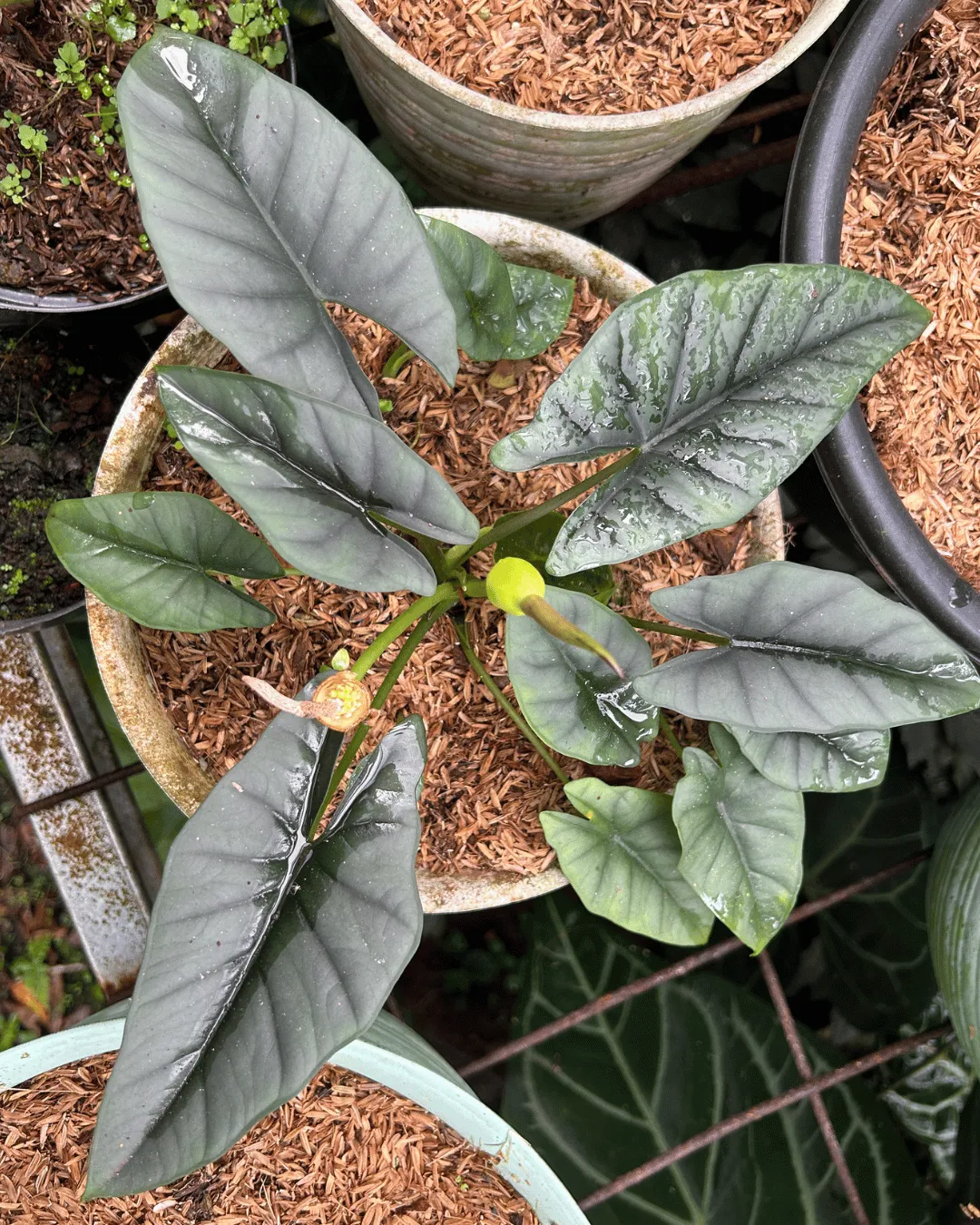
What Is Alocasia reversa?
Alocasia reversa is a rare, flowering plant in the family Araceae. It is native to the tropical limestone forests of Borneo, particularly the Padawan district of Sarawak and surrounding areas of Sabah. This species grows naturally on limestone outcrops, in warm, humid, and shaded jungle environments. Its name — reversa — directly references its most striking feature: a color pattern that is the reverse of most Alocasia species.
Furthermore, Alocasia reversa is a verified endemic of Indonesia and Malaysian Borneo. It belongs to a small, elite group of jewel Alocasia species. Collectors around the world recognize it as one of the rarest and most sought-after aroids available. It grows very slowly and is extremely sensitive to poor growing conditions. Consequently, it is almost never found in regular nurseries. Additionally, it is classified as an ornamental plant of high economic potential by Indonesian botanical researchers.
Scientists at Indonesian research institutions have confirmed its status as an endemic species with significant conservation and commercial value. Moreover, its slow growth rate and challenging propagation make each viable seed exceptionally precious. Induare Agro sources these seeds directly from responsible growers in Indonesia. We ensure full legal compliance and professional handling at every step.
Aesthetic Features Alocasia reversa
Alocasia is a genus of roughly 100 accepted species. Over 50 of these species are found in Indonesia alone. Alocasia reversa stands apart from almost every other member of its genus. Its visual identity is immediately recognizable and unlike anything else in the plant world.
Leaf Structure
The leaves of Alocasia reversa display a truly unusual color pattern. In most Alocasia species, the leaf blade is dark with light veins. Alocasia reversa does the opposite. The veins and the center midrib area are deep, dark green — almost blue-green in certain lighting. The rest of the leaf blade glows with a pale, silvery-green or light-grey color. This creates a dramatic, mirror-image effect that immediately catches the eye.
Furthermore, the leaves are thick and leathery in texture. They have a semi-glossy surface that gives them a subtle metallic sheen. Each leaf blade is ovate to sagittate — meaning arrow-shaped — and grows between 14 and 22 cm in length. Additionally, the leaves sit on short, sturdy, pale-green petioles — the stalks that connect the leaf to the stem. The whole plant stays compact. It rarely exceeds 30 to 40 cm in height. This makes it ideal for terrariums, shelves, and curated indoor plant displays.
Flower and Fruit
Alocasia reversa produces flowers, though they are modest in size. Each inflorescence — the flowering structure — consists of a spathe and a spadix. The spathe is a hood-like outer leaf that wraps around the flower. In Alocasia reversa, a pale green, oval spathe surrounds a white spadix — a finger-like central spike — which holds the tiny true flowers. The spathe reaches approximately 6 cm in length and often shows a subtle purple edge.
Moreover, when the plant is fertilized under the right conditions, it produces bright orange-red berries. These berries are visually striking. Consequently, mature, fruiting specimens are especially prized in curated collections. Note that all parts of the plant contain calcium oxalate crystals — a natural substance that is toxic if ingested. Always handle with care and keep out of reach of pets and children.
Dormancy Cycle
Alocasia reversa follows a natural dormancy cycle. Primarily, this occurs when temperatures drop or light levels fall during cooler months. During dormancy, the plant may shed its leaves and appear to die back. However, the underground corm — a bulb-like storage organ — remains very much alive. Additionally, collectors in temperate climates should maintain temperatures above 15°C (59°F) even during dormancy. Furthermore, keeping the plant slightly warmer and under grow lights can prevent or reduce dormancy entirely. New leaves emerge vigorously once warmth and light return.
Global Seed Delivery & Phytosanitary Certification
Induare Agro is a professional Indonesian plant and seed exporter. We operate with full legal compliance under Indonesian agricultural export regulations. Our mission is to connect the world’s collectors with Indonesia’s most remarkable botanical treasures. Furthermore, we ensure that every shipment meets the highest international plant health standards.
Packaging and Shipping
Every seed order from Induare Agro is packed with expert care. We use professional packaging designed to protect seeds during long international transit. Seeds are kept at the right moisture level to preserve viability on arrival. Additionally, all shipments travel via Global Express courier services. This ensures fast, traceable, and reliable delivery to collectors in Europe, North America, Asia, Australia, and beyond.
Moreover, we process all required export documentation before your seeds leave Indonesia. This includes the official Phytosanitary Certificate — a government-issued plant health document. The Phytosanitary Certificate confirms that your seeds have been inspected, are pest-free, and meet the plant import requirements of your destination country. Consequently, customs clearance is smoother and faster for you as the buyer.
Buyer Peace of Mind
Induare Agro believes every collector deserves complete confidence in their purchase. Primarily, we source seeds directly from verified, responsible growers within Indonesia. We do not source seeds from unverified or illegal channels. Furthermore, our seeds are organic — grown without synthetic chemicals or pesticides. This means you receive a product that is safe, clean, and ready for planting.
Additionally, our team monitors seasonal harvest cycles carefully. We only dispatch seeds when they are fresh and at peak viability. Alocasia reversa seeds lose viability quickly after harvest. Therefore, we time every order to ensure you receive the freshest possible seeds. Moreover, our customer support team is available to guide you through import permit requirements for your specific country. Induare Agro is your trusted partner from Indonesia to your collection.
How to Grow Alocasia reversa
Growing Alocasia reversa from seed is a rewarding challenge for dedicated collectors. Follow these steps carefully to give your seed the best chance of success.
Step 1 — Prepare Your Growing Medium Mix coconut coir or peat with perlite in a 2:1 ratio. The medium must be moist but never waterlogged. Good drainage is essential to prevent seed rot.
Step 2 — Sow the Seed Place the seed on the surface of the medium. Cover it with only a very thin layer — no more than 2–3 mm — of your growing mix. Planting too deep is a common cause of germination failure.
Step 3 — Create a Warm, Humid Environment Cover the pot or tray with a clear humidity dome or plastic wrap. Maintain a temperature between 24–29°C (75–85°F) consistently. High humidity — close to 100% — is critical at this stage.
Step 4 — Provide Indirect Light Place the covered container in a spot with bright, indirect light. Avoid direct sunlight. A position near a bright window or under a grow light works well.
Step 5 — Be Patient and Monitor Germination can take several weeks. Lift the cover briefly each day to allow fresh air in. Keep the medium lightly moist — never soaking wet. Remove the cover once the first true leaf appears.
Step 6 — Transplant the Seedling Once the seedling has 2–3 leaves, transplant it carefully into a small pot. Use a chunky, well-draining aroid mix with perlite or orchid bark. Water sparingly until the plant is established.
Step 7 — Ongoing Care Place your young plant in bright, indirect light. Water only when the top 1–2 cm of soil feels dry. Feed with a diluted liquid fertilizer every 2–4 weeks during the growing season. Maintain humidity above 60% for best results.
