
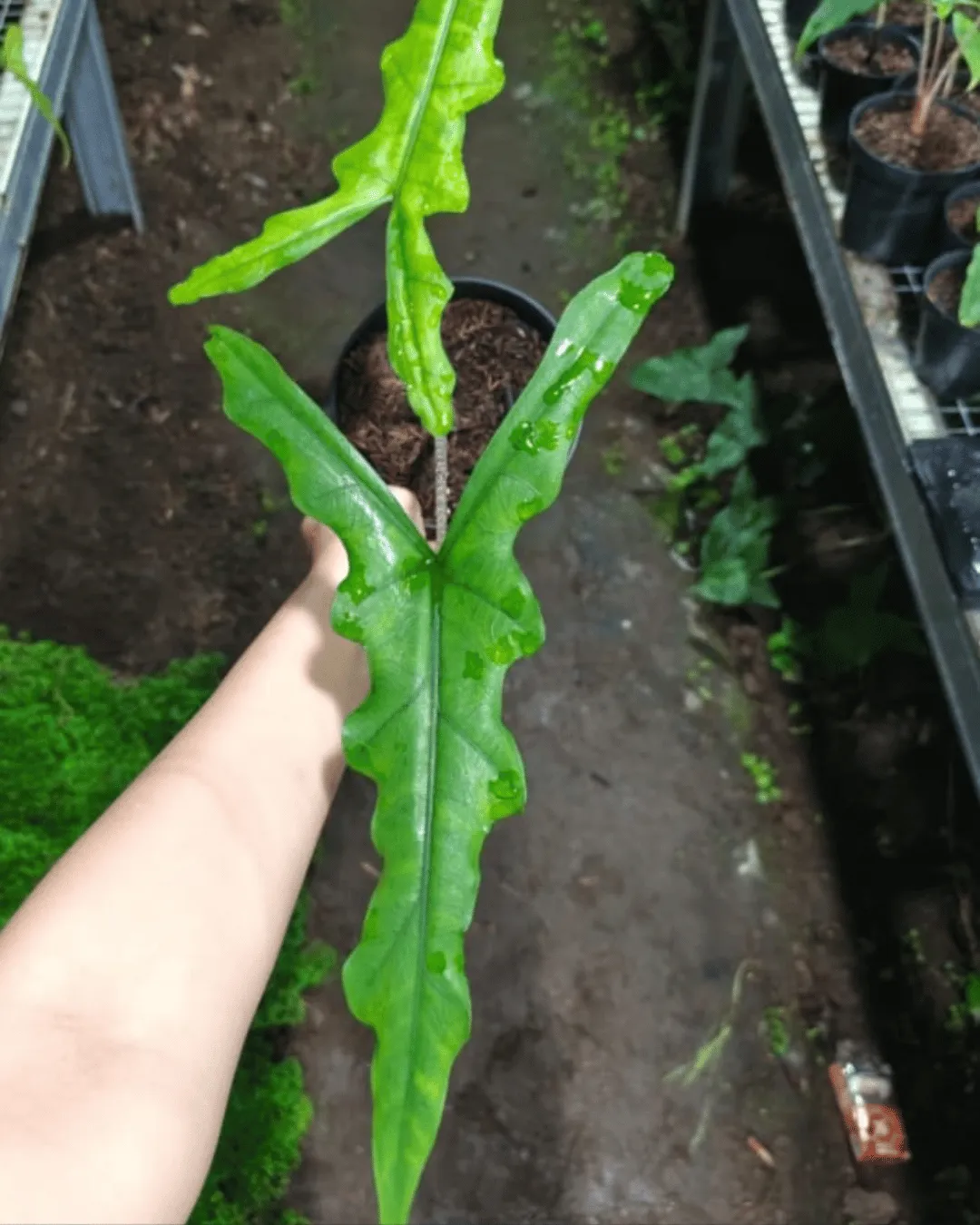
What Is Alocasia sabrina?
Alocasia sabrina is a rare and largely undescribed tropical plant from the genus Alocasia. It originates from the humid, shaded rainforests of North Sulawesi, Indonesia. Collectors and botanists also know it as Alocasia sp. Sulawesi ‘Sabrina Narrow’ or the “Narrow Jacklyn.” It remains one of the few Alocasia varieties that has existed almost exclusively in private collector circles. Consequently, seeds and specimens are extremely hard to source outside Southeast Asia.
This plant is closely related to the sought-after Alocasia Jacklyn — Alocasia tandurusa. However, Alocasia sabrina stands apart with its narrower, more elongated leaf shape and a more refined, upright growth habit. Moreover, its deeply undulating leaf margins and mottled petioles — the striped stems that support each leaf — give it a wilder, more sculptural appearance than most other aroids available in the global market. Additionally, it thrives in the same warm, humid conditions found across the Indonesian archipelago, making it a naturally resilient exotic plant when cared for correctly.
Induare Agro sources these seeds directly and responsibly from their origin region in Indonesia. We offer them as fresh, organic, export-quality seeds to collectors and growers worldwide. Furthermore, every order includes a Phytosanitary Certificate. This certificate is an official plant health document. It confirms that the seeds are free from pests and disease, meeting international biosecurity standards.
Aesthetic Features Alocasia sabrina
Alocasia sabrina is a plant defined entirely by its extraordinary visual character. Each part of this plant — its leaves, stems, and growth habit — contributes to an overall look that is unlike most aroids available to collectors today.
Leaf Structure
The leaves of Alocasia sabrina are its most distinctive feature. They are long, slender, and arrow-shaped — narrower than those of its close relative, Alocasia Jacklyn. Furthermore, the leaf margins (edges) are deeply undulating, meaning they ripple and wave dramatically along the entire length of the leaf. This creates a restless, sculptural quality that draws the eye from every angle.
The leaf surface is a deep, rich green. Primary veins — the main lines that branch out from the central rib — appear in a lighter or contrasting shade. Consequently, each leaf looks almost hand-painted, with bold natural linework across its face. The undersides of the leaves may show a faint purple or silvery flush, adding depth to the plant’s overall appearance. Additionally, leaves grow upright and confident, contributing to a strongly vertical, architectural presence in any indoor or outdoor collection.
Flower and Fruit
Like other members of the Araceae family, Alocasia sabrina produces a spathe — a large, hood-like outer leaf — and a spadix, which is a finger-like central spike covered in tiny flowers. This is the standard flowering structure for aroids. The flowers are small and inconspicuous. The plant focuses most of its energy on leaf production, which is why collectors prize it for its foliage rather than its blooms. Mature plants may produce berries after flowering. These berries contain the seeds that Induare Agro harvests fresh for export.
Petioles and Growth Habit
The petioles of Alocasia sabrina — the stem-like structures that connect each leaf to the main plant — are visually spectacular in their own right. They display a mottled, marbled pattern of green, cream, and purple-brown streaks. This striped effect mirrors the wild artistry of the plant’s Sulawesi forest origins. Moreover, the overall growth habit is upright and compact. Indoors, Alocasia sabrina typically reaches a mature height of 60 to 120 cm (2–4 feet). This makes it a manageable yet dramatic statement plant. Additionally, plants grow from a short, underground rhizome — a horizontal underground stem — which stores energy and supports new leaf production throughout the growing season.
Dormancy Cycle
Alocasia sabrina may enter a dormancy period — a rest phase — in cooler months or when temperatures drop below 15°C (59°F). During dormancy, the plant may drop some or all of its leaves. This is completely normal. The rhizome remains alive underground. Consequently, when warmth and humidity return, the plant produces fresh new growth. Growers in temperate climates should keep the rhizome warm and lightly moist during this rest phase. Furthermore, providing a stable temperature above 18°C (65°F) year-round will significantly reduce or prevent dormancy altogether.
Global Seed Delivery & Phytosanitary Certification
Induare Agro is a trusted Indonesian supplier of rare, exotic, and organic plant seeds. We are committed to legal, professional, and biosecure international shipping. Furthermore, we work directly with certified phytosanitary authorities in Indonesia to ensure every seed shipment meets global import requirements.
Packaging and Shipping
Every seed order from Induare Agro is packed carefully to protect seed viability during long-distance transit. We use moisture-appropriate materials designed to keep seeds fresh and undamaged. Additionally, we ship all international orders via Global Express courier services. This ensures fast and trackable delivery to your destination. Each parcel includes a Phytosanitary Certificate. This is an official government-issued document. It certifies that the seeds have been inspected, are free from regulated pests, and comply with the plant import laws of the destination country. Consequently, buyers can import these seeds legally and with confidence.
Buyer Peace of Mind
Induare Agro understands that rare seed buyers need full confidence in their purchase. Moreover, we know that international plant imports involve strict regulations in many countries. That is why we handle all export documentation on your behalf. Your Phytosanitary Certificate is prepared by licensed Indonesian plant health inspectors. Furthermore, we keep you informed throughout the shipping process with tracking details. Our seeds are always fresh, organically sourced, and suitable for immediate planting upon arrival. Primarily, our goal is to connect serious global collectors with Indonesia’s most exceptional botanical treasures — legally, safely, and reliably.
How to Grow Alocasia sabrina
Step 1 — Prepare Your Growing Medium Use a light, well-aerated potting mix. Combine standard aroid mix with perlite to improve drainage. Good drainage protects the roots from rot.
Step 2 — Germinate the Seed Place the seed on top of moist sphagnum moss or a perlite-peat mix. Cover with a clear humidity dome or plastic bag. Keep the temperature between 22°C and 28°C (72°F–82°F) for best germination results.
Step 3 — Provide the Right Light Place the seedling in bright, indirect light. Avoid direct sunlight, which can scorch young leaves. A north- or east-facing window works well indoors.
Step 4 — Water Carefully Keep the soil lightly moist — never soggy. Check the top 2–3 cm (1 inch) of soil before watering. Additionally, always use filtered or rainwater where possible.
Step 5 — Maintain High Humidity Alocasia sabrina thrives at humidity levels of 60% or higher. Use a humidifier or place the pot on a tray of wet pebbles. Furthermore, grouping it with other tropical plants helps raise ambient humidity naturally.
Step 6 — Feed During the Growing Season Apply a balanced liquid fertilizer every 4–6 weeks during active growth. Dilute to half the recommended strength. Moreover, stop feeding during any dormancy period.
Step 7 — Repot as Needed Repot every 12–18 months as the plant grows. Choose a pot only 2–3 cm (1 inch) larger than the previous one. Always handle the rhizome gently to avoid transplant shock.
