What Is Amorphophallus bulbifer?
Amorphophallus bulbifer is a rare subtropical tuberous plant. It belongs to the Araceae family — a large and celebrated group of tropical aroids. This species grows natively across the Indian subcontinent. Its native range includes India, Bangladesh, Myanmar, Nepal, Assam, and the eastern Himalayan foothills. Additionally, it has been recorded on the Andaman Islands and introduced into South-Central China.
This plant thrives in wooded monsoon forests and shaded hillside habitats. Furthermore, it grows along roadsides near villages and in moist, sheltered spots. Its ability to grow at higher altitudes gives it stronger cold tolerance than most tropical relatives. Consequently, it is adaptable to a wider range of climates than many exotic aroids.
Amorphophallus bulbifer is globally sought after for several reasons. Moreover, it is one of the prettiest species in its genus. Its mild fragrance, striking pink flower, and self-propagating bulbils make it highly desirable. Collectors prize it for its dramatic appearance, its seasonal rarity, and its deep roots in Ayurvedic tradition. It is a plant that rewards patience and dedication. For that reason, it commands attention in every serious exotic plant collection.
Induare Agro sources these seeds directly and ensures every batch meets international export quality standards. We supply fresh, organic, export-certified seeds for collectors across the globe.
Aesthetic Features Amorphophallus bulbifer
Amorphophallus bulbifer is truly one of the most visually distinctive plants in the entire aroid world. Every part of this plant — from its mottled stem to its color-changing berries — tells a story of botanical elegance. Below, we describe each key feature in plain, accessible language.
Leaf Structure
The plant produces a single, large, compound leaf. This leaf is much-branched and umbrella-shaped. It sits atop a long, fleshy petiole — the stalk that connects the leaf to the stem. The leaf spreads 24–40 cm across when fully open. Additionally, the leaflets are oval to lance-shaped with pointed tips, measuring 5–12 cm in length.
The leaf stalk is one of the most striking features of this plant. Furthermore, it is smooth and fleshy, dark green in base color, and beautifully mottled with whitish-pink spots. This marbled pattern gives the plant a dramatic, ornamental look even before it flowers. The whole leafy structure forms a lush, jungle-like mini-canopy above the corm — the underground bulb-like storage organ.
One of the most unique traits of this species is the bulbils that form at the leaf forks. Bulbils are tiny, self-contained mini-bulbs. They develop naturally at the branching points of the leaf. When the plant enters dormancy in autumn, these bulbils fall to the ground. Consequently, they sprout into new plants the following spring. This self-propagating trait makes Amorphophallus bulbifer especially exciting for collectors and growers alike.
Flower and Fruit
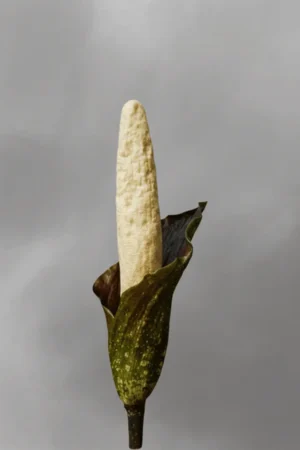
The Amorphophallus genus is famous for its dramatic inflorescence — the full flower structure, including the outer leaf-like wrapping and the inner flower spike. A. bulbifer flowers appear between April and June, before the leaf emerges. The flower rises directly from the corm without any foliage.
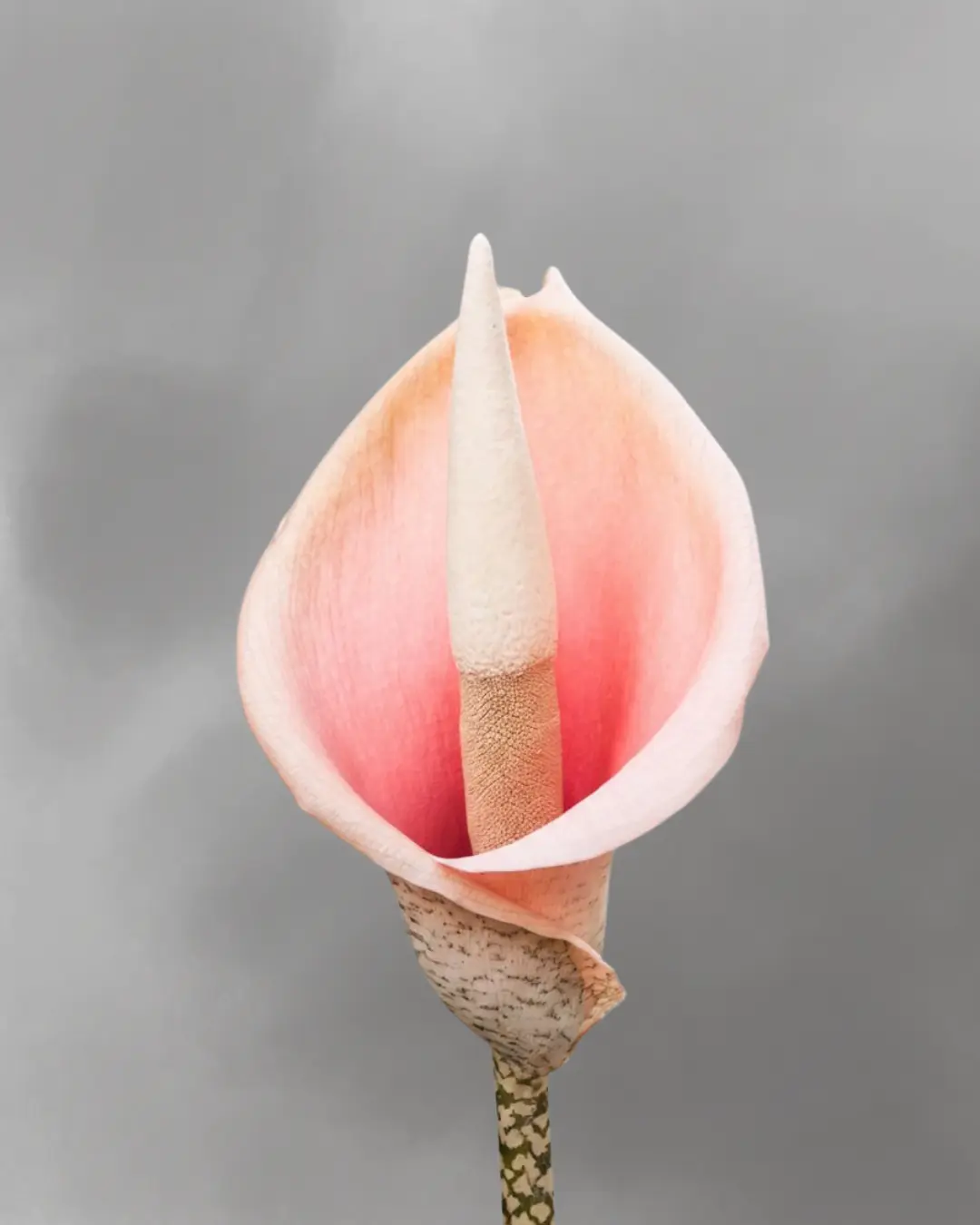
The spathe — a hood-like outer leaf that wraps around the flower — is 10–30 cm long. It is oval to boat-shaped. The outside is greyish-green with blackish-green spots. Inside, the base is deep pink, gradually fading to pale pink toward the top. This soft color gradient makes A. bulbifer one of the prettiest-flowering species in the genus.
The spadix — the elongated central flower spike — is flesh-colored. It sits inside the spathe at approximately the same length. The male flowers are at the top. The female flowers sit at the base. Furthermore, a brief mild odor is emitted for only a few hours after the flower first opens. This scent is far milder than most other Amorphophallus species, making it more suitable for indoor and close-quarters growing.
After pollination, the plant produces clustered, round berries. These berries change color progressively from green to bright red as they ripen. Primarily, this color change is what makes the fruiting stage one of the most visually rewarding phases of the plant’s life cycle. The entire fruiting display is both vivid and ornamental.
Dormancy Cycle
Amorphophallus bulbifer follows a clear annual cycle of growth and rest. This cycle is a core part of its natural biology. Understanding it helps growers get the best results. The plant flowers first, in spring. Then the leaf emerges and grows through summer. By autumn, the leaf dies back naturally. The plant then enters dormancy — a complete rest phase — through winter.
During dormancy, the corm stores energy underground. Moreover, this is when the bulbils fall and begin their own independent growth. In spring, the cycle starts again. Mature plants may take 2–3 years to bloom for the first time. Additionally, even mature plants do not bloom every single year. This seasonal rarity is one reason collectors value each blooming event so highly.
Global Seed Delivery & Phytosanitary Certification
At Induare Agro, we understand that buying rare exotic seeds internationally requires trust, precision, and full legal compliance. Consequently, we have built a shipping and documentation system that protects every buyer. Furthermore, our process ensures seeds arrive fresh, viable, and fully legal at any international destination.
Packaging and Shipping
Every seed is carefully cleaned, inspected, and packed by our experienced team. We use professional-grade, moisture-resistant packaging. This protects seeds during long-distance international transit. Additionally, we ship via Global Express courier services. These services provide fast, tracked, and insured delivery worldwide.
Furthermore, Induare Agro follows all international phytosanitary — meaning plant health and biosecurity — standards. This ensures full compliance with customs regulations in all major import countries. Moreover, we handle all export documentation on your behalf. You simply place your order, and we take care of the rest.
Buyer Peace of Mind
Every order from Induare Agro includes a Phytosanitary Certificate. This is an official government-issued document. It certifies that the seeds are free from pests, diseases, and prohibited organisms. Consequently, it is accepted by plant import authorities worldwide.
Additionally, our seeds are organic — grown without synthetic pesticides or chemicals. Furthermore, they are harvested fresh and dispatched quickly to protect germination quality. We also provide tracking information for every shipment. Therefore, you can monitor your order at every stage of its journey. Our customer support team is ready to assist with any customs or documentation queries.
Induare Agro is proud to serve collectors, botanical gardens, researchers, and rare plant enthusiasts across every continent. Furthermore, our export quality standard is the same for every single order — whether you buy one seed or many.
How to Grow Amorphophallus bulbifer
Step 1 — Choose the Right Container Select a deep pot with good drainage holes. A deep container supports the large underground corm and prevents waterlogging.
Step 2 — Prepare the Soil Mix Use a well-draining mix of loamy soil and organic matter. Additionally, you can add perlite or coarse sand to improve drainage and prevent rot.
Step 3 — Plant the Seed or Corm Plant the seed or corm approximately 5–8 cm deep. Place it with the growth point facing upward. Firm the soil gently around it.
Step 4 — Water Carefully at First Do not water heavily right after planting. Wait until you see the first shoot emerging from the soil. Then water thoroughly and allow the top layer to dry slightly between waterings.
Step 5 — Provide the Right Light Place the pot in a bright but shaded spot. Filtered light or dappled shade is ideal. Moreover, avoid harsh direct afternoon sun, which can scorch the leaves.
Step 6 — Feed During the Growing Season Fertilize every 2–4 weeks during spring and summer. Use a balanced, water-soluble fertilizer. Primarily, choose one with good potassium and phosphorus content to support healthy corm development.
Step 7 — Manage the Dormancy Period When the leaf dies back in autumn, stop watering. Allow the soil to dry out completely. Store the pot in a cool, dry, frost-free location through winter.
Step 8 — Resume Care in Spring When you see a new shoot emerging in spring, move the plant back to its growing spot. Begin watering again, and restart your fertilizing schedule. Consequently, your plant will begin a new cycle of dramatic growth.