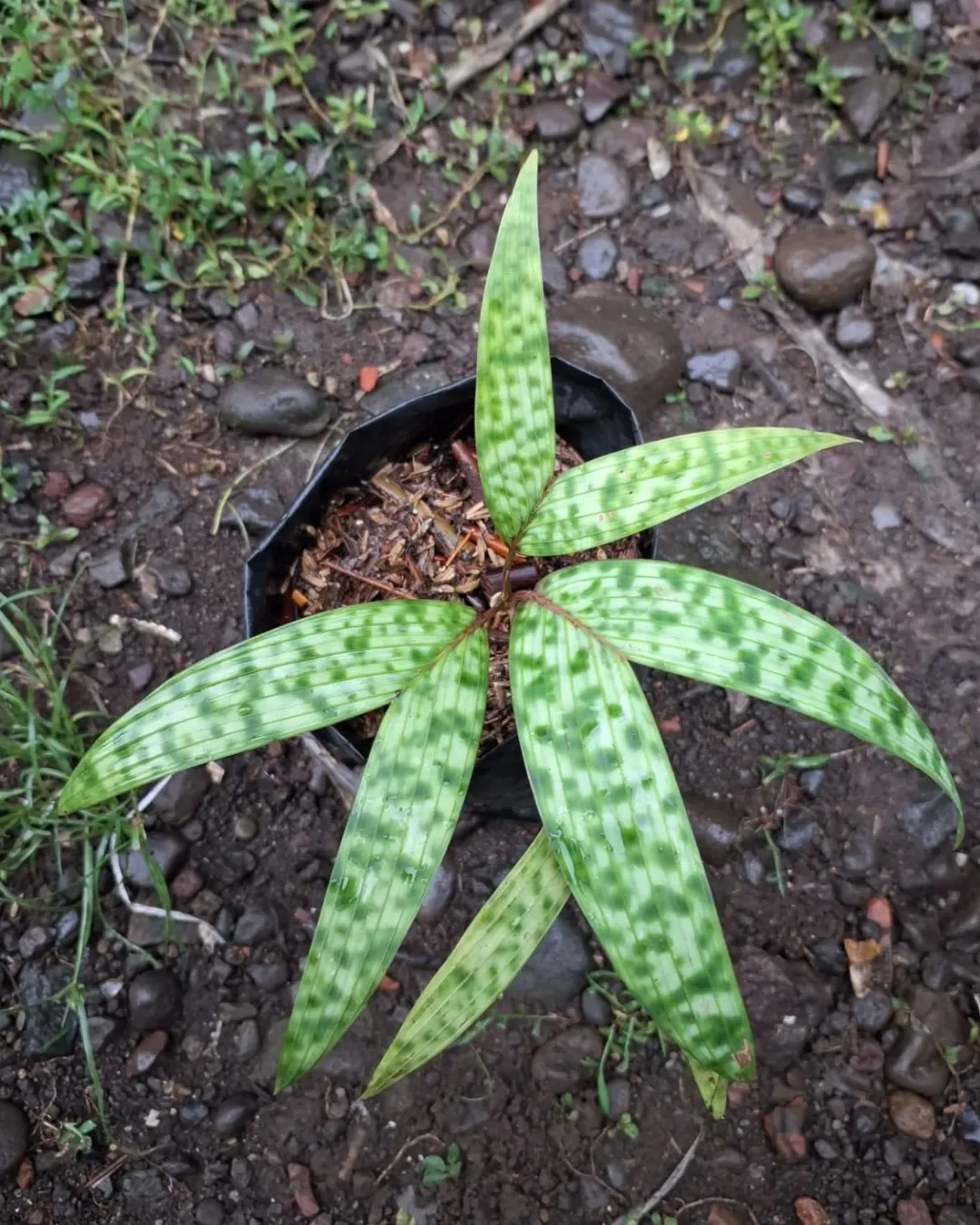
What Is Pinanga crassipes?
Pinanga crassipes is one of the most colourful and desirable small palms in the world. It is commonly known as the Mottled Dwarf Palm. Furthermore, this species is endemic to Borneo — meaning it grows naturally only on that island and nowhere else on Earth. It lives in the lower layer of Borneo’s tropical lowland rainforests. The palm grows beneath the dense tree canopy, in areas of high humidity, deep shade, and rich, moist soil.
The genus name Pinanga comes from the Malay word panang — a traditional name for this group of palms used across Southeast Asia. Additionally, the species name crassipes comes from the Latin words crassus (big) and pes (foot or stem). Consequently, the name describes the palm’s noticeably thick and robust stem — larger than most other Pinanga species.
Pinanga crassipes is widely regarded as one of the finest species in the entire Pinanga genus. Furthermore, botanical gardens, palm collectors, and rare plant enthusiasts around the world actively seek it out. It is prized for its dramatic leaf markings, vivid fruit colours, and compact size. Primarily, the combination of ornamental beauty and manageable scale makes it perfect for both garden planting and container growing. Induare Agro offers authenticated, fresh seeds of this rare Bornean species. Consequently, collectors worldwide now have a legal and verified way to add this extraordinary palm to their collections.
Aesthetic Features Pinanga crassipes
Pinanga crassipes is a multi-stemmed, clustering palm. It grows to a maximum height of around 2 metres. Furthermore, it rarely grows as a single stem — most plants produce several stems from the base, forming a dense, lush clump. The stems themselves are one of the plant’s most interesting features. They change colour with age: dark green in young plants, pale yellow at mid-age, and grey in older specimens. Additionally, the stem is robust and thick — up to 7 cm in diameter — which is unusually wide for a dwarf palm of this size.
Juvenile Leaves Pinanga crassipes
The juvenile leaves of Pinanga crassipes are its most celebrated feature. Young plants produce leaves covered in a bold pattern of light and dark green spots. Furthermore, this spotted camouflage pattern allows the young plant to blend into the dappled light and leaf litter of the rainforest floor. This protects the soft young leaves from being eaten by insects and other forest animals. Additionally, the pattern is not just decorative — it is a highly evolved survival strategy shaped by millions of years of natural selection. Collectors prize this juvenile display above almost any other trait in the palm world.
Mature Leaves and New Growth
As the plant grows taller, the leaf spots gradually fade. Consequently, mature leaves become broad, pinnate — meaning they are divided into leaflets along a central stem — and solid green. Furthermore, each new leaf — called a spear — emerges from the top of the plant in a striking pinkish-red or bronze tone. This red colour serves the same protective purpose as the spots in juvenile plants. It makes the newly emerging leaf look unpleasant to insects. Additionally, the leaf stems — called petioles — grow up to 30 cm long and range from green to yellow in colour.
Flowers and Fruit Pinanga crassipes
Pinanga crassipes produces flowers and fruit abundantly on mature plants. The flowers grow in clusters on branched stems — called inflorescences — that emerge below the leaf bases. Furthermore, the flower clusters are themselves very decorative, with the stems ranging from red to yellow in colour. Each cluster holds small ivory-coloured flowers arranged in groups of three. Consequently, the plant produces large numbers of fruit. The fruit starts yellow, then turns bright red, and finally ripens to black. Additionally, these vivid red and black fruit clusters contrast dramatically with the green foliage — making P. crassipes one of the most ornamentally spectacular palms at fruiting time.
Global Seed Delivery & Phytosanitary Certification
Induare Agro is a professional botanical seed exporter based in Indonesia. The company works directly with verified growers across Borneo and the wider Indonesian archipelago. Furthermore, Induare Agro ships rare seeds to collectors, botanical gardens, and plant research institutions in more than 50 countries worldwide. Every order follows a strict, fully documented export process from packing to final delivery.
Packaging and Shipping
Induare Agro packs every seed with moisture-control materials to preserve freshness. Cushioned express packaging protects each seed throughout the full transit journey. Furthermore, palm seeds can be sensitive to drying out during shipping. Consequently, Induare Agro packs Pinanga crassipes seeds with extra care to maximise viability on arrival. Shipments go out via Global Express couriers such as DHL and EMS. Additionally, most international orders arrive within 5–14 business days. Furthermore, every parcel includes an official Phytosanitary Certificate. This document is issued by Indonesia’s Plant Health Authority. It confirms that the seeds are free from pests, disease, and regulated plant pathogens. Consequently, it meets the import requirements of customs offices in the EU, USA, UK, Australia, Japan, and most other regulated markets worldwide.
Buyer Peace of Mind
Induare Agro puts compliance at the centre of every order. Every shipment includes the Phytosanitary Certificate and a commercial invoice. Furthermore, this complete documentation ensures smooth and fast customs clearance at every international destination. Additionally, the Induare Agro team provides after-sales growing support for every buyer. Primarily, the goal is to ensure that every collector successfully sprouts and grows their rare Pinanga crassipes from seed to a thriving, fruit-bearing palm.
How to Grow Pinanga crassipes
Pinanga crassipes grows best when its natural Bornean rainforest conditions are closely replicated. Furthermore, it adapts well to tropical, subtropical, and warm indoor environments. The key requirements are consistent warmth, high humidity, shade, and moist but well-draining soil. Follow these steps for the best results.
Step 1 — Seed Preparation Plant the seed as soon as possible after receiving it, as freshness directly affects germination rate. Additionally, soak the seed in warm water (25–28°C) for 24 hours before planting to soften the outer coat.
Step 2 — Growing Medium Use a rich, moisture-retaining mix: 40% quality potting soil, 30% coco peat or peat moss, and 30% perlite or coarse sand. Consequently, this blend holds enough moisture for the seed to sprout while draining freely enough to prevent rot.
Step 3 — Sowing Plant the seed about 2 cm deep in a pot with drainage holes. Furthermore, keep the growing medium evenly moist at all times. Do not allow it to dry out at any stage during germination.
Step 4 — Temperature and Humidity Maintain a temperature of 22–30°C and a humidity level of 70–85% throughout germination. Primarily, high humidity is essential — this palm comes from one of the most humid environments on Earth. A humidity dome or enclosed propagation tray works very well.
Step 5 — Light Place the pot in a warm, shaded or semi-shaded spot. Additionally, never expose the plant to direct sunlight. In its natural habitat, P. crassipes grows under dense forest canopy with very little direct light reaching the forest floor.
Step 6 — Watering Keep the soil moist at all times but ensure the pot drains well after each watering. Furthermore, never allow the pot to sit in standing water. Root rot is the most common cause of failure in this species.
Step 7 — Fertilising Apply a diluted, balanced liquid fertiliser (NPK 10-10-10) every 4–6 weeks during the active growing season. Additionally, a fertiliser rich in potassium supports strong stem development and more vibrant leaf colour over time.
Step 8 — Long-Term Care Repot the palm into a slightly larger container every 1–2 years as it grows. Consequently, more root space supports faster clumping and quicker development of the multi-stem habit. Furthermore, a mature, well-fed plant will begin to produce its spectacular red and black fruit clusters within 3–5 years.
© Induare Agro — Indonesia’s professional rare seed exporter.
