Amorphophallus discophorus: The Disc-Bearing Aroid on the Brink of Extinction
Among the rarest aroids on earth, Amorphophallus discophorus Backer & Alderw. occupies an extraordinarily small patch of secondary forest on the slopes of Mount Wilis in East Java, Indonesia. Botanists described it formally in 1920 in the Bulletin du Jardin Botanique de Buitenzorg. Since then, researchers have not refound it in the wild, and experts now consider it potentially extinct outside cultivation. Its name refers to a striking anatomical feature: a conspicuous disc-like swelling in the male floral zone — a character found in no closely related congener. This article introduces this remarkable and imperiled species to readers who value both botanical science and conservation.
Taxonomic Identity of Amorphophallus discophorus
Amorphophallus discophorus belongs to the family Araceae. Backer & Alderwerelt described it in Bull. Jard. Bot. Buitenzorg III, I (1920): 371. No synonyms are currently recognized for this species.
The original description forms the sole taxonomic basis for the species. Its morphology is well-documented from the type collection, though no recent field material is available to supplement the protologue.
Morphological Description

Tuber and Leaf
The tuber of Amorphophallus discophorus is depressed-globose in form. The plant produces a single solitary leaf. Its petiole extends 80–120 cm in length and displays a green surface marked with dark brown and greyish spots. The basal portion of the petiole is rugose. The lamina reaches approximately 100–150 cm in diameter. Terminal leaflet segments are elliptic to oblong-lanceolate, up to about 20 cm long and approximately 6 cm wide. They are long-acuminate at the apex, with a base that is abrupt and long-decurrent.
Inflorescence and Peduncle
The inflorescence of Amorphophallus discophorus is solitary and long-peduncled. The peduncle reaches 80–150 cm in length and shares the same surface texture and coloration as the petiole.
Spathe
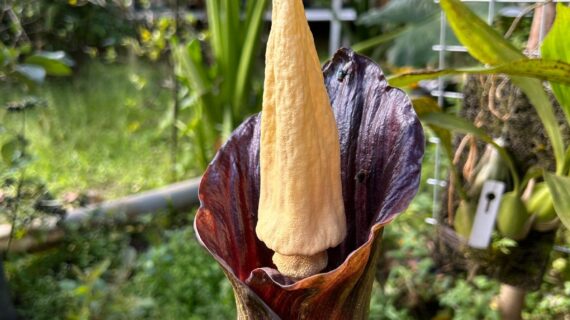
The spathe is ovate, 15–20 cm long and 7.5–14 cm in diameter. Its apex is acute to obtuse and sometimes shortly apiculate. The outer base surface is dull dark green with scattered whitish dots. The upper outer portion transitions to dirty greyish-purple with faint, scattered, paler dots and a darker margin. Internally, the base is pale yellowish-green. A narrow zone of purple follows, covered by a distinct greyish waxy layer. The limb interior is glossy dark maroon. The base interior carries small, conical, obtuse warts.
Spadix and Floral Zones
The spadix of Amorphophallus discophorus is sessile. It is shorter than, or only slightly longer than, the spathe, measuring 14–20 cm in length. The female zone is cylindric, 3–4 cm long and approximately 1.5 cm in diameter, with congested flowers.
The male zone is obconic and carries a central disciform swollen part — the distinctive disc that gives the species its name. This zone measures 2–2.5 cm in length. At the base it is approximately 1 cm in diameter, and at the top approximately 1.3 cm. The disc itself reaches about 2 cm in diameter. Its top presses against the base of the appendix. Flowers in the male zone are congested.
The appendix is sessile and elongate-conic, with a truncated base. It expands broadly in an annuliform and concave manner, measuring 10–15 cm in length and 2–3.5 cm in diameter at the middle. Its surface is verruculate. The color is cream, yellowish-green, or dirty purple with a yellowish base. The apex is obtuse to acute. Notably, the appendix produces a heavy gas-like odor during female anthesis.
Female Flowers
Each ovary is depressed to obovate in shape and subcircular to angulate in cross-section. It measures 3–4 mm in diameter and approximately 2 mm tall, depressed at the center. The lower half is yellowish-green, while the upper half is blackish-purple with a grooved surface. Each ovary is bilocular, with one basal ovule per locule. The style is 1–2 mm long and approximately 1 mm in diameter at the base. It is dark purple. The stigma is conical and obtuse, approximately 1 mm tall and 1 mm in diameter. It is bright yellow or brown, shallowly bilobed, with obtuse lobes and an echinulate surface.
Male Flowers
Each male flower carries 3–4 stamens. Stamens reach approximately 2.5 mm in length. Filaments are about 1.5 mm long and connate. Anthers are truncate to slightly rounded, approximately 1 mm long and 1–2 mm in diameter, and yellow. Pores are apical and elongate. Pollen is striate. Fruits are red.
Distribution of Amorphophallus discophorus
Amorphophallus discophorus is a local endemic. Researchers have documented it only from the area surrounding Mount Wilis in East Java. Its extremely restricted range makes it one of the most narrowly distributed members of the genus.
For distribution records and occurrence data, refer to GBIF – Amorphophallus discophorus and the Plants of the World Online (POWO) – Kew.
Habitat
This species grows in secondary forest at elevations between 600 and 1,300 m above sea level. Its presence at mid-montane altitudes on Mount Wilis places it in a relatively cool and humid forest zone. However, the absence of recent confirmed sightings raises serious concerns about the continued existence of wild populations.
Taxonomic Notes
In overall morphology, Amorphophallus discophorus closely resembles Amorphophallus annulifer from West Java. The two share many vegetative and floral characters. Nevertheless, one feature immediately separates them: A. annulifer lacks the prominent disc in the male zone entirely. Furthermore, in larger specimens of A. annulifer, the appendix greatly exceeds the spathe in length — a condition not seen in A. discophorus.
Conservation concern is severe for this species. Researchers have not refound A. discophorus in the wild in recent decades. According to Yuzammi et al. (2014), it may already be extinct in its natural habitat. Its extremely restricted range and the absence of recent collections place it among the most critically imperiled aroid species in Java.
References
- Backer, C.A. & Alderwerelt van Rosenburgh, C.R.W.K. van (1920). Amorphophallus discophorus Backer & Alderw. In: Bull. Jard. Bot. Buitenzorg III, I: 371.
- Yuzammi, Kurniawan, A., Asih, N.P.S., Erlinawati, I. & Hetterscheid, W. (2017). The Amorphophallus of Indonesia. Center for Plant Conservation Botanic Gardens, Indonesia.
- Kew Science. Amorphophallus discophorus Backer & Alderw. – Plants of the World Online. Available at: https://powo.science.kew.org/
- GBIF Secretariat. Amorphophallus discophorus occurrence data. Global Biodiversity Information Facility. Available at: https://www.gbif.org/


