
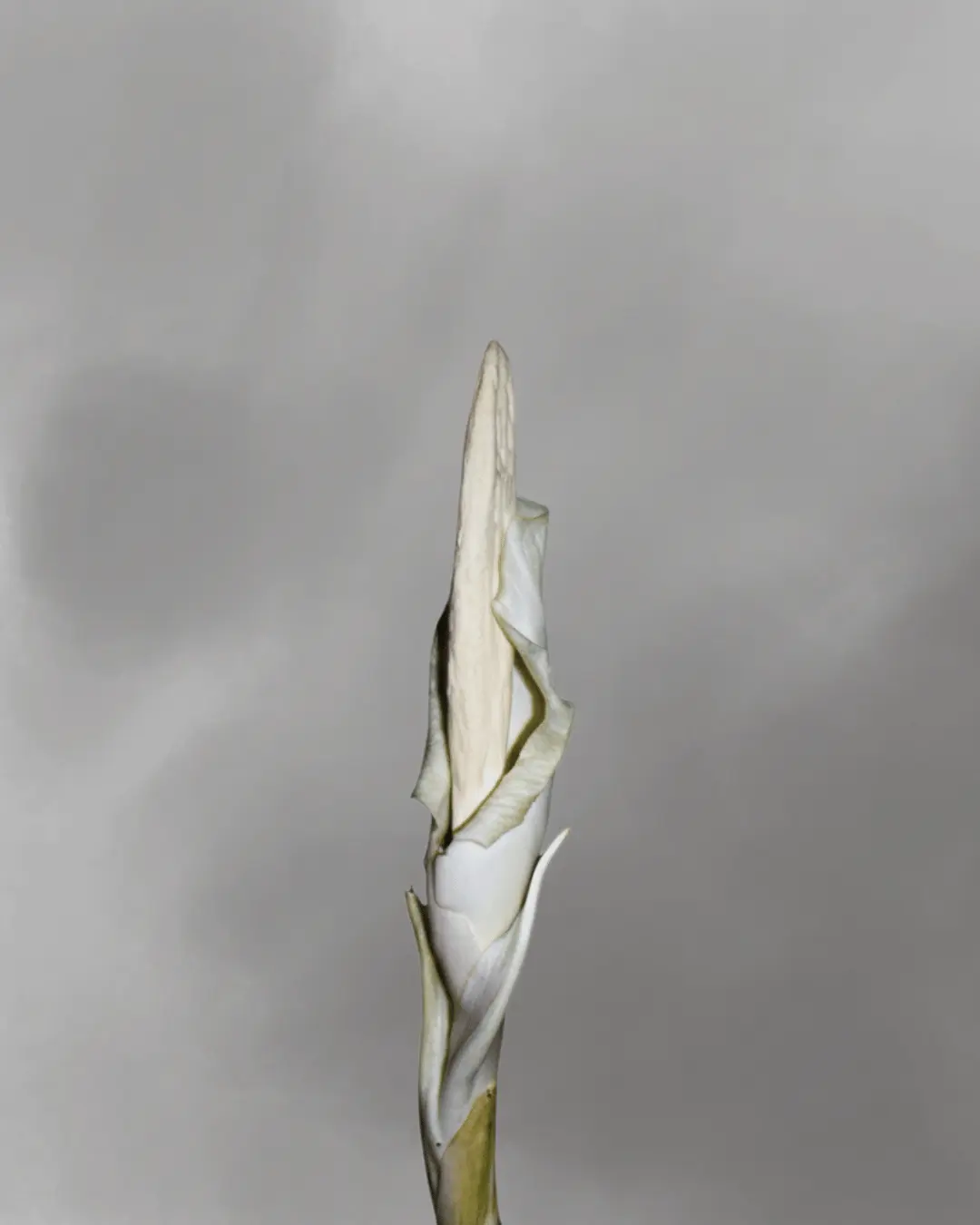
What Is Amorphophallus eburneus?
Amorphophallus eburneus is a rare exotic plant in the Araceae family. It grows in the wild only on karst limestone outcrops in the Padawan and Tebedu areas of Sarawak, Malaysian Borneo. This very limited natural range makes it one of the most sought-after rare plants in Indonesia and the wider Southeast Asian region.
First formally described by botanist Josef Bogner in 1989, A. eburneus belongs to the white-flowered “Eburneus Group.” Furthermore, it is locally endemic — meaning it exists naturally nowhere else on earth. Collectors and botanical gardens across Europe, North America, and Asia prize it for its striking ivory-white blooms and dramatic leaf structure.
Additionally, Amorphophallus eburneus is classified as an exotic plant with restricted natural availability. Wild populations face ongoing pressure from habitat loss. Consequently, responsibly sourced seeds — like those supplied by Induare Agro — play a key role in preserving this species for future generations.
Moreover, as a rare plant from Indonesia and Borneo, it carries a unique story. Every seed you plant connects you to one of the most unusual and biodiverse habitats on the planet.
Aesthetic Features Amorphophallus eburneus
Amorphophallus is a large genus of around 220 tropical tuberous plants. A. eburneus stands out even within this extraordinary group. Its physical features are bold, elegant, and unlike any common garden plant.
Leaf Structure
The leaf of Amorphophallus eburneus is large and dramatic. It rises on a single long petiole — the leaf stalk — that can grow up to 120 cm tall. Furthermore, the petiole is smooth and turgid, meaning it is firm and full, with no markings or spots.
The leaf blade spreads wide above the petiole. It is divided into broad leaflets, each one reaching up to 60 cm in length. Additionally, the leaflets are not stalked at the base. This simple, clean division gives the plant a bold, architectural look.
The leaf grows for one full season, then dies back completely. This is normal and healthy. The plant stores all its energy in the underground corm — a solid, starchy storage organ, similar to a bulb. Primarily, the corm is the engine of the plant’s growth and survival.
Flower and Inflorescence
The flower of A. eburneus is its most striking feature. It produces an inflorescence — a single flower structure — made of two main parts. The spathe is the outer hood-like bract, a modified leaf that wraps around the flower. The spadix is the central spike that holds the tiny male and female flowers.
In A. eburneus, the spathe stands erect and is ivory-white in colour. The name “eburneus” itself means “ivory” in Latin — a direct reference to this pure, creamy-white spathe. Furthermore, the spadix appendix — the tip of the central spike — has a rough, wrinkled texture.
Moreover, the inflorescence often produces two spathes set at opposite sides, a trait also seen in related species. Female flowers are scattered across the spadix, while male flowers fuse into neat vertical rows. Consequently, the flower architecture is as scientifically fascinating as it is visually impressive.
Like many aroids, the flower appears before the leaf in each cycle. It blooms for a very short window. Collectors who time the bloom correctly witness something few people ever see in private cultivation.
Dormancy Cycle
Amorphophallus eburneus follows a two-phase life cycle. It alternates between an active growing phase and a full dormancy period. During dormancy, all above-ground growth dies back. The corm rests underground.
Additionally, this dormancy is a natural and essential part of the plant’s biology. Do not discard the corm during this time. The plant is simply resting and storing energy for its next dramatic emergence.
Primarily, the timing of dormancy follows moisture and temperature cues. In cultivation, a dry rest period of several months triggers healthy regrowth. Furthermore, understanding this cycle is key to long-term success with this species.
Global Seed Delivery & Phytosanitary Certification
Induare Agro is a professional supplier of rare exotic seeds and organic planting material from Indonesia. We are fully committed to safe, legal, and responsible global shipping. Every order meets international plant trade standards.
Packaging and Shipping
Induare Agro ships worldwide via Global Express courier. We use professional packaging designed to keep seeds viable during transit. Seeds are carefully cleaned, dried to the correct moisture level, and sealed to prevent damage.
Furthermore, every shipment includes full export documentation. We prepare and include a Phytosanitary Certificate with every international order. This is an official government-issued document. It confirms that the seeds have been inspected and are free from pests and diseases.
Additionally, we provide tracking information for every shipment. Consequently, you can monitor your order from dispatch to delivery. Our team handles all export paperwork on your behalf. You receive only the seeds — stress-free.
Buyer Peace of Mind
Induare Agro sources seeds directly from verified growers in Indonesia. We ensure export quality standards at every step. Moreover, our seeds carry organic certification — grown without harmful chemicals or artificial treatments.
The Phytosanitary Certificate included with your order satisfies customs requirements in most countries. Furthermore, it demonstrates our commitment to transparent and fully legal trade. Consequently, buyers in Europe, North America, Australia, and Asia receive their orders with confidence.
Additionally, we work with collectors, botanical gardens, and professional growers. We understand what rare plant buyers need. Primarily, we exist to connect the world’s best rare plants from Indonesia to dedicated collectors everywhere.
How to Grow Amorphophallus eburneus
Step 1 — Prepare Your Growing Medium Use a well-draining mix of coco peat, perlite, and coarse orchid bark. Add a small amount of worm castings to boost nutrients. The mix should hold moisture without becoming waterlogged.
Step 2 — Plant the Seed Place the fresh seed just below the surface of the growing medium. Cover lightly — no deeper than 1–2 cm. Keep the pot in a warm location with indirect bright light.
Step 3 — Provide Warmth and Humidity Maintain a temperature of at least 20°C (68°F). High humidity encourages fast germination. Furthermore, place a clear cover over the pot to retain moisture until the first shoot appears.
Step 4 — Water Carefully Water moderately — keep the medium just moist, never soggy. Overwatering is the most common mistake. Additionally, allow the top layer to dry slightly between waterings.
Step 5 — Support the Growing Season Once the shoot appears, move the plant to brighter indirect light. Feed lightly with a balanced liquid fertiliser every two weeks. The leaf will grow rapidly during the active season.
Step 6 — Manage Dormancy When the leaf yellows and dies back, reduce watering slowly. Allow the corm to enter full dormancy. Store the pot in a dry, warm spot. Consequently, the corm will re-sprout in the next season with renewed vigour.
