What Is Amorphophallus pendulus?
Amorphophallus pendulus is one of the rarest plants in the entire Araceae family. It grows only in the rainforests of Borneo — specifically in Brunei and Sarawak, Malaysia. Furthermore, it lives at altitudes between 300 and 500 metres above sea level. The plant thrives in the wet, shaded floor of tropical lowland forests. Consequently, it is almost never found in cultivation outside Southeast Asia. Most collectors search for years without finding a verified source.
The name pendulus refers to the plant’s most striking feature: its hanging, downward-facing flower. Additionally, this rare growth habit makes it visually unlike almost any other aroid in the world. Botanists Josef Bogner and Simon Mayo formally described the species — a relatively recent addition to the scientific record. Induare Agro works directly with local Bornean growers to source these seeds legally and ethically. Furthermore, every seed is verified for freshness and quality before it is packed and shipped. This makes Induare Agro one of the very few suppliers globally who can offer A. pendulus with full documentation.
Aesthetic Features Amorphophallus pendulus
Amorphophallus pendulus has a set of physical traits that make it immediately recognisable. Furthermore, these features set it apart from the hundreds of other species in the genus. Each part of the plant — from the leaf stalk to the flower — has its own distinct character.
Leaf Structure Amorphophallus pendulus
The leaf stalk — called a petiole — is long and heavily mottled. Its surface has a pattern that looks almost like lichen growing on bark. Consequently, this textured, earthy appearance is one reason collectors find the plant so appealing. The leaf itself is made up of multiple divided sections — called leaflets — that spread out in a wide, elegant arc. Additionally, mature leaflets are bright green with pale white veins running along the centre. The full leaf can reach up to 180 cm in height in tropical conditions. Furthermore, only one leaf grows at a time. Each new leaf is larger than the one before it.
Flower and Fruit Amorphophallus pendulus
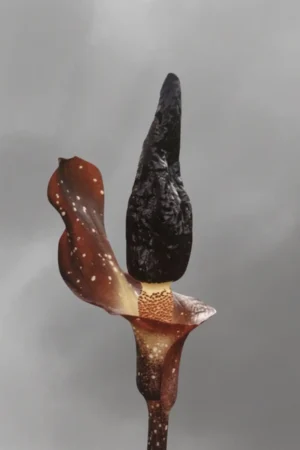
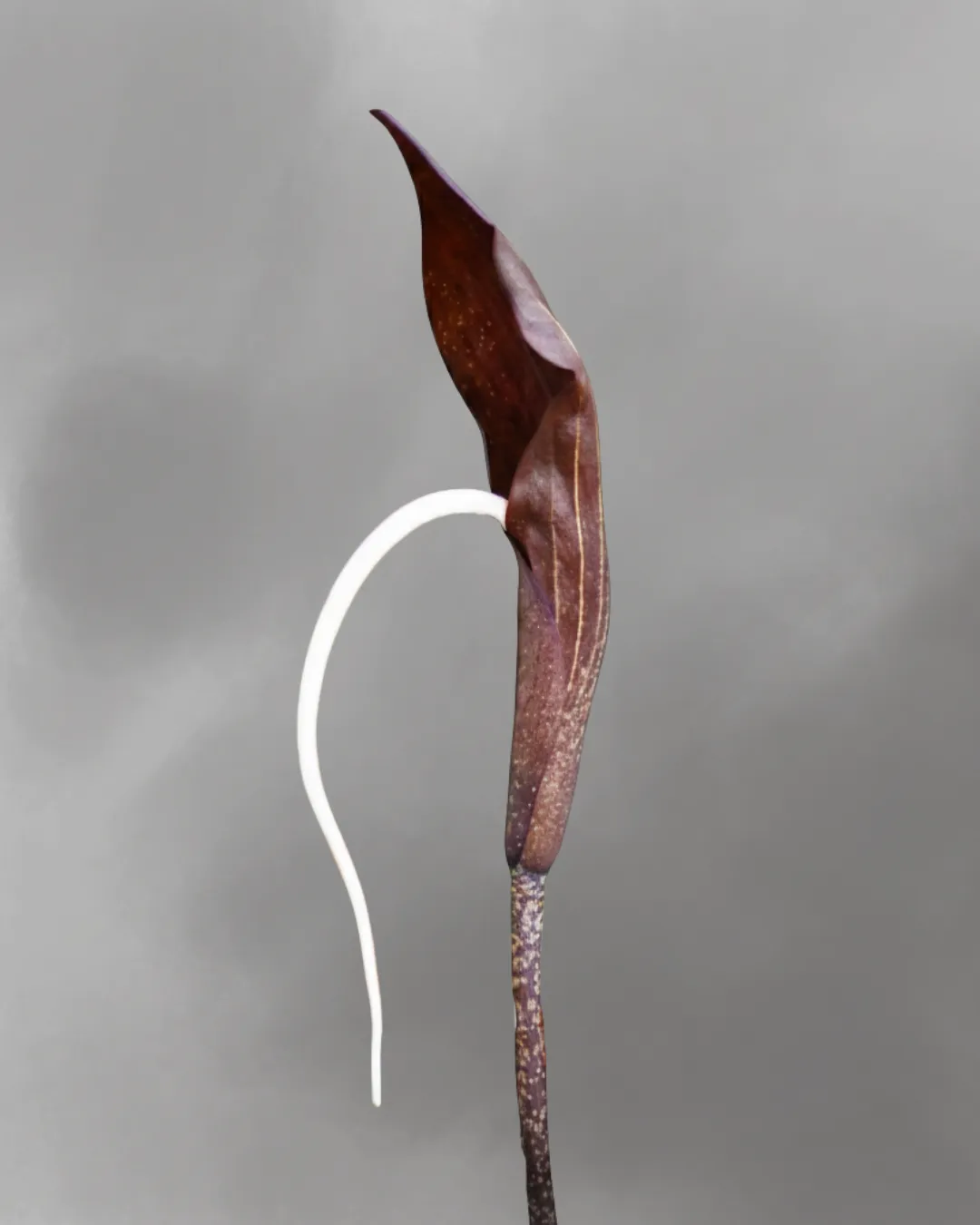
The flower of A. pendulus is what makes this species truly one of a kind. The inflorescence — the full flower structure — hangs downward in a drooping, pendulous position. This is extremely rare in the genus. Furthermore, the flower has a green-purple outer hood, known as a spathe, and a cream to pale inner spike, known as a spadix — the central column inside the hood. The flower releases a strong scent to attract flies and beetles for pollination. Consequently, this odour is part of the plant’s natural design and signals a healthy, active bloom. After pollination, the plant forms orange-yellow fruits. Additionally, each fruit holds a single seed — the same seed that Induare Agro harvests and ships to collectors around the world.
Dormancy Cycle
Like all members of its genus, A. pendulus follows a clear yearly rest cycle. The leaf grows, matures, and then dies back naturally. Primarily, this rest period — called dormancy — is not a sign of plant death. It is the corm — the underground storage bulb — gathering energy for the next growth cycle. Furthermore, each time the plant re-sprouts, it comes back larger and stronger. Collectors should keep the pot and wait. Additionally, once the corm reaches around 1 kg in weight, the plant becomes capable of producing its first flower.
Global Seed Delivery & Phytosanitary Certification
Induare Agro is a professional plant seed exporter based in Indonesia. The company specialises in rare and exotic Indonesian and Bornean species. Furthermore, Induare Agro is fully committed to legal, safe, and well-documented global exports.
Packaging and Shipping
Every seed order from Induare Agro includes an official Phytosanitary Certificate. This document comes from Indonesia’s Plant Quarantine Authority. Consequently, it confirms that the seeds are clean, pest-free, and safe to import. It meets the entry rules of customs offices in the EU, USA, UK, Australia, Japan, and most other countries. Furthermore, Induare Agro packs all seeds with moisture control materials and cushioned express packaging. Shipments go out via Global Express couriers such as DHL and EMS. Additionally, most international orders arrive within 5–14 business days. All export papers — including the Phytosanitary Certificate and commercial invoice — travel with every parcel.
Buyer Peace of Mind
Induare Agro follows a strict compliance process on every order. Collectors never need to worry about rejected parcels or customs issues. Furthermore, the full documentation included with each shipment ensures a smooth, traceable delivery from Borneo to the collector’s door. Primarily, the team at Induare Agro also provides after-sales guidance. This helps growers get started with confidence, even if they are new to cultivating rare aroids.
How to Grow Amorphophallus pendulus
Amorphophallus pendulus is a rewarding but exacting plant to grow. Furthermore, success depends on replicating the warm, humid conditions of the Bornean rainforest. Follow these steps carefully for the best results:
Step 1 — Seed Preparation Soak the seed in warm water (28–30°C) for 24–48 hours before planting. Additionally, lightly scratch the outer seed coat with fine sandpaper. This helps water enter the seed and speeds up sprouting.
Step 2 — Growing Medium Mix 40% peat or coco peat, 30% perlite, and 30% coarse organic bark. Consequently, this mix drains fast, holds some moisture, and matches the acidic forest floor conditions the plant prefers.
Step 3 — Sowing Plant the seed 2–3 cm deep in a pot with drainage holes. Furthermore, keep the soil consistently moist — but never soggy — throughout the sprouting stage.
Step 4 — Temperature and Humidity Keep the temperature between 21°C and 29°C at all times. Primarily, maintain high humidity of 60% or more. A humidity dome or enclosed propagation tray is strongly recommended for this species.
Step 5 — Light Place the pot in bright, indirect light. Additionally, protect it from direct sun at all times. Strong sunlight can dry the soil too fast and stress the young plant.
Step 6 — Watering Water moderately during active growth. Let the top 2 cm of soil dry slightly between waterings. Furthermore, never let the pot sit in standing water. This species is sensitive to root rot.
Step 7 — Dormancy Care When the leaf dies back, reduce watering significantly. Consequently, the corm needs a cool, dry rest — but the soil should not dry out completely. Do not discard the pot. The corm will re-sprout on its own.
Step 8 — Repotting and Feeding Repot each year at the start of the new growth cycle. Move to a slightly larger pot each time. Additionally, apply a balanced organic fertiliser (NPK 10-10-10) at the start of the season to support steady corm growth.
© Induare Agro — Indonesia’s professional rare seed exporter.