What Is Alocasia trigina?
Alocasia trigina is a rare tropical plant native to the humid rainforests of Southeast Asia. It belongs to the family Araceae — the same family as many beloved exotic aroids. This species grows naturally in Indonesia, where dense forest canopies and rich, moist soils create the perfect conditions for it to thrive.
Furthermore, Alocasia trigina remains largely unknown in mainstream horticulture. Its limited natural range makes wild specimens exceptionally hard to find. Consequently, seeds and plants in cultivation are scarce and highly sought after by specialist collectors worldwide.
Indonesia is home to over 50 species of Alocasia. Many of these species are endemic — meaning they grow nowhere else on Earth. Alocasia trigina belongs to this rare group. Its name reflects key botanical traits that set it apart from more common relatives.
Additionally, this species grows in the understory of tropical forests. It prefers filtered light, high humidity, and organically rich soil. These are the same conditions found across much of the Indonesian archipelago, from the lowland jungles of Sumatra to the montane forests of Borneo.
Primarily, collectors seek Alocasia trigina for its ornamental value. Its striking appearance, combined with its rarity, makes it a true trophy plant. Induare Agro is proud to offer export-quality seeds sourced directly from Indonesia.
Aesthetic Features Alocasia trigina
Alocasia is a genus celebrated for some of the most dramatic foliage in the plant kingdom. Alocasia trigina lives up to this reputation fully. Below, we explore its most striking physical traits.
Leaf Structure Alocasia trigina
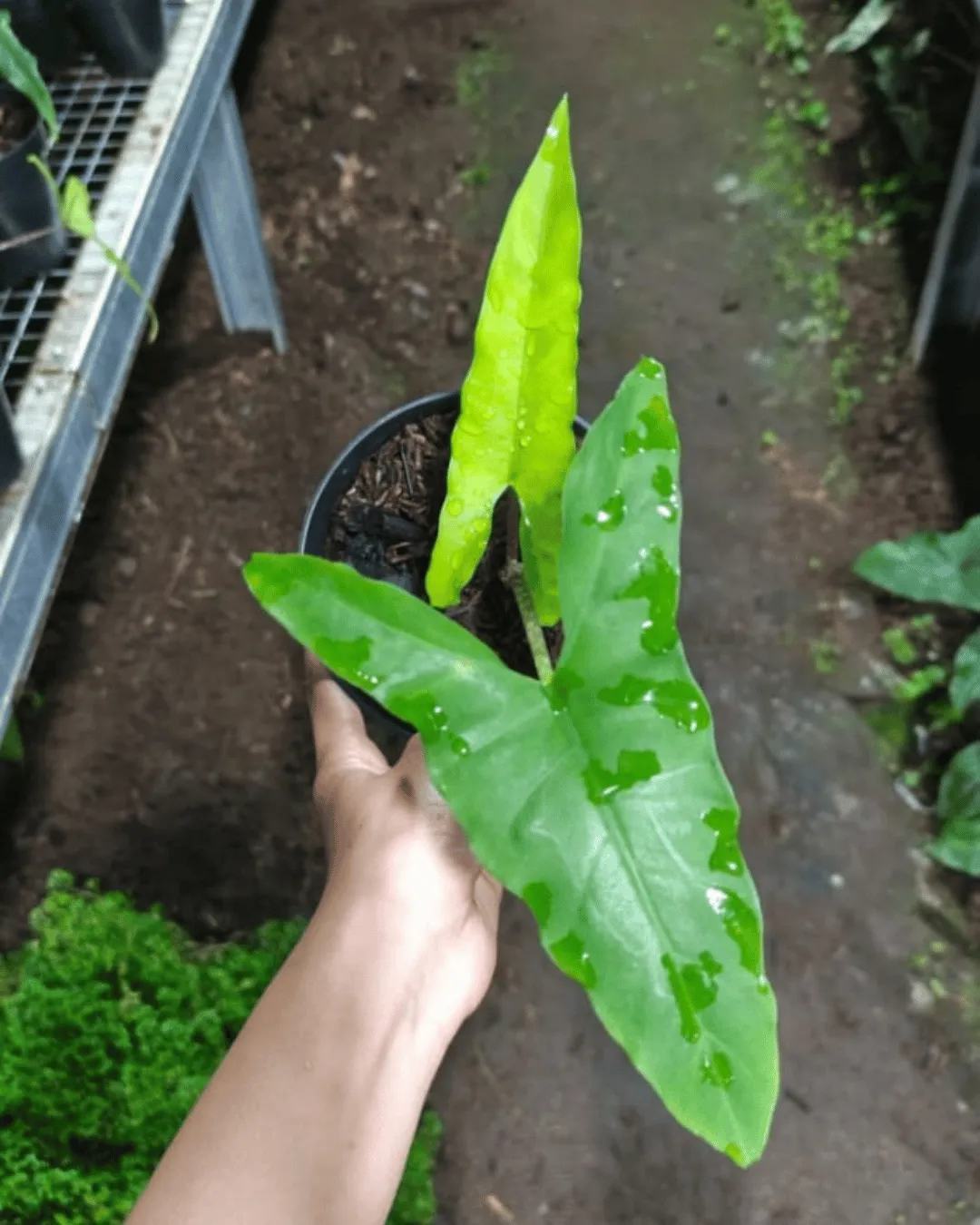
The leaves of Alocasia trigina are its most impressive feature. They are large, bold, and arrow-shaped — a form botanists call “sagittate,” meaning shaped like an arrowhead. Each leaf grows on a long, upright stalk called a petiole.
Furthermore, the leaf surface displays deep, rich green tones. Prominent veins run from the centre outward, creating a striking contrast against the leaf blade. The texture is smooth to slightly waxy, which helps the plant shed excess water in its rainy native habitat.
Additionally, the leaf margins — the edges of the leaf — may show subtle undulation. This gives each leaf a sculptural, three-dimensional quality. Primarily, this architectural form is what makes Alocasia trigina so prized as a display plant in high-end collections.
The leaves can grow impressively large under optimal conditions. Mature specimens in tropical climates may produce leaves reaching 40–80 cm in length. Moreover, the plant typically holds several leaves at once, forming an elegant, upright crown.
Flower and Fruit Alocasia trigina
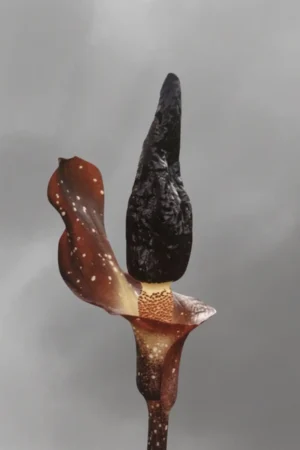
Like all members of the Araceae family, Alocasia trigina produces a distinctive flower structure. The flower consists of two main parts. First, there is the spadix — a finger-like central spike where the tiny flowers actually grow. Second, there is the spathe — a hood-like outer leaf that wraps around and partially covers the spadix.
Consequently, the flower is not showy in the traditional sense. It is subtle and architectural rather than brightly coloured. The spathe is typically pale green to creamy white. Flowers are more likely to appear when the plant is grown outdoors in a tropical climate.
After pollination, Alocasia trigina produces small berries. These berries ripen to a red or orange colour. Furthermore, seeds are dispersed naturally by birds in the wild. This is one reason wild populations remain so scattered and difficult to locate.
Dormancy Cycle
Alocasia trigina can enter a rest period — called dormancy — in cooler or drier conditions. During dormancy, the plant may drop its leaves. This can alarm new growers, but it is completely normal behaviour.
Moreover, the plant stores energy in its underground structure, called a corm — a thickened, bulb-like base. The corm survives dormancy safely and sends up new growth when conditions improve. Primarily, this survival strategy allows Alocasia trigina to cope with seasonal changes in its native habitat.
Additionally, growers in temperate climates should keep the corm warm and slightly moist during dormancy. Do not overwater during this phase. Consequently, the plant will return vigorously when temperatures rise again.
Global Seed Delivery & Phytosanitary Certification
Induare Agro is an experienced exporter of rare tropical seeds from Indonesia. We understand that buying rare seeds internationally requires trust. Furthermore, we take every step to ensure your seeds arrive safely, legally, and in excellent condition.
Packaging and Shipping
Each seed is carefully cleaned, inspected, and prepared for export. Furthermore, we pack seeds with moisture-control materials to preserve viability during transit. We use durable, professional packaging that protects seeds from physical damage and humidity fluctuations.
Induare Agro ships via Global Express courier services. These services offer tracking, speed, and reliability. Moreover, most international shipments arrive within 7–14 business days, depending on the destination country.
Additionally, we communicate shipment details clearly with every buyer. You will receive a tracking number as soon as your order ships. Primarily, our goal is to make international seed buying simple, safe, and worry-free.
Buyer Peace of Mind
Every order from Induare Agro includes a Phytosanitary Certificate. This is an official government-issued document. It confirms that our seeds have been inspected by Indonesia’s plant health authorities and are free from pests and diseases.
Furthermore, a Phytosanitary Certificate is required by most countries for the legal import of plant material. Consequently, your seeds pass through customs smoothly and legally. You avoid delays, rejections, and compliance issues.
Moreover, Induare Agro complies fully with CITES regulations and all applicable Indonesian export laws. We are committed to ethical, sustainable sourcing. Additionally, we only export seeds from legally permissible species and quantities. Your purchase supports responsible trade in rare botanical material.
How to Grow Alocasia trigina
Alocasia trigina is a rewarding plant to grow. Follow these steps carefully for the best results.
Step 1 — Prepare Your Growing Medium Use a loose, well-draining mix that holds some moisture. Combine coco coir, perlite, and orchid bark in roughly equal parts. Avoid heavy, compact soils that retain too much water.
Step 2 — Sow the Seed Place the seed on the surface of the moist growing medium. Press it gently into the top layer without burying it deeply. Cover the container loosely with a clear lid or plastic wrap to retain humidity.
Step 3 — Provide Warmth and Humidity Keep the seed in a warm spot between 22°C and 30°C (72°F–86°F). High humidity — above 70% — is essential for germination. A small seedling heat mat helps maintain consistent warmth.
Step 4 — Maintain Moisture Keep the growing medium lightly moist at all times. Do not let it dry out completely. Additionally, do not overwater — soggy soil causes the seed to rot before it sprouts.
Step 5 — Provide Indirect Light Place the container in bright, indirect light. Avoid direct sunlight, which can scorch young seedlings. Furthermore, a grow light set to a 12-hour cycle works well in temperate climates.
Step 6 — Wait for Germination Germination typically takes 2–6 weeks under optimal conditions. Consequently, patience is key. Once a small shoot appears, remove the cover gradually to acclimatise the seedling to ambient air.
Step 7 — Pot Up and Establish When the seedling has two or three small leaves, transfer it to a slightly larger pot. Primarily, keep conditions warm and humid as the plant establishes. Begin light feeding with a balanced liquid fertiliser every two weeks.
All seeds supplied by Induare Agro are sourced responsibly from Indonesia and exported in full compliance with international plant trade regulations.