
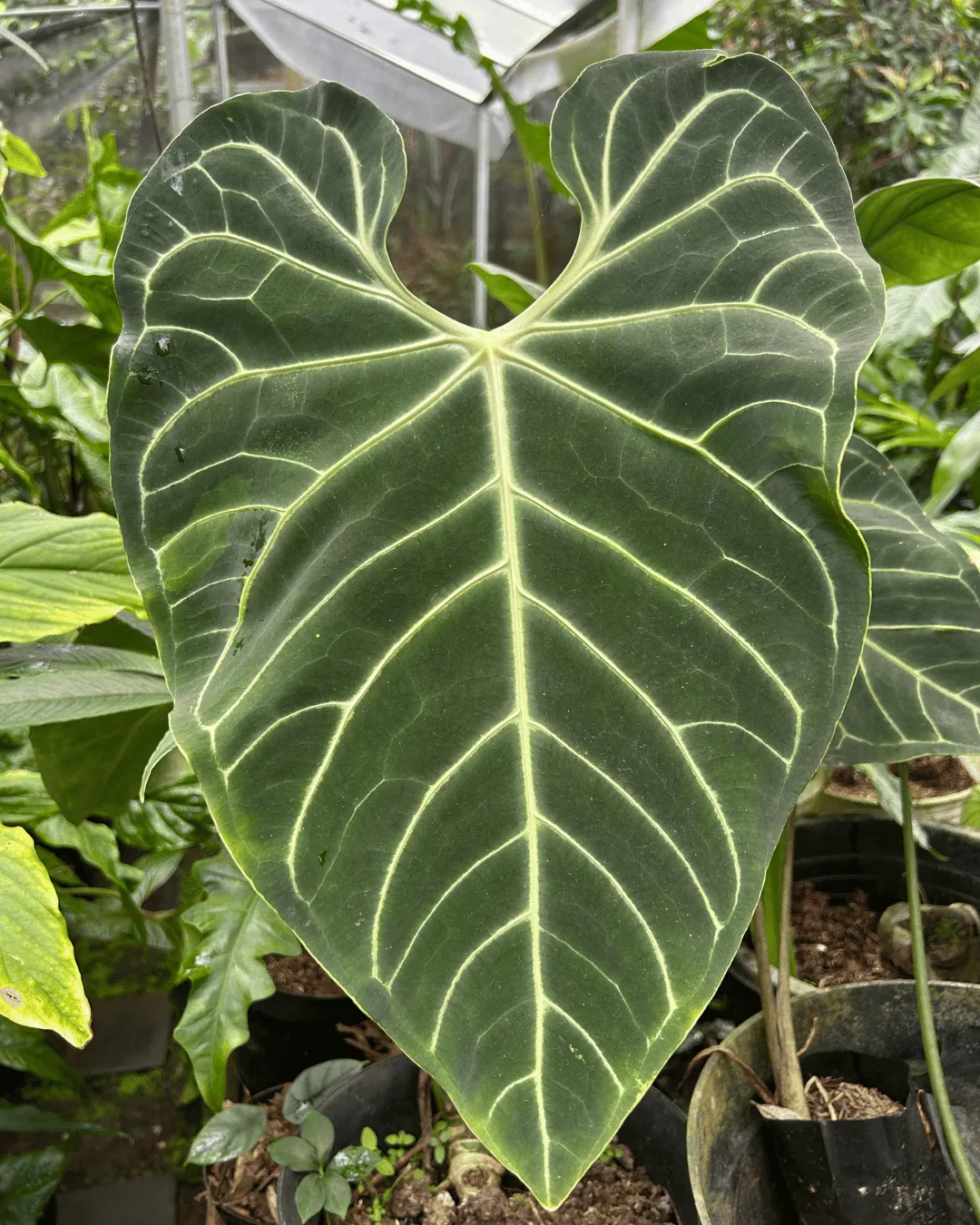
What Is Anthurium regale?
Anthurium regale is widely regarded as the most majestic aroid species a collector can grow. It is native to the Río Huallaga valley in northeastern Peru. Specifically, it grows in the pre-montane rainforests of the Huánuco and San Martín regions. Furthermore, it was first formally described by Europeans in 1866. That record noted the plant was first collected by Gustav Wallis for the famous Belgian botanist Jean Jules Linden. Consequently, A. regale has been known to the horticultural world for over 150 years — yet it remains deeply rare and extremely hard to obtain.
In the wild, this species grows on steep, shaded slopes and stream banks. It lives at elevations of 300 to 1,000 metres above sea level. Furthermore, the natural humidity in its habitat stays close to 100% at all times. The average temperature ranges from 15°C to 26.6°C. Primarily, this cool, wet, shaded environment shapes everything about the way this plant looks and grows. Peru’s strict export regulations make sourcing verified seeds extremely difficult outside of the country. Consequently, Anthurium regale seeds are among the most sought-after items in the global rare plant market.
Induare Agro offers fresh, authenticated Anthurium regale seeds. Additionally, every order ships with full legal documentation. This gives collectors worldwide a rare and verified path to growing the legendary Royal Anthurium from seed.
Aesthetic Features Anthurium regale
Anthurium regale is a plant of extraordinary scale and visual drama. It is one of the largest-leaved members of its genus. Furthermore, it is considered the defining species of the velvet-leaf Anthurium collecting world. Every part of this plant commands attention — from the size of its leaves to the bold pattern of its veins.
Leaf Size and Texture
The leaves of Anthurium regale are its most striking feature. In cultivation, leaves can reach up to 1 metre in length. In the wild, mature specimens produce leaves exceeding 2 metres. Primarily, the leaf surface is velvety — covered in fine, soft hairs that catch the light from every angle. Additionally, the texture is slightly bumpy or quilted, giving the surface a rich, three-dimensional quality. The leaf is dark green to near-black-green when mature. Furthermore, new leaves emerge in a lighter, more tender green. They deepen in colour as they harden and age.
Vein Pattern
The veins are the defining visual feature of A. regale. They are thick, raised, and creamy white to pale silver in colour. Consequently, they create a bold, almost painted contrast against the dark green leaf surface. The veins run from the central midrib outward in a large, dramatic fan pattern. Additionally, secondary veins branch out in precise geometric lines between the main veins. Furthermore, under certain light, the veins appear to shimmer. This effect is why this species is sometimes called the Giant Silver-Veined Anthurium among collectors.
Flower Structure and Fruiting
Anthurium regale produces flowers. However, it is grown entirely for its extraordinary leaves. The flower consists of a spathe — a broad, green, leaf-like hood — and a spadix — a thin central spike where the tiny true flowers grow. Furthermore, the species is protogynous — meaning the female part of the flower is ready before the male part releases pollen. Consequently, natural self-pollination is unlikely. Cross-pollination from a second plant is needed to produce berries and seeds. Additionally, successful seed production in cultivation is rare and considered a significant achievement among collectors. The plant typically holds only 1 to 3 leaves at a time, growing slowly from a compact central stem supported by thick aerial roots.
Global Seed Delivery & Phytosanitary Certification
Induare Agro is a professional botanical seed exporter based in Indonesia. The company connects rare tropical plant species with collectors and institutions across more than 50 countries. Furthermore, Induare Agro follows a fully documented export process for every single order. Primarily, legal compliance and seed viability are the two pillars of every shipment.
Packaging and Shipping
Induare Agro carefully wraps every seed in moisture-control material before dispatch. Cushioned express packaging protects seeds throughout the full transit journey. Shipments go out via Global Express couriers such as DHL and FedEx. Additionally, most international orders arrive within 5–14 business days. Furthermore, every parcel includes an official Phytosanitary Certificate. This document is issued by Indonesia’s Plant Health Authority. It confirms the seeds are free from pests, disease, and regulated plant pathogens. Consequently, it satisfies the import requirements of customs authorities in the EU, USA, UK, Australia, Japan, and most other regulated markets worldwide.
Buyer Peace of Mind
Induare Agro puts full documentation in every parcel. The Phytosanitary Certificate and commercial invoice travel with every shipment. Furthermore, this ensures smooth and fast customs clearance at every destination. Additionally, the Induare Agro team provides after-sales growing support. Primarily, the goal is to make sure every collector successfully germinates and establishes their Anthurium regale from the very first seed.
How to Grow Anthurium regale
Anthurium regale is a slow grower. Furthermore, it is one of the most rewarding plants a serious collector can cultivate. The key to success is stable warmth, very high humidity, and a light, airy growing mix. Follow these steps carefully:
Step 1 — Seed Preparation Place the fresh seed on a bed of damp sphagnum moss — a soft, fibrous natural moss available at most plant shops. Additionally, keep the moss in a shallow tray with about 1 cm of water at the base. This keeps humidity near 100% around the seed at all times.
Step 2 — Germination Environment Enclose the tray in a clear plastic bag or humidity dome. Furthermore, maintain a temperature of 22–26°C at all times. A. regale seeds need consistently warm and humid conditions to sprout successfully.
Step 3 — Sprouting Time Germination can take 2–8 weeks. Consequently, patience is essential. Do not disturb the seed or change conditions during this period. Check moisture levels daily and mist lightly if the moss begins to dry.
Step 4 — First Transplant Once the seedling has 1–2 small leaves, move it carefully into a small pot. Furthermore, use a light, airy mix: 40% orchid bark, 30% perlite, and 30% coco peat. This mix replicates the well-drained forest floor of its Peruvian habitat.
Step 5 — Light Place the seedling in bright, indirect light. Additionally, an east- or north-facing window works best. Avoid direct sun at all times — it scorches the velvety leaf surface quickly.
Step 6 — Humidity Maintain humidity of at least 70%, ideally above 80% at all times. Primarily, high humidity is the single most critical factor for this species. A humidifier, humidity tent, or enclosed plant cabinet works well.
Step 7 — Watering Water when the top two-thirds of the growing mix feels dry. Furthermore, always use filtered or rain water at room temperature. Never let the pot sit in standing water, as root rot develops quickly in wet conditions.
Step 8 — Feeding and Long-Term Growth Apply a diluted balanced liquid fertiliser (NPK 10-10-10 or similar) every 4 weeks during the active growing season. Additionally, reduce feeding in cooler or darker months when growth naturally slows. Furthermore, as the plant matures, it will begin to produce increasingly larger and more dramatic leaves with each new growth cycle.
© Induare Agro — Indonesia’s professional rare seed exporter.
