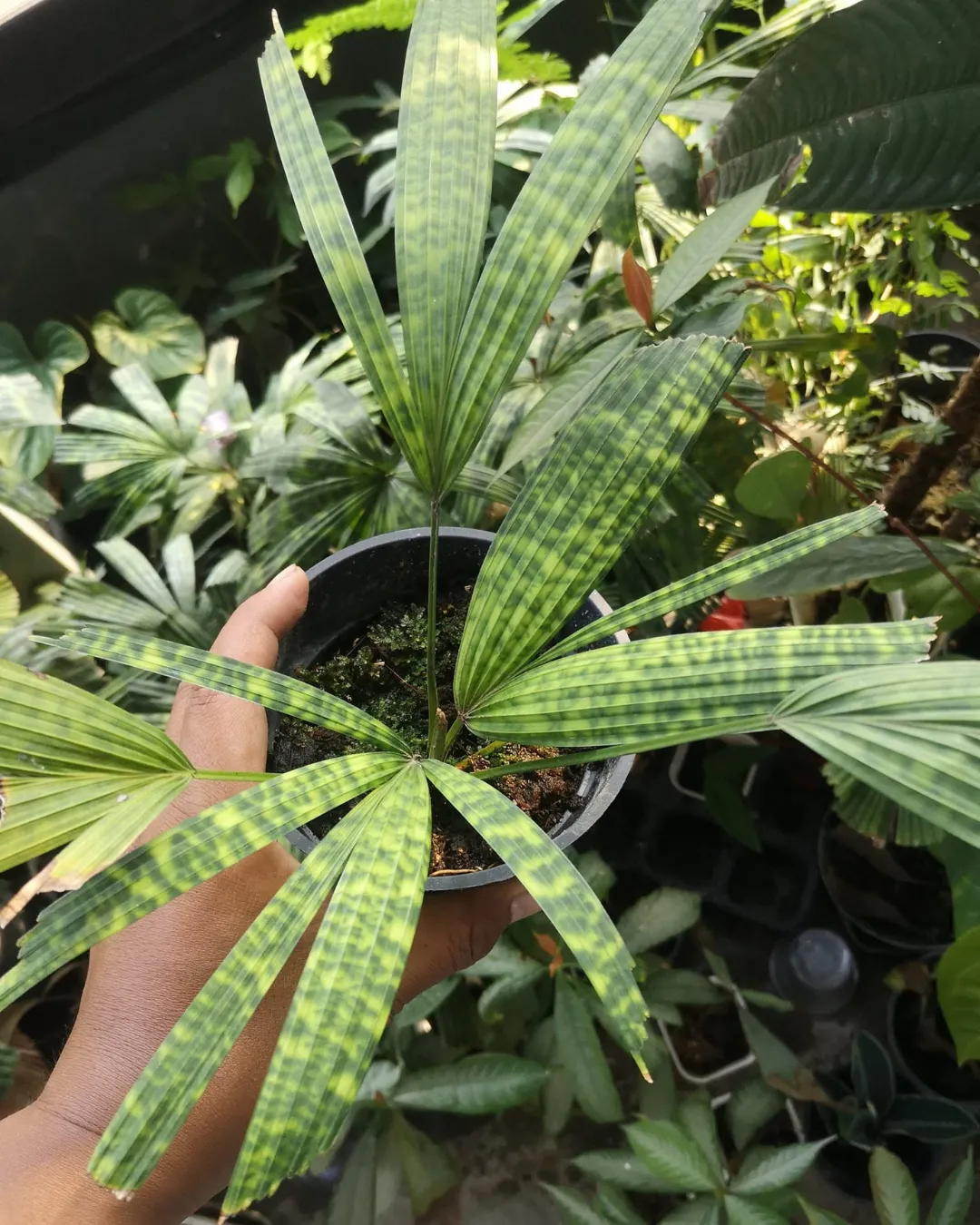
What Is Licuala mattanensis?
Licuala mattanensis is one of the rarest and most beautiful palms on Earth. It originates from a very small area in Central Kalimantan, Borneo, Indonesia. Specifically, it grows near the Mattan River — which is where the name “mattanensis” comes from. The wild population is estimated at fewer than 1,000 mature individuals. Consequently, this plant is considered critically rare in both the wild and in cultivation.
This rare plant lives on steep limestone slopes and cliff bases in deep rainforest shade. The habitat receives between 2,500 and 3,500 mm of rainfall each year. Moreover, high humidity and stable warm temperatures define its natural environment. These conditions make Licuala mattanensis highly adapted to tropical rainforest life.
The cultivar name ‘Mapu’ refers to the plant’s most prized feature — its tessellated leaf pattern. This is a checkered design of dark and light green that appears on every leaf surface. Additionally, this pattern is completely unique in the palm world. No other palm species produces anything like it. This fact alone drives extraordinary global demand among collectors, botanists, and exotic plant enthusiasts.
Induare Agro is proud to offer fresh, export-quality seeds of this legendary Indonesian plant. We source directly from responsible growers in Kalimantan. Furthermore, every seed we sell is handled with care to preserve viability during international shipping.
Aesthetic Features Licuala mattanensis
Licuala mattanensis ‘Mapu’ is widely regarded as the most visually stunning fan palm in existence. Its appearance is dramatic, architectural, and truly unlike any other plant. Additionally, every part of this palm — from its leaves to its trunk — tells the story of a species shaped by millions of years of rainforest evolution.
Leaf Structure Licuala mattanensis
The leaves of Licuala mattanensis are nearly perfectly circular. Each leaf measures between 60 and 80 cm in diameter. Moreover, the leaf surface displays the famous tessellated pattern — a living mosaic of dark green diamonds alternating with lighter green areas. This checkered design is most vivid in young leaves and in shaded conditions. The leaves have a thick, almost leathery texture with a subtle metallic sheen. Furthermore, each leaf is divided into just two to four broad segments. This is far fewer than most fan palms, giving it an unusually bold and open appearance.
The leaf tips are square-edged with lightly serrated margins. Parallel veins run across the surface, adding to the graphic visual effect. Primarily, it is this leaf — and no other feature — that makes Licuala mattanensis the most sought-after rare plant among collectors globally.
Trunk and Growth Habit Licuala mattanensis
Licuala mattanensis is a slow-growing palm. It typically takes many years to reach its full height of 2 to 4 meters. The trunk is slender, measuring just 5 to 8 cm in diameter. Young trunks are covered with fibrous old leaf bases. Consequently, mature trunks become smooth and display prominent ring-like marks where old leaves once attached. The trunk sometimes shows a slight natural lean. This is believed to relate to its cliff-dwelling origins in the wild.
Furthermore, the palm typically grows as a single stem, or solitary plant. Occasional clustering has been observed in cultivation. The slow growth rate and compact size make it perfectly suited for container growing indoors or in smaller tropical gardens.
Flowers and Fruit
Licuala mattanensis produces long, arching flower stalks — called inflorescences — that emerge from between the leaf bases. The flowers themselves are small and relatively inconspicuous. Additionally, the fruit that follows is elongated and narrow. This distinguishes the Mapu variety from similar-looking palms like Licuala sp. ‘Kalimantan Mottled’, which produces round seeds. The fruit ripens to a reddish colour. However, the flowers and fruit are clearly secondary to the foliage. Primarily, collectors grow this palm for its extraordinary leaf display.
Global Seed Delivery & Phytosanitary Certification
Induare Agro is an Indonesian export specialist focused on rare plants and exotic seeds. We operate with full compliance to international phytosanitary — plant health — regulations. Furthermore, every order we ship meets the legal requirements of the destination country. We take the trust of our global buyers seriously.
Packaging and Shipping
Every seed is cleaned, inspected, and assessed for freshness before packing. We use moisture-controlled packaging to protect the seed during long transit times. Additionally, we work with trusted Global Express courier partners to ensure fast and reliable delivery worldwide. Shipping is available to most countries across Europe, Asia, the Americas, and beyond. Furthermore, tracking information is provided with every order so buyers can monitor their shipment in real time.
Seeds are packed to prevent physical damage, moisture loss, and temperature shock during transit. Consequently, the seeds you receive are in the best possible condition for planting. Induare Agro treats every seed as the rare and valuable specimen it truly is.
Buyer Peace of Mind
Every order from Induare Agro includes a Phytosanitary Certificate issued by the Indonesian government’s agricultural authority. This certificate confirms that your seeds are free from pests, diseases, and prohibited organisms. Buyers use it to clear their seeds through customs legally and without delays.
Furthermore, Induare Agro provides full documentation support if buyers need additional paperwork for their country’s import requirements. We are committed to making the global trade of rare exotic seeds safe, legal, and transparent. Consequently, collectors around the world trust us as their preferred source for Indonesian plants and rare seeds.
How to Grow Licuala mattanensis
Growing Licuala mattanensis ‘Mapu’ successfully requires patience and the right conditions. Follow these steps for the best results.
Step 1 — Soak the Seeds Soak fresh seeds in warm water for 24 to 48 hours before planting. This softens the outer seed coat and improves germination rates. Change the water once during the soak period.
Step 2 — Prepare the Growing Mix Use a well-draining mix of peat moss, perlite, and loamy soil. The mix should be slightly acidic, with a pH between 5.5 and 6.5. Additionally, ensure the pot or tray has adequate drainage holes to prevent waterlogging.
Step 3 — Plant the Seeds Plant each seed approximately 1 to 2 cm deep in the growing mix. Cover lightly with soil and press gently to ensure good contact.
Step 4 — Create the Right Environment Place the pot in a warm, humid location with temperatures between 25°C and 30°C (77°F to 86°F). Bright, indirect light is ideal.
Step 5 — Water and Wait Keep the soil consistently moist but never waterlogged. Germination is slow and may take several weeks to a few months. Additionally, maintain high humidity by covering the tray with a clear plastic dome or placing it in a humidity tent.
Step 6 — Transplant Seedlings Once seedlings develop their first true leaf, move them to individual pots. Use the same well-draining mix as before. Furthermore, keep new transplants in full shade for the first several weeks while they establish their root systems.
Step 7 — Ongoing Care Fertilise lightly every six to eight weeks during the growing season using a balanced palm fertiliser. Protect the plant from cold temperatures below 15°C (59°F).


