
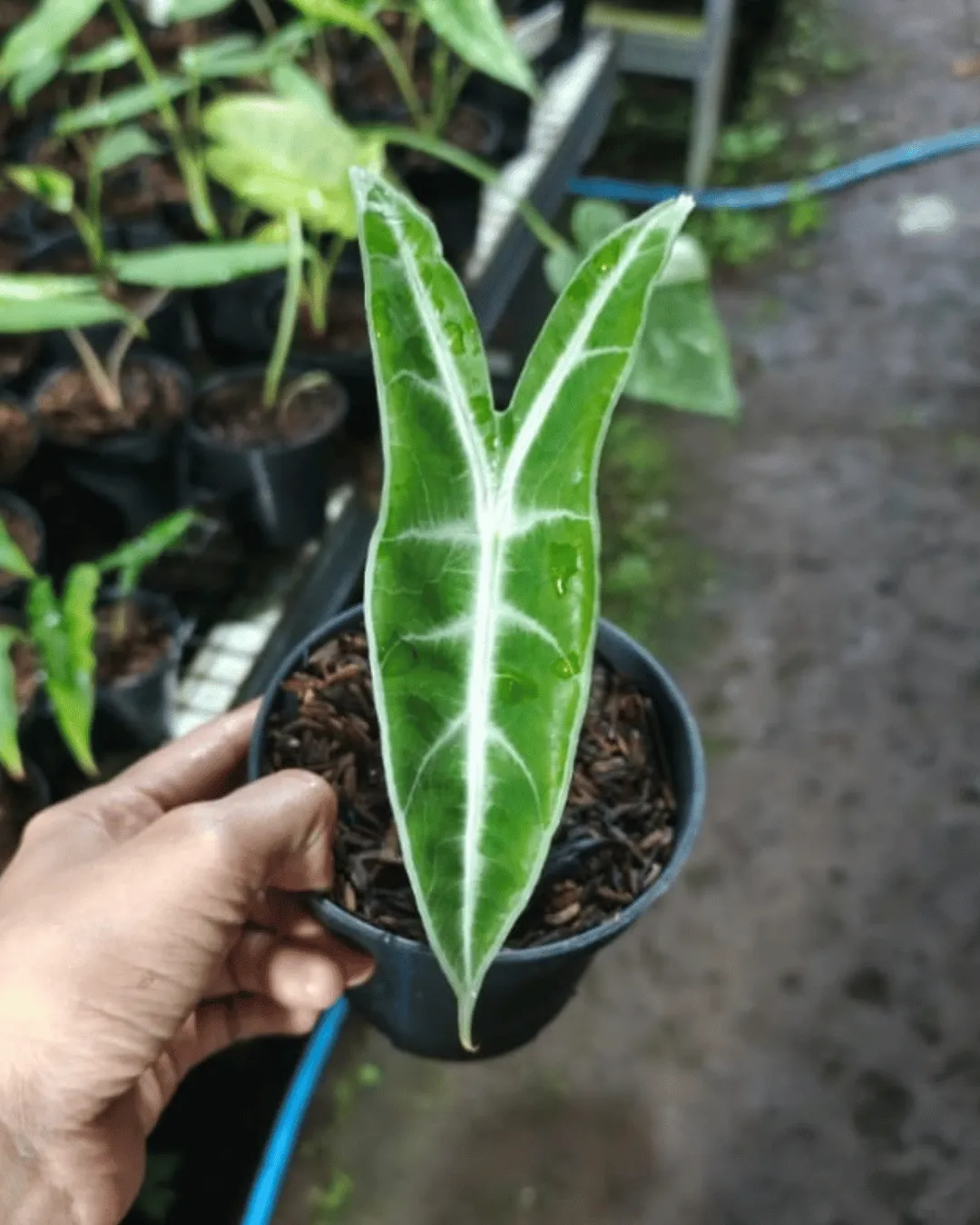
What Is Alocasia longiloba tiger fangs?
Alocasia longiloba tiger fangs is one of the most desirable and hard-to-find forms within the Alocasia longiloba species complex. It is commonly known as the Tiger Taro. Furthermore, this plant belongs to one of the most important and varied groups in the entire aroid family. The species was first formally described by the Dutch botanist Friedrich Miquel in 1856. The name longiloba comes from two Latin words — longus meaning “long” and lobus meaning “lobe” — a direct reference to the plant’s signature elongated, deeply lobed leaves.
The tiger fangs form takes the already dramatic longiloba leaf to another level. Its narrow, sharply pointed leaf tips and bold, fang-like posterior lobes give the plant a fierce and striking character. Consequently, the name “tiger fangs” perfectly describes the aggressive, angular shape of the leaf. This form is native to the tropical rainforests of Southeast Asia. Primarily, it is found across Malaysia, Borneo, Sumatra, and parts of the Indonesian archipelago. It grows on the forest floor and on rocky slopes, in humid and partially shaded conditions.
Additionally, Alocasia longiloba is the most prolific parent species in Alocasia hybrid history. It produced famous cultivars including the well-known Alocasia × amazonica — the African Mask plant — one of the most widely recognised houseplants in the world. Furthermore, this heritage makes the longiloba tiger fangs form doubly significant — both as a rare collector specimen and as a living part of aroid botanical history. Induare Agro offers authenticated seeds of this rare form, export-ready with full documentation included.
Aesthetic Features Alocasia longiloba tiger fangs
Alocasia longiloba tiger fangs is a medium to large aroid with a bold, upright growth habit. The plant reaches 40–100 cm in height under typical indoor growing conditions. Furthermore, it holds multiple large leaves at once. These spread outward and upward in a fan-like arrangement that fills a space dramatically. The leaf stalks — called petioles — are long and distinctively mottled. They show an irregular pattern of brown, green, and pale markings that add visual interest even without a leaf in view.
Leaf Shape and Surface
The leaves are the defining feature of this plant. They are deeply arrow-shaped — meaning the base of each leaf splits into two long, pointed lobes that reach backward like a pair of fangs. Furthermore, the blade narrows to a sharp tip at the outer end. The upper surface of the leaf is a deep, matte blue-green. Additionally, the surface has a slightly waxy texture that catches and reflects light in changing ways throughout the day. Leaf blades typically grow 40–85 cm in length. Each leaf is a bold, graphic presence on its own.
Veining and Colour
The veining of A. longiloba tiger fangs is one of its most prized features. Thick silver-white primary veins cut across the dark green surface in a bold, almost hand-painted pattern. Consequently, the contrast between the dark leaf and pale veins is vivid and dramatic. Additionally, the underside of the leaf is a rich burgundy to deep purple. This hidden colour becomes visible as the leaf moves in a breeze. Furthermore, the petioles — leaf stalks — display irregular oblique stripe markings. These markings are the feature that first inspired the “Tiger Taro” name, as they closely resemble a tiger’s stripes.
Growth Habit and Dormancy
Alocasia longiloba tiger fangs grows from a rhizome — a thickened, underground stem that stores energy for the plant. Furthermore, this rhizome allows the plant to survive periods of lower light or cooler temperatures by entering dormancy — a natural rest phase. During dormancy, all leaves may die back. The rhizome stays alive underground and will produce new growth when conditions improve. Consequently, collectors must not discard the pot during a dormancy period. Additionally, the plant is a perennial — meaning it regrows year after year from the same root system, typically producing larger leaves with each new growth cycle.
Global Seed Delivery & Phytosanitary Certification
Induare Agro is a professional botanical seed exporter based in Indonesia. The company specialises in rare and sought-after Southeast Asian and tropical plant species. Furthermore, Induare Agro ships seeds to collectors, botanical gardens, and plant research institutions in more than 50 countries worldwide. Every order follows a strict, fully documented export process from packing to final delivery.
Packaging and Shipping
Induare Agro packs every seed with professional moisture-control materials. Cushioned express packaging protects the seeds safely throughout the full transit journey. Shipments go out via Global Express couriers such as DHL and EMS. Additionally, most international orders arrive within 5–14 business days. Furthermore, every parcel includes an official Phytosanitary Certificate. This document is issued by Indonesia’s Plant Health Authority. It confirms that the seeds are free from pests, disease, and regulated plant pathogens. Consequently, it meets the import requirements of customs offices in the EU, USA, UK, Australia, Japan, and most other countries globally.
Buyer Peace of Mind
Induare Agro puts full documentation and legal compliance at the centre of every order. Every shipment includes the Phytosanitary Certificate and a commercial invoice. Furthermore, this ensures smooth and fast customs clearance at every international destination. Additionally, the Induare Agro team provides after-sales growing support for every buyer. Primarily, the goal is simple — to help every collector successfully germinate their Alocasia longiloba tiger fangs seeds and grow a thriving, healthy specimen from day one.
How to Grow Alocasia longiloba tiger fangs
Alocasia longiloba tiger fangs is a rewarding plant to grow from seed. Furthermore, growers in tropical, subtropical, and warm indoor environments can all achieve great results. The key is to replicate the warm, humid, partially shaded floor of its native Southeast Asian rainforest. Follow these steps for the best germination and early growth results.
Step 1 — Seed Preparation Soak the seed in warm water (25–28°C) for 12–24 hours before planting. Additionally, this softens the outer coat and helps water reach the inside of the seed faster, speeding up germination.
Step 2 — Growing Medium Use a light, airy, fast-draining mix: 40% orchid bark, 30% perlite, and 30% coco peat or fine compost. Consequently, this replicates the loose, well-aerated forest floor soil of the plant’s native habitat.
Step 3 — Sowing Plant the seed just below the surface — no more than 1–2 cm deep — in a small pot with drainage holes. Furthermore, keep the medium consistently moist throughout the germination stage. Do not let it dry out completely.
Step 4 — Temperature and Humidity Maintain a temperature between 22°C and 28°C and a humidity level of 65–80% at all times. Primarily, warmth and high humidity are the two most important factors for fast and healthy germination.
Step 5 — Light Place the pot in bright, indirect light. Additionally, avoid direct sun at all times. In its native habitat, this plant grows beneath the forest canopy in filtered, dappled light conditions.
Step 6 — Watering Keep the growing medium evenly moist during active growth. Furthermore, let the top 2–3 cm dry slightly between waterings once the seedling is established. Never allow the pot to sit in standing water, as this causes rhizome rot.
Step 7 — Dormancy Care If the plant enters dormancy — leaves die back and growth stops — reduce watering. Consequently, the rhizome needs a dry but not completely parched rest period. Do not throw the pot away. New leaves will emerge when conditions improve.
Step 8 — Fertilising and Repotting Apply a balanced liquid fertiliser (NPK 10-10-10 or similar) every 4 weeks during the active growing season. Additionally, repot every 1–2 years into a slightly larger container with fresh growing medium. Furthermore, this encourages a bigger rhizome, faster growth, and larger, more dramatic leaves each season.
© Induare Agro — Indonesia’s professional rare seed exporter.
