
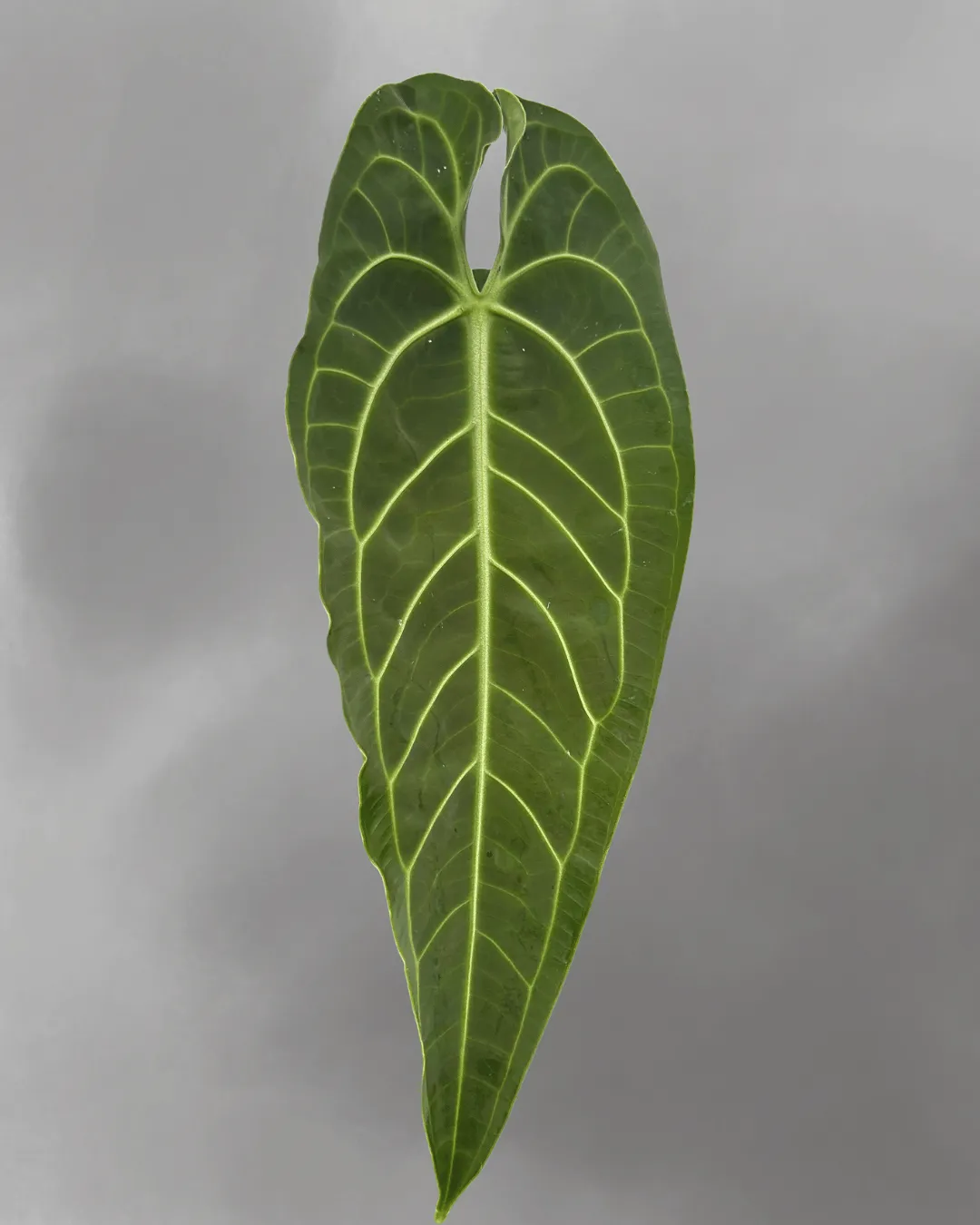
What Is Anthurium waroqueanum?
Anthurium waroqueanum is one of the most famous rare plants in the world. It is commonly called the Queen Anthurium. This title is well earned. No other anthurium produces leaves of such extraordinary length, texture, and visual drama. The plant is native to the rainforests of Colombia. It grows in the Pacific lowlands and the mountain valleys of Central and Western Colombia. Furthermore, it lives at elevations between 400 and 1,200 metres — in misty cloud forest environments with high humidity and filtered light.
In the wild, A. waroqueanum is an epiphyte. This means it grows on tree trunks and branches rather than in the ground. It anchors its roots to bark and absorbs moisture and nutrients from the air around it. Consequently, wild plants are most often found clinging to tree trunks about 2.5 metres above the forest floor.
The species was first collected in 1874 by the German botanist Gustav Wallis during an expedition for the famous Veitch Nurseries. Furthermore, it was formally described by botanist Thomas Moore in 1878. The plant was named in honour of Arthur Warocqué — a Belgian industrialist and plant collector who supported botanical exploration in the 19th century.
Today, wild populations face pressure from habitat loss and over-collection. Consequently, ethically grown seeds from verified sources are the most responsible choice for collectors. Induare Agro supplies these seeds through a fully legal and documented process. Additionally, every order ships with a Phytosanitary Certificate — ensuring full compliance with international plant import regulations.
Aesthetic Features Anthurium waroqueanum
Anthurium waroqueanum belongs to a special group called the velvet-leaf anthuriums. These plants have a layer of tiny, flat hairs on their leaf surface. Consequently, the leaves feel exactly like velvet to the touch. This soft, rich texture is the defining physical trait of the Queen Anthurium. Furthermore, it sets this species apart from almost every other houseplant available on the market today.
Leaf Size and Texture
The leaves of A. waroqueanum are long, narrow, and deeply velvety. Young leaves are lighter green. Additionally, as they mature, they deepen to a rich, dark green — sometimes appearing almost black in low light. In ideal growing conditions, the leaves can grow over one metre in length and up to 38 cm wide. Primarily, this extraordinary size is what gives the Queen Anthurium its iconic, regal appearance. Furthermore, the veins — which run across the full length of each leaf — appear in a bold silver or cream white. These veins become more defined and dramatic as the plant reaches maturity.
Growth Form
Anthurium waroqueanum grows in a rosette form. This means the leaves emerge from a central stem in a clustered, outward-spreading pattern. The stem is short and grows slowly over time. Additionally, the plant is not a climber in the traditional sense. It does not actively crawl or wind upward. Instead, it anchors to surfaces with exposed aerial roots — roots that grow above the soil and absorb moisture from the surrounding air. Consequently, in cultivation, a moss pole or bark mount encourages the roots to attach naturally, just as they would in a Colombian cloud forest.
Flowers and Berries
A. waroqueanum does produce flowers, though they are not the main attraction. The flower consists of a spadix — a slim central spike — and a spathe — a hood-like leaf bract — both of which are green in colour. Furthermore, the flower has no significant fragrance. After successful pollination, the plant produces small red berries. Each berry contains one or two seeds. Primarily, seed production in this species is rare and slow, which makes commercially available seeds exceptionally valuable to collectors worldwide.
Global Seed Delivery & Phytosanitary Certification
Induare Agro is a professional botanical seed exporter based in Indonesia. The company works with verified growers and trusted regional sources to supply rare and exotic plant seeds to collectors around the world. Furthermore, Induare Agro ships to botanical gardens, universities, and private collectors in more than 50 countries. Every order follows a strict, fully documented export process from start to finish.
Packaging and Shipping
Induare Agro wraps every seed in moisture-control packaging before dispatch. Cushioned express packaging protects the seeds throughout the full transit journey. All shipments go out via Global Express couriers such as DHL and EMS. Additionally, most international destinations receive orders within 5–14 business days. Furthermore, every parcel includes an official Phytosanitary Certificate. This document is issued by Indonesia’s Plant Health Authority. It confirms that all seeds are free from pests, disease, and regulated plant pathogens. Consequently, this certificate meets the import requirements of customs offices in the EU, USA, UK, Australia, Japan, and most other countries worldwide.
Buyer Peace of Mind
Induare Agro puts documentation and compliance first. Every order ships with full export papers — including the Phytosanitary Certificate and a commercial invoice. Furthermore, this approach ensures smooth, fast customs clearance at every destination worldwide. Additionally, the Induare Agro team provides after-sales growing support for all customers. Primarily, the mission is simple — to make sure every collector successfully germinates and establishes their Queen Anthurium from the very first seed.
How to Grow Anthurium waroqueanum
Anthurium waroqueanum requires consistent warmth, high humidity, and excellent drainage. Furthermore, growers in tropical, subtropical, and controlled indoor environments can all achieve great results. Follow these steps for the best chance of germination and healthy early growth.
Step 1 — Seed Preparation Rinse the seed gently in clean water before planting. Additionally, soak it in warm water (22–26°C) for 12 hours to soften the outer layer and encourage faster sprouting.
Step 2 — Growing Medium Use a very airy, well-draining mix: 40% sphagnum moss, 30% orchid bark, and 30% perlite. Consequently, this replicates the loose, bark-rich surface that the plant roots into in its natural cloud forest habitat.
Step 3 — Sowing Press the seed gently onto the surface of the moist growing medium. Furthermore, do not bury it deep — a light covering of 0.5 cm is enough. Keep the medium consistently moist throughout the germination stage.
Step 4 — Temperature Maintain a steady temperature of 20–28°C at all times. Primarily, stable warmth is the most critical factor for successful Queen Anthurium germination. Avoid any cold drafts or sudden temperature drops.
Step 5 — Humidity Keep humidity at 70–85% during germination and early growth. Additionally, a clear humidity dome over the pot helps maintain these levels with minimal effort. High humidity is non-negotiable for this species.
Step 6 — Light Place the pot in bright, indirect light. Furthermore, avoid any direct sun — especially midday sun — as this will scorch the tender young leaves. A north- or east-facing window works very well indoors.
Step 7 — Watering Keep the growing medium consistently moist — but never wet or waterlogged. Consequently, the roots need air around them at all times. Always use a pot with drainage holes and never allow standing water to collect at the base.
Step 8 — Mounting and Fertilising Once the seedling develops 2–3 true leaves, attach it to a moss pole or bark mount. Additionally, apply a diluted liquid fertiliser (NPK 20-20-20 or similar) every 4 weeks during the growing season. Furthermore, a calcium and magnesium supplement every 8 weeks supports stronger, larger leaf development over time.
© Induare Agro — Indonesia’s professional rare seed exporter.
