
What Is Cercestis mirabilis?
Cercestis mirabilis is a rare tropical climbing plant from the family Araceae. It originates in the humid lowland rainforests of West and Central Africa. Its native range stretches from Benin to Uganda and Angola. In the wild, it climbs tall trees using clasping roots, reaching up to 10 metres in height. Botanist Josef Bogner formally described it in 1985. Before that, it was placed under the genera Nephthytis and Rhektophyllum. Today, collectors around the world know it by its popular common name: the African Embossed Aroid. Additionally, it is sometimes called the Wondrous Cerces.
This plant is exceptionally rare in cultivation. Consequently, it commands high interest among aroid enthusiasts and high-end plant collectors. Furthermore, its dramatic leaf transformation — from silvery, arrow-shaped juvenile leaves to broad, deep-green adult foliage — makes it truly one of a kind. Moreover, it has traditional ethnobotanical uses in its native Africa. In Gabon, young leaves and inflorescences are eaten as a vegetable. In Congo, the leaf sap is used in traditional remedies. Primarily, however, global demand is driven by its extraordinary appearance and its extreme rarity outside of Africa.
Induare Agro is proud to offer seeds of this exceptional species. We supply fresh, organic, export-quality seeds to collectors worldwide.
Aesthetic Features Cercestis mirabilis
Cercestis is a small genus of climbing aroids within the family Araceae. Cercestis mirabilis is the most sought-after species in this genus. Its appearance changes dramatically as it grows. Consequently, juvenile and adult plants can look like entirely different species. This transformation is one of the key reasons collectors find it so fascinating.
Leaf Structure
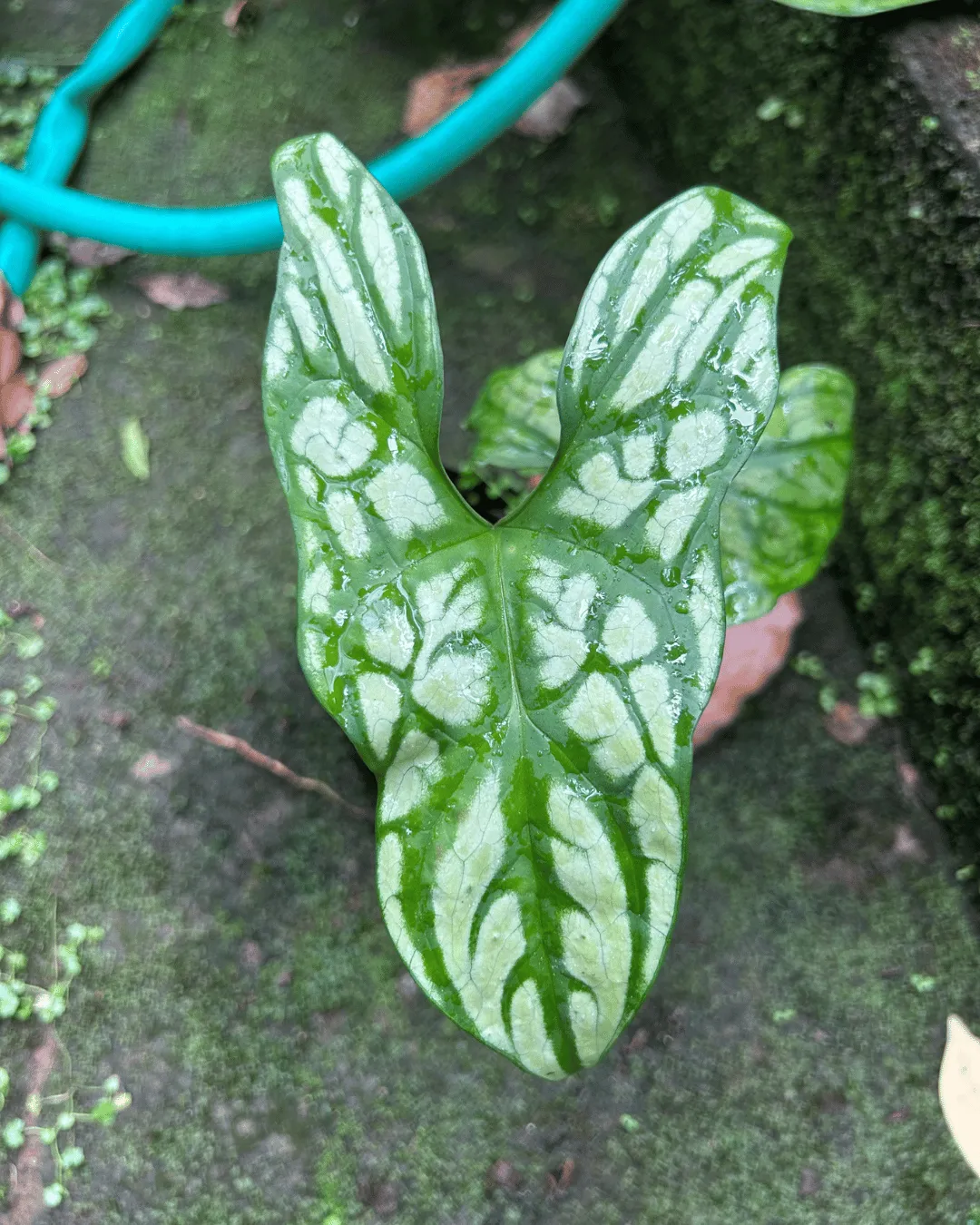
The juvenile leaves of Cercestis mirabilis are arrow-shaped — a shape botanists call sagittate. They are decorated with striking silvery-white or creamy-white markings along the veins. These markings create an embossed, textured effect on the leaf surface. Furthermore, the leaves are glossy and deeply veined, giving them a bold, sculptural look. As the plant matures, the leaves grow much larger — up to 60 cm (24 inches) long. Additionally, the adult leaves become solid deep green and broad, losing their silvery variegation over time. The petiole — the stalk that attaches the leaf to the stem — can grow 25–60 cm long in mature plants. Moreover, adult leaves may develop small perforations along the midrib as the plant reaches full maturity.
The stem is thick, up to 5 cm in diameter, and the plant climbs by producing clasping, adhesive roots. Primarily, this climbing habit means the plant loves a moss pole or a sturdy support structure. The overall growth habit is bold and architectural, making it a statement piece in any collection.
Flower and Fruit
Cercestis mirabilis produces flowers in the form of a spathe and spadix — a structure common to all members of the Araceae family. The spathe is a hood-like outer leaf or bract. It is pale green to yellow in color and grows about 10 cm (4 inches) long. The spadix is the central spike inside the spathe. It is shorter and thicker than the spathe, growing about 5 cm (2 inches) long. The individual flowers are small and not especially showy. However, when pollinated, the plant produces grape-sized, edible berries. These berries range from olive green to orange or red-pink when ripe. Furthermore, the fruit is noted to be rich in nutrients and vitamins. Flowering generally occurs in summer, given warm temperatures and adequate moisture.
Dormancy and Growth Rate
Cercestis mirabilis is a slow-growing plant. Consequently, each plant produces only 3–5 new leaves per year under typical indoor conditions. Additionally, the plant does not have a true dormancy period in warm tropical climates. However, growth slows significantly if temperatures drop below 15°C (59°F). Moreover, the plant may enter a rest phase during cooler months in non-tropical regions. Primarily, this slow growth adds to the rarity and collector value of each specimen. The plant grows year-round when kept warm, humid, and in bright, indirect light.
Global Seed Delivery & Phytosanitary Certification
At Induare Agro, we believe every collector deserves access to the world’s rarest plants. Consequently, we have built a professional global shipping system. Furthermore, we comply fully with international plant export regulations. Additionally, every seed order ships with official documentation. Primarily, our goal is to make your buying experience safe, legal, and worry-free.
Packaging and Shipping
Every seed we ship is carefully selected for freshness and viability. We use professional export-grade packaging to protect seeds during long international journeys. Furthermore, we ship via Global Express courier services to ensure fast, reliable delivery worldwide. Additionally, seeds are packed to maintain optimal moisture and temperature conditions during transit. Primarily, we focus on live arrival condition. We prepare each parcel with care so your seeds reach you in perfect planting condition.
Induare Agro has years of experience exporting rare and exotic seeds from Indonesia to collectors around the world. Moreover, our team handles all export paperwork professionally and efficiently.
Buyer Peace of Mind
Every order from Induare Agro includes a Phytosanitary Certificate. This is an official government-issued document. Consequently, it certifies that your seeds have been inspected and are free from pests and diseases. Furthermore, it is required by most countries for legal import of plant material. Additionally, this certificate protects you as a buyer and ensures smooth customs clearance. Primarily, it gives you full confidence that your order complies with international plant import regulations.
We are committed to legal, ethical, and responsible trade of rare plant seeds. Moreover, all our seeds are organically grown and handled without harmful chemicals. Induare Agro stands behind every order with professional customer service.
How to Grow Cercestis mirabilis
Follow these simple steps to successfully germinate and grow your Cercestis mirabilis seed.
Step 1: Prepare Your Growing Medium Use a well-draining, moisture-retentive mix of peat, perlite, and fine orchid bark. Make sure your pot or tray has good drainage holes to prevent waterlogging.
Step 2: Sow the Seed Place the seed on top of the moist growing medium. Press it gently into the surface — do not bury it deeply. Keep the medium consistently moist but never soggy.
Step 3: Create a Warm, Humid Environment Cover the pot with a clear plastic dome or place it inside a sealed clear bag. Maintain a temperature of 22–28°C (72–82°F) for best germination results.
Step 4: Provide Indirect Light Place the pot in a bright spot away from direct sunlight. Bright, filtered light encourages healthy sprouting. Additionally, a grow light works very well for germination.
Step 5: Be Patient Cercestis mirabilis seeds can take several weeks to germinate. Consequently, do not let the medium dry out during this period. Check moisture levels every 2–3 days.
Step 6: Transplant the Seedling Once the seedling has 2–3 leaves, transplant it carefully into a slightly larger pot. Furthermore, introduce a small moss pole or stake for the plant to begin climbing.
Step 7: Ongoing Care Maintain high humidity of 60–80% around the plant. Water when the top 2–3 cm of soil feels dry. Moreover, feed monthly with a diluted balanced fertiliser during the growing season.
