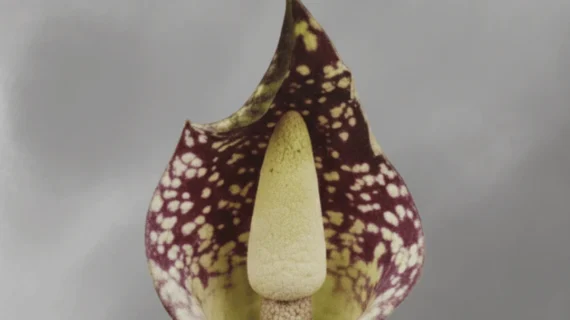
Amorphophallus beccarii
Amorphophallus beccarii is one of the most distinctive endemic aroids of Sumatra. Renowned for its remarkable variation in floral appearance, this species displays an impressive range of spathe colors, patterns, and forms while maintaining a recognizable vegetative structure. Its adaptability in appearance has long attracted the attention of taxonomists and plant enthusiasts alike.
Despite this variability, Amorphophallus beccarii possesses a consistent combination of characteristics that allows botanists to distinguish it from other Sumatran members of the genus. Its elegant inflorescence, patterned petiole, and specialized reproductive structures make it a fascinating species within the Araceae.
Taxonomic Overview
- Scientific Name: Amorphophallus beccarii Engl.
- Original Publication: Botanische Jahrbücher für Systematik 1 (1881): 182
- Synonyms:
- Amorphophallus cobra Alderw.
- Amorphophallus gracilis Engl.
- Amorphophallus incurvatus Alderw.
- Amorphophallus obovoideus Alderw.
- Amorphophallus subcymbiformis Alderw.
The species has accumulated several synonymous names over time, largely because of the extraordinary diversity observed in its inflorescence shape and coloration. Modern observations support the interpretation that these forms belong to a single, highly variable species.
Morphology of Amorphophallus beccarii
Tuber
The tuber is subglobose to somewhat depressed-globose and may reach approximately 10 cm in diameter. Raised areas occur on the surface, and the tuber does not produce offsets. Its coloration ranges from reddish to pinkish tones.
Leaf
A mature plant produces a solitary leaf.
The petiole measures approximately 30–90 cm in length and 1–2 cm in diameter. Its surface is smooth, glossy, and typically dark brown to reddish-brown. Numerous whitish spots decorate the petiole, becoming larger toward the upper portion.
The leaf blade reaches approximately 45–90 cm in diameter. The rachises are generally unwinged, although distal sections may become slightly winged. Certain branches can develop intercalary bulbils.
Leaflets are elongate-elliptic to lanceolate and vary from 6–28 cm long and 2–7 cm wide. Their texture is somewhat leathery, with a slightly glossy dark green upper surface and a paler lower surface marked by brownish veins.
Inflorescence
The inflorescence is solitary and borne on a long peduncle.
The peduncle ranges from 25–62 cm in length and approximately 0.6–1.5 cm in diameter, displaying a coloration similar to the petiole.
Spathe
The spathe stands erect or arches over the appendix. Its overall length ranges from approximately 7–24 cm.
The basal portion forms a strongly convolute tube that is narrowly tubular to somewhat campanulate. The limb is more or less spreading, concave, and occasionally furrowed.
Coloration varies considerably. External surfaces may range from entirely pale green to green with faint purplish flushing or whitish-green near the margins. Internal coloration is equally diverse, ranging from pale whitish-green to dark reddish-purple. Rounded whitish spots frequently occur across the limb.
The lower interior often develops pale pink, dark maroon, or purple wart-like structures that may merge into a densely ridged and corrugated pattern.
Spadix
The sessile spadix is generally shorter than the spathe and measures approximately 5.5–13 cm in length.
Female Zone
The female zone is cylindrical and slightly elongated, measuring approximately 1.5–2.2 cm long and 1–2 cm in diameter.
The ovaries are bright green, slightly depressed, and unilocular. Styles are extremely short or nearly absent. The stigma is subhemispheric with a faint central depression and a finely warted surface.
Male Zone
The male zone is fusiform and measures approximately 1.5–4 cm long and 2.5–7 cm in diameter.
Male flowers consist of four stamens. The anthers are truncate in shape and open through terminal pores. Pollen appears whitish to dirty white.
Appendix
The appendix varies from ovoid-triangular to elongate fusiform-conical. It is thick-walled, white in color, and typically 2.5–7 cm long with a diameter of 1.5–3.5 cm.
The apex is broadly obtuse and may bear staminodes. Some individuals possess diamond-shaped projections, occasionally accompanied by conical elevations separated by deep furrows. These structures gradually diminish toward the upper portions of the appendix.
Fruit
The berries are elliptic-ovate to slightly laterally flattened. Mature fruits become deep red and typically contain a single seed.


Distribution of Amorphophallus beccarii
The first occurrence of Amorphophallus beccarii is restricted to northern and western Sumatra, Indonesia.
The species is considered endemic to the island. Historical records indicate that the type locality was situated in Kayutanam, West Sumatra. Current observations confirm its presence across several suitable habitats within the western Sumatran region.
For additional taxonomic and occurrence records, consult:
- POWO: https://powo.science.kew.org/
- GBIF: https://www.gbif.org/
Habitat
Amorphophallus beccarii inhabits deep, shaded secondary forests. It frequently occurs near rivers, streams, and waterfall systems where humidity remains consistently high.
Known populations occur between approximately 100 and 1500 meters above sea level. These environments provide the moist and sheltered conditions that favor the development of both vegetative and reproductive structures.
Taxonomic Notes
Amorphophallus beccarii represents one of the most taxonomically challenging species within the Sumatran flora. The extraordinary variation observed in spathe shape, coloration, and ornamentation historically led botanists to describe multiple taxa that are now treated as synonyms.
Field studies have revealed no stable morphological character combination capable of consistently separating these forms into distinct species. Consequently, the names listed under synonymy are generally regarded as representing variations within a single, highly polymorphic species.
The species also shares the ability to produce foliar bulbils with Amorphophallus muelleri and Amorphophallus manta. However, the developmental origin of these bulbils differs. In A. beccarii, bulbils arise as modifications of entire branching points and detach only after leaf tissues begin to deteriorate.
This unique combination of vegetative and floral traits makes Amorphophallus beccarii readily distinguishable from other Sumatran species despite its remarkable variability.
Botanical Significance
Among endemic Sumatran aroids, Amorphophallus beccarii stands out for its exceptional morphological diversity. Few species within the genus exhibit such a broad spectrum of floral forms while retaining a coherent set of diagnostic vegetative characters.
Its adaptability, striking appearance, and taxonomic importance continue to make it a valuable subject for botanical research and conservation efforts across Sumatra.
References
- Engler, A. (1881). Amorphophallus beccarii. Botanische Jahrbücher für Systematik 1: 182.
- Yuzammi. Taxonomic treatment and field observations of Indonesian Amorphophallus species.
- Plants of the World Online (POWO): https://powo.science.kew.org/
- Global Biodiversity Information Facility (GBIF): https://www.gbif.org/


