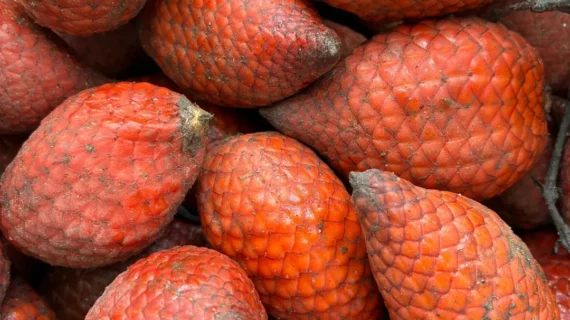
Salacca affinis: The Spiny Red Snakefruit of the Sundaland Rainforests
Deep within the swampy lowland rainforests of Borneo, Sumatra, and the Malay Peninsula grows a fruit that few outsiders ever taste. Salacca affinis, commonly called red salak or red snakefruit, hides its egg-shaped, scarlet fruit at the very center of a dense, spine-armed clump. Consequently, harvesting it demands patience and thick gloves, since the surrounding thorns can reach ten centimeters in length. Furthermore, this relative of the better-known Salacca zalacca, or common salak, remains largely unknown outside its native range, making it a genuine curiosity for collectors of rare tropical botanicals. This article explores its morphology, distribution, habitat, taxonomy, and economic relevance in detail.

Morphological Characteristics
Salacca affinis is a dioecious palm, meaning individual plants are either male or female. Additionally, it is acaulescent and cespitose, forming large clustered tufts rather than a single upright trunk. The stem itself usually stays underground or creeps along the soil surface, though older specimens can occasionally reach one to two meters in height.
Leaves and Petioles
The leaves are pale green and pinnate, growing up to sixty centimeters long. Primarily, what distinguishes this species visually is its petiole, which can extend a full meter and bristles with yellow-orange to brown spines arranged in clusters of two to four. Moreover, the rachis carries additional irregular spines, and the topmost leaflets display a distinctive toothed, almost torn appearance at their tips.
Flowers and Fruit
Male inflorescences are considerably larger than female ones, stretching fifty to one hundred centimeters and bearing individual flowers up to six centimeters long. Female inflorescences, by contrast, rarely exceed five centimeters. The fruit itself is ovate and tapers at both ends, measuring roughly eight centimeters long and four centimeters wide. It ripens to a deep red and is covered in smooth, flat, overlapping scales that resemble snake skin, hence the common English name. Each fruit typically holds up to three seeds surrounding a flesh that tastes sweet with a notably sour aftertaste, especially when compared to cultivated salak.
Distribution
According to POWO, the native range of Salacca affinis spans western Malesia. Specifically, populations occur across Peninsular Malaysia, Sumatra, Borneo, Java, and Singapore. Notably, the species was long presumed extinct in Singapore until its rediscovery in 2011 within the Nee Soon Swamp Forest, a finding that renewed conservation interest in the region’s freshwater swamp habitats. Consequently, researchers now regard the Nee Soon population as an important indicator of remaining lowland swamp biodiversity in the city-state. For distribution records and herbarium data, readers can consult GBIF and Plants of the World Online.
Habitat
Salacca affinis grows in the shaded understory of lowland tropical rainforests, particularly near ponds and swamp margins. It favors positions with high humidity and partial shade, sheltered from strong wind, and thrives in regions receiving more than 1,500 millimeters of annual rainfall. Additionally, the species prefers well-drained, slightly acidic to neutral soils rich in organic matter. It tolerates minimum temperatures around twenty degrees Celsius, though brief exposure to cooler conditions rarely causes lasting harm.
Taxonomic Notes
The species was formally described by botanist William Griffith in 1845. Its genus name, Salacca, derives from the Malay word “salak,” the regional term for this group of palms. The specific epithet affinis comes from the Latin phrase “ad finis,” meaning “at the boundary” or “closely related,” a reference to its resemblance to the congeneric Salacca zalacca. Furthermore, several synonyms exist in the taxonomic literature, including Salacca affinis var. borneensis, Salacca borneensis, and Salacca dubia, all now subsumed under the accepted name. Taxonomically, the genus Salacca belongs to the palm family Arecaceae, subfamily Calamoideae, tribe Calameae, and comprises roughly twenty species distributed across Southeast Asia and the eastern Himalayas.
Economic Value and Ethnobotany
Local communities across Sumatra and Borneo know this palm by various vernacular names, including linsum, ridan, buah manau, and kelubi, and gather its fruit informally rather than through organized cultivation. Primarily, the fruit is eaten fresh, valued for its sweet-sour flavor profile that some describe as reminiscent of asam paya. Research into marketable wild fruits of Sarawak has documented Salacca affinis, known locally as “asam ridan,” among species still gathered and sold in regional markets, though it remains a minor commodity compared to cultivated salak. Consequently, large-scale cultivation has never taken hold, primarily because the fruit of Salacca zalacca is considered superior in sweetness and market appeal. The plant’s formidable spines further discourage ornamental planting in gardens and public spaces, which keeps it confined mostly to botanical collections and its native forest habitat. Nevertheless, its rarity and striking scaled fruit continue to attract interest among palm enthusiasts and collectors of exotic Indonesian plants seeking organic, export-quality seed material with proper phytosanitary certification.
Conclusion
Salacca affinis exemplifies the quiet biodiversity hidden within Sundaland’s swamp forests. Its formidable spines, snake-scaled fruit, and localized folk names tell a story of a plant shaped entirely by its wild habitat rather than by cultivation. For collectors and researchers alike, sourcing seeds of such species through organizations like Induare Agro offers a rare opportunity to grow a genuine piece of Indonesia’s rainforest heritage, complete with proper export documentation and organic sourcing practices.
References
-
-
- Plants of the World Online. “Salacca affinis Griff.” Royal Botanic Gardens, Kew. Available at: https://powo.science.kew.org/
- GBIF Secretariat. “Salacca affinis Griff.” Global Biodiversity Information Facility. Available at: https://www.gbif.org/
- Monaco Nature Encyclopedia. “Salacca affinis.” Available at: https://www.monaconatureencyclopedia.com/salacca-affinis/?lang=en
- Palmpedia – Palm Grower’s Guide. “Salacca affinis.” Available at: https://palmpedia.net/wiki/Salacca_affinis
- Loo, A. H. B. “Rediscovery in Singapore of Salacca affinis.” Nature in Singapore / National Parks Board records.
- Shaffiq, M. A. et al. “Marketable Wild Fruits of Sarawak, Borneo: Their Mode of Consumption, Uses and Sugar Profiles.” ResearchGate.
- Wikispecies. “Salacca.” Available at: https://species.wikimedia.org/wiki/Salacca
-


