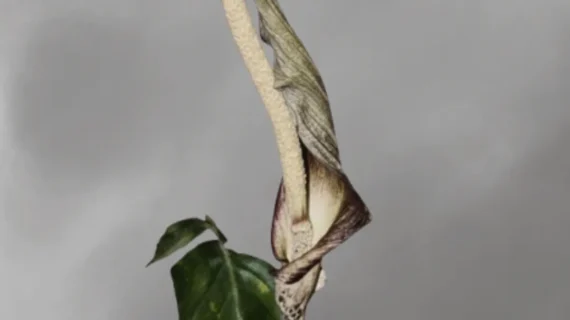
Amorphophallus costatus: A Rare Streamside Aroid Endemic to South Kalimantan
Among the most narrowly distributed members of its genus, Amorphophallus costatus Hett. stands as a botanical rarity known only from a single locality in South Kalimantan, Indonesia. Botanists formally described it in 1994 in the journal Blumea. Since then, it has not been recollected from the wild. Its compact inflorescence, distinctive cheesy scent at female anthesis, and highly restricted range make it one of the more intriguing members of this remarkable genus. This article introduces the species to curious readers and plant scientists alike.
Taxonomic Identity of Amorphophallus costatus
Amorphophallus costatus belongs to the family Araceae. Hetterscheid described it in Blumea 39 (1994): 247. No synonyms are currently recognized for this species.
The protologue description by Hetterscheid (1994) forms the taxonomic foundation for this species. Because researchers have not recollected it since the original description, all morphological data traces back to that single type collection.
Morphological Description
Tuber and Leaf
The tuber of Amorphophallus costatus is globose in shape. The plant produces a solitary leaf with a smooth petiole of approximately 60 cm in length and about 1.5 cm in diameter. The petiole background is whitish, but irregular and confluent dark emerald green spots largely cover it. These spots carry obscurely dark violet-brown upper margins and flushing patterns.
The lamina is large, reaching approximately 100 cm in diameter. Its rachises carry narrowly winged branches only at the distalmost segments. The leaflets are oblanceolate and acuminate, with a cuneate base. They measure 8–21 cm long and 2.5–5 cm wide. The upper leaflet surface is moderately glossy and dark green, with an irregularly undulate margin.
Inflorescence and Peduncle
The inflorescence of Amorphophallus costatus is solitary and short-peduncled. The peduncle measures 14–16.5 cm long and approximately 1 cm in diameter at the base. It shows a lilac-pink coloration marked with several blackish-green spots that are either elliptic or irregular in shape.
Spathe
The spathe is erect and elongate-triangular, 16–24 cm long and 8–10 cm in diameter. At the base, it is strongly convolute, forming a narrow tube. The limb terminates in a short acuminate tip. Its lower margin is outwardly reflected and subauriculate. Externally, the base is pinkish with brownish veins and a few punctiform blackish spots.
Internally, the lowermost zone of the base is dark maroon. The remaining interior transitions to dirty white or yellowish-white. The outer limb surface is dirty greyish-green with strongly raised dirty brownish-violet main veins. The inner limb surface is entirely glossy maroon and carries a few rounded dirty white spots. At the base, several shallow warts appear in a shortly ridge-like arrangement.
Spadix and Floral Zones
The spadix of Amorphophallus costatus exceeds the spathe in length. It is sessile and measures 19.5–26.5 cm long. The female zone is oblique-cylindric, 0.7–1.3 cm long and 0.8–1.1 cm in diameter. Its flowers are congested or somewhat distant.
The male zone is cylindric, 2.5–3 cm long and 0.8–1.1 cm in diameter. Its surface is densely rugulose. The ground color is a dirty pale yellow, strongly suffused with brownish tones. Notably, this zone gives off a strong cheesy smell during female anthesis.
Female Flowers
Each ovary is approximately pyriform in shape, about 1.5 mm tall and 1.2–1.4 mm in diameter. The base is white, while the rest of the ovary is blackish-maroon. Each ovary is unilocular. The style is inconspicuous and conic. It is bi- or trefurcate, slightly rugulose, approximately 0.5 mm long and 0.8 mm tall, and blackish-maroon. The stigma is often subapical, 2- or 3-lobed, thin, and verruculate. It carries some longer scabrae, is pale brown, 0.8–1 mm tall and 1 mm in diameter, with conic lobes.
Male Flowers
Each male flower carries 2–4 stamens. However, their individual limits are often obscured through fusion into irregular longitudinal ridges. Stamens reach approximately 2 mm in length. Filaments measure about 1.5 mm long, free at the base and connate up to 2/3 of their length. Anthers are subtruncate, rounded or elliptic in cross-section, approximately 0.5 mm long, and carry 1 or 2 thecae. Each theca consists of 1 or 2 locules. Pores are apical and rounded or elliptic. Pollen is irregularly striate to irregularly areolate.
(Morphological description as in the protologue; Hetterscheid 1994.)
Distribution of Amorphophallus costatus
Amorphophallus costatus is endemic to South Kalimantan, Indonesia. Specifically, it occurs at Datar Alei, west of Mount Batu Besar. As of the most recent published data, researchers know it only from this single type locality. Consequently, this makes it one of the most narrowly distributed species in the genus.
For occurrence data and distribution records, refer to GBIF – Amorphophallus costatus and the Plants of the World Online (POWO) – Kew.
Habitat
This species grows along stream margins at an altitude of approximately 400 m above sea level. Its streamside habitat and narrow elevational range suggest a strong dependence on specific microhabitat conditions. Furthermore, this ecological specificity adds to the conservation concern surrounding the species.
Taxonomic Notes

Amorphophallus costatus does not resemble any other Amorphophallus species currently known from Kalimantan. Therefore, confusion with sympatric congeners is unlikely. However, researchers have never recollected it since the original description, and the species may show greater morphological variation across its range than currently documented.
It is also worth noting that Amorphophallus rugosus from East Malaysia shows a very similar morphology in its spathe and spadix. Nevertheless, A. rugosus is easily distinguished by its much longer peduncle. This single character effectively separates the two species in the field.
References
- Hetterscheid, W.L.A. (1994). Amorphophallus costatus Hett. In: Blumea 39: 247.
- Kew Science. Amorphophallus costatus Hett. – Plants of the World Online. Available at: https://powo.science.kew.org/
- GBIF Secretariat. Amorphophallus costatus occurrence data. Global Biodiversity Information Facility. Available at: https://www.gbif.org/


