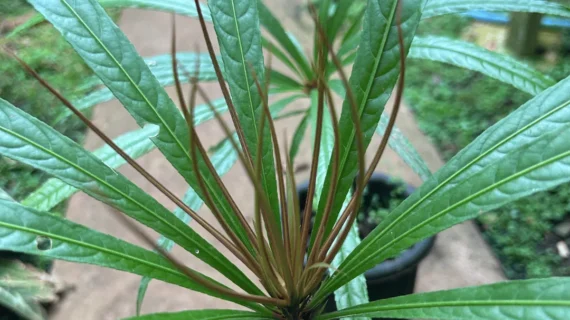
Barringtonia papuana: The Night-Blooming Kun-Job Tree of New Guinea
Few tropical trees combine ornamental drama with ethnobotanical significance as effectively as Barringtonia papuana Lauterb. This remarkable tree from New Guinea produces some of the most slender and elongated leaves in its genus — new leaves emerge in a deep burgundy red, gradually transitioning to rich glossy green as they mature. Furthermore, its showy flowers open exclusively at night, drawing in moths and bats as pollinators with their delicate brush-like clusters of pink to creamy-yellow stamens. Known locally as Kun-job in Maian, B. papuana belongs to the family Lecythidaceae — the same family as the Brazil nut (Bertholletia excelsa) and the cannonball tree (Couroupita guianensis). Botanists, horticulturists, and collectors increasingly prize this species for its bold tropical aesthetic and its place in the rich ethnobotanical traditions of Papua New Guinea.
Taxonomic Identity of Barringtonia papuana
Barringtonia papuana belongs to the family Lecythidaceae, subfamily Barringtonioidea, within the order Ericales. Lauterbach described it from specimens collected in New Guinea, and it was subsequently verified by Payens in his landmark 1967 monograph of the genus Barringtonia. No synonyms are currently recognized under the accepted name by the Plants of the World Online (POWO).
The genus Barringtonia J.R.Forst. & G.Forst. encompasses approximately 80 species distributed across the Old World tropics, from East Africa and Madagascar through tropical Asia to the Pacific Islands. The genus was named in honor of Daines Barrington (1727–1800), an English lawyer, naturalist, and Fellow of the Royal Society. Barringtonia papuana is one of several species endemic to New Guinea, a floristic hotspot within the Malesian region.
Note on related name: Barringtonia josephstaalensis W.N.Takeuchi, described in 2000 from Papua New Guinea’s Josephstaal Forest Management Area, is recognized by POWO as a separate species distinct from B. papuana, despite earlier confusion in horticultural literature.
Morphological Description
Habit and General Appearance
Barringtonia papuana is a small to medium-sized tree, growing up to 10 m in height under natural conditions. In cultivation it typically remains smaller and more compact. The trunk is erect and the canopy is notably crown-shaped, with leaves clustered near the branch tips — a typical pattern in the genus.
Leaves
The leaves of Barringtonia papuana are lanceolate, glossy, and among the most slender in the entire genus. Notably, new growth emerges as a vivid reddish color, creating a dramatic bicolored display when young and old leaves occur simultaneously on the same tree. As leaves mature, they transition fully to deep glossy green. The leaf blades are notably long, with some reports indicating lengths exceeding one metre on mature trees. Leaf venation is striking and clearly visible, adding to the ornamental appeal of the foliage.
Flowers
The flowers of Barringtonia papuana are cauliflorous and racemose, emerging directly on the trunk and main branches. Consequently, this cauliflorous habit produces a dramatic visual display. Flowers open at night and are large and showy. Each flower carries numerous long, filamentous stamens in pink or creamy-yellow tones that form a characteristic pom-pom-like brush structure typical of the genus. Petals are white to pale. The flowers close by morning, though the display repeats over multiple nights. Additionally, the flowers are pollinated by nocturnal visitors — moths and bats attracted to the abundant nectar and the pale, luminous colors visible in low light.
Fruits and Seeds
The fruits of Barringtonia papuana are fleshy and non-edible. They ripen from green through to a striking turquoise-blue color at full maturity. Seeds float readily, reflecting a typical Barringtonioid adaptation to hydrochory — dispersal by water. This floating ability allows seeds to travel considerable distances along waterways and coastal currents, a key factor in the dispersal ecology of the species across New Guinea’s river systems and coastal zones.
Distribution of Barringtonia papuana
Barringtonia papuana is native to New Guinea, growing in both the Papua New Guinea and Indonesian Papua (West Papua and Papua Provinces) portions of the island. According to POWO, its native range covers New Guinea, where it grows primarily in the wet tropical biome. In cultivation, it has established successfully in Singapore’s Gardens by the Bay and in various botanical collections in tropical Asia and beyond.
For verified occurrence data and georeferenced records, refer to GBIF – Barringtonia papuana and the Plants of the World Online (POWO) – Kew.
Habitat
Barringtonia papuana typically grows in coastal regions and swampy areas. More broadly, it occurs in lowland tropical rainforest, riverine forest, and near coastal margins — particularly in zones where soil remains consistently moist or seasonally waterlogged. This preference for wet, lowland conditions is consistent with the ecology of many species in the Barringtonia genus. Furthermore, the species tolerates partial shade and grows well under the canopy of larger coastal or riparian trees.
Ethnobotany and Traditional Uses
Barringtonia papuana shares an important ethnobotanical role with many of its relatives across the Pacific. Specifically, the bark of this species contains saponins and serves as a traditional fish poison. Communities crush the bark and add it to water, where it stuns or kills fish and allows for easier harvesting. Throughout the Pacific region, this method of fishing has been in use for generations.
Additionally, species within the Barringtonia genus serve as medicinal plants in various Pacific and Southeast Asian communities. Several relatives treat ailments such as pain, fever, and skin conditions. The fruit and seeds of related species similarly carry saponin-based toxic properties used in comparable fish-stunning traditions across the region.
In terms of horticultural value, B. papuana is an increasingly popular ornamental tree in tropical botanical gardens and private collections. Its combination of vivid new-growth coloration, enormous glossy leaves, and spectacular nocturnal flowers makes it a standout specimen. Gardens by the Bay in Singapore cultivates it in their Understorey Garden within the World of Plants, where it attracts nighttime visitors during bloom events.
Taxonomic Notes
The genus Barringtonia encompasses approximately 80 species and was named in honor of Daines Barrington, an English lawyer and naturalist (1727–1800). Within the genus, B. papuana belongs to section Barringtonia — those species with closed flower buds. The primary taxonomic authority for the genus remains Payens’ (1967) monograph published in Blumea, which comprehensively treated all species then known from the Malesian region.
Barringtonia papuana is closely allied to several other Papuan species. However, its distinctively slender, elongated, lanceolate leaves and its restricted distribution within New Guinea set it apart from broader-ranging relatives such as B. racemosa and B. asiatica. The species is considered among the most ornamentally appealing members of its genus precisely because of these leaf characters and its nocturnal flowering habit.
Photo Reference


References
- Payens, J.P.D.W. (1967). A monograph of the genus Barringtonia (Lecythidaceae). Blumea 15(2): 157–263.
- Govaerts, R. (1996). World Checklist of Seed Plants 2(1, 2): 1–492. MIM, Deurne.
- Takeuchi, W.N. (2000). A floristic and ethnobotanical account of the Josephstaal Forest Management Agreement Area, Papua New Guinea. Sida, Contributions to Botany 19(1): 1–63.
- Ng Yu Qin (2023). What’s Blooming: Barringtonia papuana. Gardens by the Bay, Singapore. Available at: https://www.gardensbythebay.com.sg/en/learn-with-us/explore-resources/whats-blooming/barringtonia-papuana.html
- NParks Flora & Fauna Web (2021). Barringtonia papuana Lauterb. National Parks Board, Singapore. Available at: https://www.nparks.gov.sg/florafaunaweb/flora/7/2/7242
- Kew Science. Barringtonia papuana Lauterb. – Plants of the World Online. Available at: https://powo.science.kew.org/taxon/urn:lsid:ipni.org:names:469132-1
- GBIF Secretariat. Barringtonia papuana occurrence data. Global Biodiversity Information Facility. Available at: https://www.gbif.org/species/3082749


