Cananga odorata: Getting to Know the Fragrant Tree of the Tropics
Few trees carry a reputation as sweetly scented as Cananga odorata. Walk beneath one in full bloom, and the air itself seems to change character, carrying notes that perfumers have chased for over a century. Primarily recognized today as the source of ylang-ylang oil, this species deserves attention well beyond the fragrance counter. Its story spans rainforest canopies, island folklore, and a taxonomic history that stretches back to the eighteenth century. This article introduces the species from a scientific standpoint, covering its morphology, distribution, habitat, taxonomic placement, and long-standing ethnobotanical uses.
Taxonomic Notes on Cananga odorata
Cananga odorata belongs to the custard-apple family, Annonaceae, within the subfamily Ambavioideae. Furthermore, it sits in a notably small genus: Cananga contains only two accepted species worldwide, the other being Cananga brandisiana. According to POWO, the accepted name Cananga odorata (Lam.) Hook.f. & Thomson was first published in Flora Indica, Systematic Account, volume 1, page 130, in 1855.
The species carries a somewhat tangled synonymy. Its basionym is Uvaria odorata Lam., published in 1785, and several homotypic synonyms have accumulated since, including Canangium odoratum (Lam.) Baill. ex King and Unona odorata (Lam.) Dunal. Additionally, taxonomists recognize two infraspecific taxa: the typical variety, Cananga odorata var. odorata, and a naturally dwarfed shrub form, Cananga odorata var. fruticosa (Craib) J.Sinclair, which rarely exceeds 1.5 meters in height and is often cultivated ornamentally for its compact habit and curled petals. Consequently, gardeners encounter two rather different growth forms under the same species name.
Morphological Description
Cananga odorata is a fast-growing evergreen tree that can reach heights of 12 to 18 meters under typical conditions, with exceptional individuals recorded up to around 33 meters. The trunk is generally straight, the bark pale grey, and the young twigs carry fine pubescence that disappears with age, leaving older branches dark and distinctly striate. Primarily, the crown develops a spreading, somewhat pendulous form as the tree matures, giving older specimens their characteristic drooping silhouette.

The leaves are simple, alternate, and arranged along the twigs without stipules. Blades are ovate-oblong to elliptic-oblong, typically measuring 10 to 21 centimeters long and 4 to 10 centimeters wide. The apex tapers into an oblique acuminate point, while the base is broadly cuneate, rounded, or truncate. Moreover, the underside remains lightly pubescent along the midrib and lateral veins, and the venation stands out prominently against the blade surface.
Flowers and Fruit
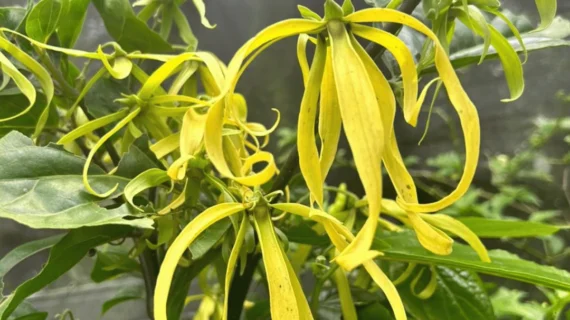
The flowers form the species’ most distinctive feature. They hang in drooping clusters of two to six blooms within the leaf axils, each flower carrying an intense, sweet fragrance that intensifies toward evening. Three small, triangular sepals sit beneath six narrow petals arranged in two whorls of three. The petals begin pale green and twisted, gradually relaxing and turning pale yellow as the flower matures, with a small purple-brown spot marking the base of each petal’s inner surface. Individual petals measure roughly 5 to 7.5 centimeters in length, occasionally reaching nearly 9 centimeters.
Internally, each flower holds numerous stamens and multiple free carpels, whose stigmas fuse into a single domed structure at the flower’s center. Research into floral development shows that a flower requires around 35 days to progress from bud to senescence, with the female-receptive phase occurring roughly half a day to a full day before the male phase becomes active. This protogynous timing reduces self-pollination and favors cross-pollination between different trees.
After successful pollination, the flower develops into an aggregate fruit composed of numerous separate monocarps, generally 10 to 16 per cluster. Each monocarp is smooth, ellipsoid to oblong-obovoid in shape, and measures 1.5 to 2.3 centimeters long. The fruit ripens from green to a deep purple-black color and contains several small, flattened seeds embedded in soft pulp, which birds readily consume and disperse.
Distribution
According to POWO (Plants of the World Online, Royal Botanic Gardens, Kew), the native range of Cananga odorata extends from southern Indo-China through Malesia to Queensland, Australia. Countries and regions within this native range include Vietnam, Thailand, Peninsular Malaysia, Borneo, Sumatra, Java, Sulawesi, the Lesser Sunda Islands, the Philippines, New Guinea, the Solomon Islands, and Queensland.
Consequently, the species has become one of the most widely naturalized aromatic trees in the tropics. Introduced populations now grow across South and Southeast Asia (India, Sri Lanka, Bangladesh, Myanmar, Cambodia, Laos, southern China, and Taiwan), throughout much of tropical Africa (including Kenya, Tanzania, Senegal, Guinea, and the Comoros), across Pacific island groups (Fiji, Samoa, Tonga, the Society Islands, and the Caroline Islands, among others), and into the Caribbean and Central America (Cuba, Haiti, the Dominican Republic, Puerto Rico, Costa Rica, Nicaragua, and Guatemala). Records for both native and introduced distribution are maintained by POWO and cross-referenced through occurrence data on GBIF, which compiles herbarium and field observation records worldwide.
Habitat Preferences
Cananga odorata grows primarily within the wet tropical biome, favoring humid lowland forest but tolerating a fairly broad elevation range. Recorded occurrences span from near sea level up to roughly 2,200 meters above sea level, though the species performs best in warm, consistently moist lowland conditions. Habitat classifications associated with the species include lowland and hill forest, woodland margins, savanna edges, shrubland, and disturbed or artificial terrestrial sites, reflecting its tolerance for secondary and cultivated landscapes as well as intact forest.
Soils range from sandy to clay loam, and the tree tolerates brief waterlogging, though it performs best in rich volcanic or fertile sandy substrates with good drainage. The IUCN Red List assessed Cananga odorata in 2021 and classified it as Least Concern, reflecting its wide native distribution, large population size, and extensive naturalization across introduced ranges.
Economic Value and Ethnobotany
The essential oil distilled from Cananga odorata flowers, commercially known as ylang-ylang oil, ranks among the most important natural materials in the global perfume industry. Producers typically steam-distil freshly harvested flowers, yielding an oil valued for its complex profile, often described as sweet, floral, and slightly spicy. Additionally, this oil has appeared as a component in numerous celebrated fragrances, underscoring the species’ commercial significance well beyond its native range.
Beyond perfumery, communities across the species’ range have long applied Cananga odorata in traditional medicine and daily life. In parts of Indonesia, dried flowers have served as a treatment against malaria symptoms, while fresh flower paste has been applied to ease asthma discomfort, and leaves have been rubbed onto skin to relieve itching. In Tonga and Samoa, bark preparations have functioned as a treatment for stomach ailments and occasionally as a laxative. The wood also carries practical value: Indonesian craftspeople have historically produced rope fiber from the beaten bark, while the timber itself has served in local construction, canoe-building, and matchstick manufacturing.
Cultural uses extend further still. Fresh flowers appear in Indonesian wedding customs, where petals are traditionally strewn across the marital bed, and the blooms are commonly woven into leis and floral offerings during regional festivities. Ornamentally, Cananga odorata also functions as a fast-growing shade and roadside tree throughout much of tropical Asia and the Pacific, appreciated as much for its shade canopy as for its fragrance.
Closing Notes
Cananga odorata combines taxonomic distinctiveness, striking floral morphology, and centuries of practical use into a single, remarkably adaptable tropical tree. Its wide native range across the Indo-Pacific, paired with even wider naturalization, illustrates how effectively this species has traveled alongside human cultivation. For growers and researchers alike, the tree offers a compelling case study in how a single fragrant flower can shape agriculture, trade, and cultural tradition across an entire region.
References
- Plants of the World Online (POWO). Cananga odorata (Lam.) Hook.f. & Thomson. Royal Botanic Gardens, Kew. Available at: https://powo.science.kew.org/taxon/urn:lsid:ipni.org:names:72580-1
- Global Biodiversity Information Facility (GBIF). Cananga odorata, GBIF Backbone Taxonomy. Available at: https://www.gbif.org/
- Govaerts, R., Nic Lughadha, E., Black, N., Turner, R. & Paton, A. (2021). The World Checklist of Vascular Plants, a continuously updated resource for exploring global plant diversity. Scientific Data 8: 215. DOI: 10.1038/s41597-021-00997-6
- Verdcourt, B. (1971). Annonaceae. Flora of Tropical East Africa: 1–131.
- Johnson, D.M. & Murray, N.A. (eds.) (2022). Flora of Thailand 16(1): 1–332. The Forest Herbarium, Royal Forest Department.
- Turner, I.M. & Veldkamp, J.F. (2009). A history of Cananga (Annonaceae). Gardens’ Bulletin Singapore 61(1): 189–204.
- World Agroforestry Centre. Cananga odorata, Agroforestree Database species profile.
- Wu, Z. & Raven, P.H. (eds.) (2011). Flora of China 19: 1–884. Science Press (Beijing) & Missouri Botanical Garden Press (St. Louis).
-


