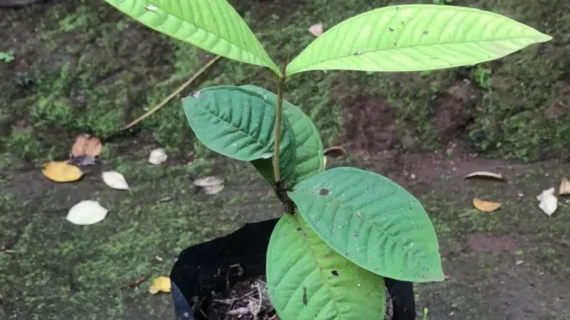
Syzygium versteegii: A Rare Rainforest Tree from New Guinea
Deep within the lowland rainforests of New Guinea grows a tree that few outside its native range have ever seen. Syzygium versteegii is an evergreen species prized by botanists and rare-plant collectors alike for its oversized foliage and striking pink blossoms. Primarily known from Papua, this tree remains largely absent from international horticulture, which only adds to its appeal. Consequently, anyone encountering Syzygium versteegii for the first time is looking at a genuine botanical rarity rather than a common ornamental. This article introduces the species in detail, covering its morphology, distribution, habitat, taxonomy, and economic significance.
Morphological Description
Growth Habit and Trunk
Syzygium versteegii typically reaches 15 metres in height, though exceptional specimens can climb to 35 metres in favourable forest conditions. The bole is usually straight and cylindrical, growing up to 45 centimetres in diameter. Additionally, mature trees often develop buttresses at the base, sometimes reaching a metre high, which help anchor the tree in shallow tropical soils. The trunk can remain unbranched for as much as 20 metres before the crown begins. Furthermore, this tall, clean bole makes the species structurally similar to many other canopy trees in the Myrtaceae family.
Leaves, Flowers, and Fruit
The foliage of this species is unusually large for the genus. According to horticultural sources, leaves can grow between 28 and 50 centimetres long and 12 to 19 centimetres wide, giving the canopy a bold, dramatic texture. Young leaves reportedly emerge pale pink before maturing to deep green. Moreover, the flowers are pink and carry numerous stamens, a common trait among Myrtaceae species. Bees and other insects act as the primary pollinators. Following pollination, the tree produces dark red, fleshy fruit roughly 5 centimetres long and 3 centimetres in diameter, each containing a single large seed.

Distribution
The native range of Syzygium versteegii is New Guinea, according to Plants of the World Online (POWO), the authoritative checklist maintained by the Royal Botanic Gardens, Kew. Records held by GBIF further confirm occurrences across the island, including areas within Papua, Indonesia. The species grows primarily within the wet tropical biome. Consequently, its distribution is tightly linked to the humid, high-rainfall forests that dominate the island’s lowlands. Outside New Guinea, the species is rarely documented, and it remains largely unknown in cultivation elsewhere in the world.
Habitat
Syzygium versteegii grows as a sub-canopy to canopy tree within lowland rainforest. Field records place it at elevations up to 125 metres above sea level, placing it firmly among lowland rather than montane flora. The species thrives in dense, consistently humid forest conditions where rainfall remains high throughout the year. Additionally, its preference for lowland rainforest aligns it with many other Myrtaceae trees native to the region, which similarly rely on stable moisture and filtered light beneath a closed canopy.

Taxonomic Notes
Syzygium versteegii (Lauterb.) Merr. & L.M.Perry belongs to the family Myrtaceae. The species was first described as Jambosa versteegii by Lauterbach, published in Nova Guinea in 1910. Merrill and Perry later transferred it into the genus Syzygium, publishing this recombination in the Journal of the Arnold Arboretum in 1942. This kind of reclassification was common during the twentieth century, as botanists worked to consolidate the older genus Jambosa into the broader Syzygium.
The genus Syzygium itself is enormous, comprising an estimated 1,200 to 1,800 species distributed from Africa and Madagascar through South Asia to the Pacific. The highest concentration of diversity occurs between Malaysia and northeastern Australia. Notably, many New Guinea species, including this one, remain poorly studied, and taxonomic revisions continue to refine their classification. No specific conservation assessment for this species is currently available.
Economic Value and Ethnobotany
Local communities in New Guinea harvest Syzygium versteegii from the wild, primarily for its timber. The wood is occasionally traded, though it is not a major commercial species. Like other Syzygium timbers, the heartwood is typically golden brown to greyish brown, sometimes showing pink or purplish tones, with a fine texture and slightly interlocked grain. Consequently, the wood suits applications such as tool handles, furniture components, flooring, and general joinery. The fruit is possibly edible, though documentation on culinary use remains limited.
Beyond timber, this species holds growing appeal among rare-plant collectors and botanical enthusiasts. Its dramatic leaf size and striking pink flowers make it a sought-after specimen for tropical gardens and serious private collections. Moreover, seeds are propagated most successfully when sown fresh, shortly after the fruit ripens.
Closing Thoughts
Syzygium versteegii represents one of New Guinea’s lesser-known botanical treasures. Its combination of towering stature, oversized leaves, and vivid pink blooms sets it apart within an already remarkable genus. As interest in rare, exotic, and organically harvested plant seeds continues to grow worldwide, this species stands as a compelling example of the botanical diversity still waiting to be appreciated beyond its native rainforest.
References
- Plants of the World Online (Kew Science). Syzygium versteegii (Lauterb.) Merr. & L.M.Perry. Available at: https://powo.science.kew.org/
- Global Biodiversity Information Facility (GBIF). Syzygium versteegii occurrence records. Available at: https://www.gbif.org/
- Conn, B.J. & Damas, K.Q. Guide to the Trees of Papua New Guinea. Available at: http://www.pngplants.org/PNGtrees/
- Merrill, E.D. & Perry, L.M. (1942). Journal of the Arnold Arboretum, Vol. 23: 256.
- Useful Tropical Plants Database. Syzygium versteegii. Ken Fern, tropical.theferns.info.
- World Flora Online. Syzygium versteegii (Lauterb.) Merr. & L.M.Perry. Available at: http://www.worldfloraonline.org/


