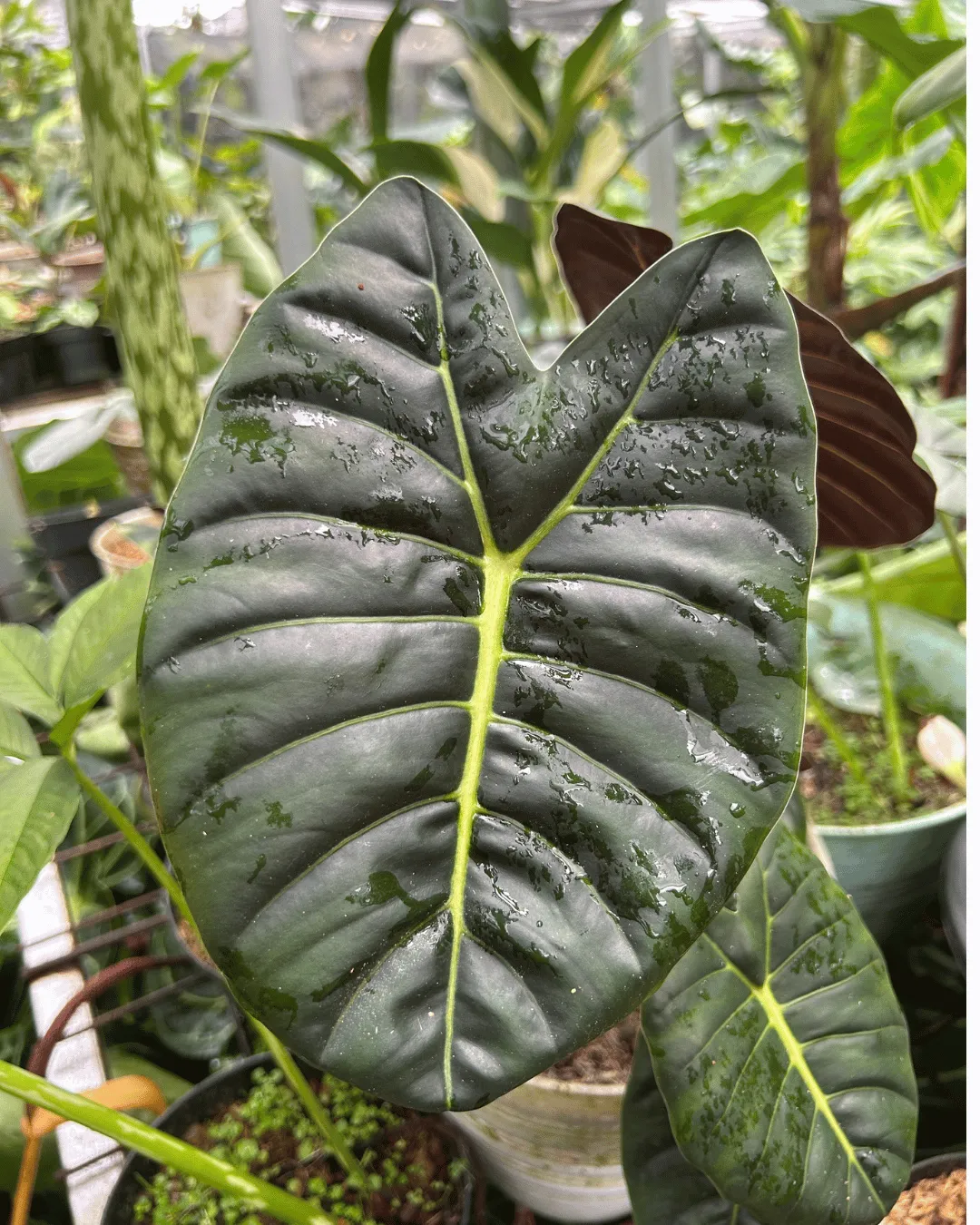
What Is Alocasia Golden Bone?
Alocasia golden bone is a rare and captivating hybrid aroid that originates from the lush tropical jungles of Indonesia. It is believed to be a natural hybrid of Alocasia micholitziana ‘Green Velvet,’ native to the Philippines, and Alocasia cuprea, native to the island of Borneo. An Indonesian grower named Astri Yanto first introduced Alocasia golden bone to the global market in 2006. She reportedly obtained a specimen from a friend who collected it from the jungle. This origin story adds a deep sense of mystery and rarity to the plant.
Consequently, Alocasia golden bone sits at the very top of most collectors’ wish lists. The plant belongs to the Araceae family — a large group of tropical flowering aroids. Furthermore, its unusual coloring and strong visual contrast set it apart from most plants in this genus. It thrives naturally in the warm, humid, shaded understory of Southeast Asian rainforests. Additionally, its adaptation to forest shade makes it well-suited for bright indoor spaces. Because it is difficult to source as a true species specimen, demand far outstrips supply on the global market. Moreover, seeds from verified Indonesian origin — shipped legally with proper documentation — are especially prized among international rare plant enthusiasts.
Aesthetic Features Alocasia Golden Bone
Alocasia is a genus of broad-leaved, perennial tropical plants in the family Araceae, native to tropical and subtropical Asia. Alocasia golden bone showcases the finest visual traits of both its parent species. Furthermore, it combines the velvet texture of A. micholitziana with the metallic surface sheen of A. cuprea. The result is a plant of extraordinary visual impact. Primarily, collectors value it for one thing above all else: its striking leaf appearance.
Leaf Structure Alocasia golden bone
The leaves of Alocasia golden bone are broad, shield-shaped, and slightly leathery to the touch. Their surface has a smooth, semi-glossy finish with a subtle velvet quality in lower light. Additionally, the leaf margins are gently wavy, adding a sense of motion and drama to each blade. The most iconic feature is the vivid lime-green to golden-yellow veins — this is where the name “golden bone” originates. These veins run boldly across a deep, dark green background. Consequently, the contrast is dramatic and immediately eye-catching. Moreover, in strong indirect light, the leaf surface can reveal hints of bronze and teal. The leaves grow in an upright, compact habit and can reach 50–70 cm in height under ideal indoor conditions. Furthermore, each new leaf that unfurls appears to outdo the last in color intensity and vein definition.
Flower and Inflorescence Alocasia golden bone
Alocasia golden bone produces a flower structure known as an inflorescence — a cluster of tiny blooms on a central spike. The central spike is called a spadix — a finger-like stalk holding the tiny flowers. This spadix is wrapped in a spathe — a hood-like outer leaf that protects it. Furthermore, the inflorescence of Alocasia golden bone is dark reddish in color. It closely matches the deep maroon tones seen on the underside of the leaves. Additionally, the undersides of mature leaves display a rich burgundy-maroon coloration. This abaxial — meaning underside — coloring adds another layer of beauty to an already stunning plant. Primarily, however, collectors grow this plant for its foliage rather than its flowers.
Dormancy Cycle
Like all Alocasia species, Alocasia golden bone follows a natural dormancy cycle. A corm — a swollen, bulb-like underground stem that stores nutrients — powers this cycle. When temperatures drop below 15°C (60°F) or light levels fall significantly, the plant withdraws energy from its leaves. Consequently, leaves may yellow, drop, or appear to die back. This is completely normal behavior. Moreover, the corm remains alive underground, storing energy for regrowth. Additionally, dormancy typically lasts 8 to 12 weeks in standard indoor conditions. Furthermore, once light and warmth return in late winter or early spring, new growth emerges from the corm center. Primarily, growers should stop watering heavily during dormancy. This prevents root rot — the most common cause of corm failure. A firm corm means a living plant; always check firmness before discarding.
Global Seed Delivery & Phytosanitary Certification
Induare Agro is Indonesia’s trusted source for rare, exotic, and export-quality tropical plant seeds. Furthermore, we understand that buying rare seeds internationally requires full confidence in quality, legality, and safe arrival. Consequently, we have built a professional, end-to-end export process that protects every buyer. Moreover, all seeds are grown and harvested organically. We never use synthetic treatments or harmful chemicals in our propagation process.
Packaging and Shipping
Induare Agro ships all orders via Global Express courier services. Furthermore, every seed is packed using professional moisture-control packaging. This protects the seed’s viability during transit across any climate or distance. Additionally, we seal each package carefully to prevent damage from temperature changes or humidity during shipping. Primarily, our goal is for every seed to arrive in planting-ready condition. Moreover, tracking is provided so buyers can monitor their order at every stage of its journey.
Buyer Peace of Mind
Every order from Induare Agro includes an official Phytosanitary Certificate. A Phytosanitary Certificate is a government-issued document that proves the seeds are pest-free, disease-free, and legally cleared for international export. Furthermore, this certificate is required by customs authorities in most countries. Consequently, buyers avoid delays, confiscation, or legal issues at their local border. Additionally, the certificate proves your seeds come from a legitimate, inspected source in Indonesia. Moreover, this makes Alocasia golden bone seeds from Induare Agro fully compliant with international plant import regulations. Primarily, this documentation gives collectors complete peace of mind. You are purchasing export-quality seeds from a trusted, professional Indonesian supplier.
How to Grow Alocasia Golden Bone
Follow these steps to grow Alocasia golden bone successfully from a corm or seed.
Step 1 – Prepare Your Germination Environment Set up a warm, high-humidity enclosure such as a propagation box or a sealed container with moist sphagnum moss. Maintain a temperature between 25–30°C (77–86°F) at all times. Stable warmth is the single most important factor for triggering germination.
Step 2 – Prepare the Corm Gently peel away the outer brown shell of the corm to reveal the white or cream-colored flesh beneath. Soak the corm in room-temperature water for 1–2 hours before planting. Be careful not to damage the pointed tip — this is where the new leaf will emerge.
Step 3 – Plant the Corm Place the corm on moistened sphagnum moss with the pointed tip facing upward. Do not bury it in soil at this stage. Cover the container to maintain 80–90% humidity around the corm.
Step 4 – Wait for Root Development Roots will begin to emerge within 2–4 weeks under warm, stable conditions. Keep the environment humid and avoid direct sunlight during this period. Patience is essential — do not disturb the corm while roots are forming.
Step 5 – Transplant to Soil Once the corm has developed several roots and at least one formed leaf, transplant it to a well-draining mix. Use a blend of 40% coco coir, 30% perlite, and 20% orchid bark for best results. Water lightly after transplanting and place in bright, indirect light.
Step 6 – Ongoing Care Maintain humidity above 60% and keep temperatures above 18°C (65°F). Water when the top 2–3 cm of soil feels dry. Additionally, fertilize monthly during the growing season with a balanced liquid fertilizer at half strength.
