Amorphophallus gigas: Sumatra’s Colossal Corpse Flower Revealed
Few plants on earth match the sheer scale of Amorphophallus gigas Teijsm. & Binn. This Sumatran giant is one of the largest aroids in the world. Its inflorescence reportedly reaches up to 4.36 metres in height, and its tuber can weigh up to 70 kg. Teijsmann and Binnendijk formally described it in 1862 in the Natuurkundig Tijdschrift voor Nederlandsch-Indië. Since then, it has fascinated botanists and plant collectors for its extraordinary dimensions and dramatic appearance. Endemic to Sumatra, this species grows in secondary forests and draws immediate attention whenever it flowers — an event as rare as it is spectacular.
Taxonomic Identity of Amorphophallus gigas
Amorphophallus gigas belongs to the family Araceae. Teijsmann & Binnendijk described it in Natuurk. Tijdschr. Ned.-Indië 24 (1862): 329. One synonym is currently recognized:
- Conophallus gigas
This synonym reflects an earlier generic circumscription before the species moved into its current accepted genus.
Morphological Description
Tuber and Leaf
The tuber of Amorphophallus gigas is depressed-globose. Reports indicate it can weigh up to 70 kg, making it one of the heaviest tubers in the plant kingdom. It produces no annual offsets. The plant bears a single solitary leaf per growing season.
The petiole is impressive, reaching 3–3.5 metres in length and 11–12 cm in diameter. Its surface is smooth or slightly rugose near the base, and dark green with numerous large and small, rounded to elongate-oval, pale green spots. The lamina grows to at least 3 metres in diameter. Its rachises carry broad wings distally. Leaflets are elongate-elliptic and long-acuminate, with an acumen 3–3.5 cm long. They measure 13–25 cm long and 5–9 cm in diameter.
Inflorescence and Peduncle
The inflorescence of Amorphophallus gigas is long-peduncled and reportedly reaches up to 4.36 metres in total height. The peduncle alone extends 2–2.5 metres in length. Its surface pattern matches the petiole. This extraordinary peduncle height, combined with the long spadix, places A. gigas among the tallest flowering structures of any non-branched inflorescence known to science.
Spathe
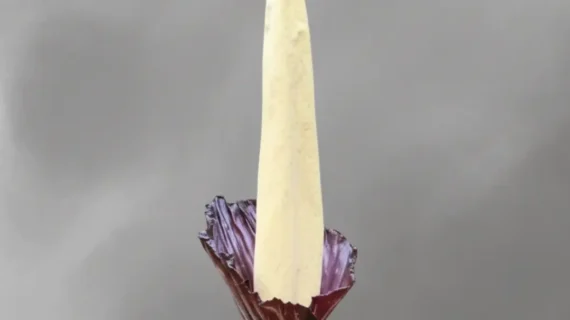
The spathe is campanulate, erect, and broadly ovate, measuring 55–60 cm in length. Externally, the base is dark olive-green with obscure ring-like, paler spots. The upper portion transitions from dark green to pale green, with a dark red-brown margin. Internally, the base is pale green with reddish-brown spots and reddish veins. The margin is plicate-sinuous, and all veins are strongly raised. The entire inner surface carries a bold, sculptured appearance.
Spadix and Floral Zones
The spadix of Amorphophallus gigas is sessile and longer than the spathe, reaching approximately 150 cm in length. The female zone is slightly obconic and approximately 7.5 cm long. Its flowers are well-spaced and distant from one another. The male zone is strongly obconic, approximately 2 cm long, with congested flowers.
The appendix is elongate-conic, acute to obtuse at the apex, and reaches approximately 140 cm in length and 25 cm in diameter. Its surface is pale brownish. This enormous appendix, which acts as a heat source to volatilize scent compounds, gives the species much of its impressive visual stature.
Female Flowers
Each ovary is globose to slightly ovate, with a flattened base. It measures approximately 4 mm in diameter and 3.5–4 mm tall. In cross-section it is circular to subangular, and bilocular to trilocular, with one basal ovule per locule. The style is elongate and slender, tapering toward the stigma. Its base is sometimes slightly thickened, and an articulation sits at 7 mm from the base. The style measures 2–3 (–3.5) mm long and approximately 1.5 mm in diameter at the base, tapering to about 1 mm at the top. It is laterally compressed. The stigma is small and shallowly bilobed, slightly laterally compressed, approximately 1 × 1.4 mm in diameter and about 1 mm tall. Its surface is minutely rugulose, with rounded lobes.
Male Flowers
Each male flower carries 3–5 stamens. Stamens reach 4 mm in length. Filaments are short, approximately 1 mm long, and basally connate. Anthers are approximately 3 mm long and 2–2.5 (–3) mm in diameter. They are subrectangular in cross-section with a subtruncate top. A longitudinal groove runs across the connective. Pores are apical and elongate before anthesis, approximately 0.5 mm long.
Fruit and Seed
Berries are one- or two-seeded. They begin green, then turn yellow, followed by orange, and finally a fiery red at full maturity. One-seeded berries measure 1.3–1.6 cm long and 0.8–0.9 cm wide. Two-seeded berries measure up to 1.2 cm wide. In shape, they are obovate (one-seeded) or broadly conic and laterally flattened (two-seeded). The base is truncate and broadly subacute. The style scar is rounded, with no style remnant remaining.
Seeds are elongate-elliptic and flattened on one side. The rhaphe is distinct. Seeds measure 1.1–1.2 cm long and 0.7 cm in diameter. The seed coat is shallowly rugose, predominantly blackish or greyish-black, variously marked with yellowish-brown small spots that may be confluent.
Distribution of Amorphophallus gigas
Amorphophallus gigas is endemic to Sumatra, Indonesia. Within Sumatra, it grows across a range of elevations and secondary forest types, though it does not occur outside the island.
For verified occurrence data and distribution records, refer to GBIF – Amorphophallus gigas and the Plants of the World Online (POWO) – Kew.
Habitat
This species favors secondary forests, particularly in open canopy gaps on slopes. Young plants often grow gregariously in clusters, while older individuals tend to be solitary and isolated. It also occasionally grows near paddy fields. The species tolerates a wide elevational range, occurring from sea level up to approximately 1,200 m altitude.
Taxonomic Notes
In overall morphology, Amorphophallus gigas closely resembles A. decus-silvae from West Java. Both species share very similar vegetative architecture and inflorescence structure, and both reach extraordinary dimensions. Nevertheless, several consistent floral differences separate them reliably. A. decus-silvae produces smaller stigmas, longer and more slender styles, shorter stamens, and anthers with very obtuse angles and rounded pores — in contrast to the characters seen in A. gigas. For a detailed morphological comparison, the reader should refer to the entry for A. decus-silvae in the source monograph.

References
- Teijsmann, J.E. & Binnendijk, S. (1862). Amorphophallus gigas Teijsm. & Binn. In: Natuurk. Tijdschr. Ned.-Indië 24: 329.
- Kew Science. Amorphophallus gigas Teijsm. & Binn. – Plants of the World Online. Available at: https://powo.science.kew.org/
- GBIF Secretariat. Amorphophallus gigas occurrence data. Global Biodiversity Information Facility. Available at: https://www.gbif.org/


