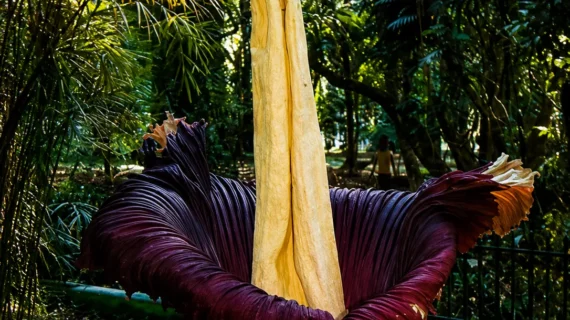
Amorphophallus titanum: The World’s Largest Inflorescence from Sumatra’s Rainforests
No plant on earth produces a larger unbranched inflorescence than Amorphophallus titanum (Becc.) Becc. This Sumatran giant holds a world record that has fascinated scientists and the public since Beccari first described it in 1879 in the Bulletin of the Tuscan Horticultural Society. Its inflorescence can reach up to 3.8 m in height, and its tuber can weigh up to 120 kg. The plant produces one leaf at a time — a single structure so large it resembles a small tree. When the inflorescence opens, it emits a powerful odor of rotting flesh to attract insect pollinators. Botanic gardens around the world draw thousands of visitors each time a titan arum blooms. Endemic to Sumatra, this species is both a botanical icon and an IUCN-listed endangered plant in the wild.
Taxonomic Identity of Amorphophallus titanum
Amorphophallus titanum belongs to the family Araceae. Beccari described it in Bull. Soc. Tosc. Ortic. 4 (1879): 46. Two synonyms are recognized:
- Amorphophallus selebicus Nakai
- Conophallus titanum Becc.
Both reflect earlier treatments before the species settled into its current accepted name and genus placement.
Morphological Description
Tuber and Leaf
The tuber of Amorphophallus titanum is depressed-globose, reaching 1 metre or more in diameter. Tubers weighing up to 120 kg have been recorded, including at the Botanical Gardens in Bonn, Germany. The surface is brown with many grouped accessory buds. The interior is dirty white, very soft, and greasy. The tuber produces no offsets. The plant bears a single solitary leaf per growing cycle.
The petiole is 1–5 m in length and 20–30 cm in diameter at the base. It is turgid and smooth, green or dark green, with large, oval to rounded, pale green spots. The lamina reaches up to 7 m in diameter. Leaflets are elongate-elliptic, up to 40 cm long and 20 cm wide, acuminate, leathery, and moderately glossy on the upper surface. A single leaf may last up to 16 months. After the leaf dies down completely, the tuber enters dormancy for 1 to 3 years before producing another leaf or an inflorescence.
Inflorescence and Peduncle
The inflorescence of Amorphophallus titanum is solitary and short-peduncled. The peduncle measures 30–70 cm long and 10–15 cm in diameter, colored like the petiole. In fruit, the peduncle elongates to approximately 150 cm. The total inflorescence height ultimately depends on tuber weight and can range from 85 cm up to 3.8 m — the record was recently measured at Cibodas Botanic Gardens. The smallest tuber recorded producing an inflorescence weighed 9 kg. Furthermore, leaves and inflorescences never appear simultaneously on the same plant.
Spathe
The spathe is campanulate and very broadly triangular, 40–160 cm long and up to 2 m in diameter. The limb is spreading and rim-shaped, with a plicate margin bearing many small, triangular, obtuse lobes. The veins of the limb are strongly developed and raised. The outer base surface is pale green with whitish spots, transitioning toward the margin into dirty purplish-brown. The inner base surface is purplish, above which a broad, dirty yellowish zone follows. The limb is dark purplish-brown. The base interior is verrucate. Notably, the entire spathe sheds at the fruiting stage.
Spadix and Floral Zones
The spadix of Amorphophallus titanum is sessile and much longer than the spathe, ranging from 1 to 3 m in length. The female zone is conic, 12–43 cm long and 8–17 cm in diameter. Flowers in the female zone are distant. The male zone is obconic, 6–35 cm long. At the base it measures 5.5–15 cm in diameter; at the top, 8–20 cm. Lower flowers in the male zone are slightly distant, while upper flowers are congested. The appendix is elongate-fusiform and obtuse, 80–200 cm long and 10–25 (–50) cm in diameter at the base. Its color is dirty yellowish-white or with a faint purplish hue. The surface carries one or a few irregular, shallow grooves and folds, and is densely rugose. The appendix heats up during bloom to volatilize scent compounds, drawing pollinators from a wide radius.
Female Flowers
Each ovary is ovate to approximately conic, about 6 mm in diameter and 6–8 mm tall. In cross-section it is circular. Each ovary is 2- or 3-locular, with one basal ovule per locule. The basal half is whitish; the remainder is brownish-purple. The style is slender, 14–22 mm long. At the base the diameter is approximately 3 mm; at the top it narrows to about 2 mm. The style is blackish-purple. The stigma is depressed-globose, approximately 2–3 mm in diameter and 1.5–2 mm tall. It is entire or with a very shallow central depression, greyish-brown or purple. The surface is densely verrucate.
Male Flowers
Each male flower carries 3–7 stamens. Stamens are 4–5 mm long. Filaments are 2–3 mm long and basally to nearly entirely connate. Anthers are 2 mm long and 1.5–4 mm in diameter, truncate, and whitish. Pores are apical, small, and oval at anthesis. Pollen is rounded and exine smooth, 110–140 µm in diameter.
Fruit
The infructescence is long-peduncled and slightly conic. The fruiting portion reaches up to 75 cm long and 30 cm in diameter. Berries number in the several hundreds, and are elongate, 4–5 cm long and 2–3.5 cm in diameter, 2-seeded. They ripen from orange-red to fiery red. All berries in one infructescence ripen near-simultaneously.
Distribution of Amorphophallus titanum
Amorphophallus titanum is endemic to Sumatra, Indonesia. Within Sumatra, it occurs across a range of elevations and forest types. However, its populations continue to face pressure from habitat loss.
For verified occurrence data and georeferenced records, refer to GBIF – Amorphophallus titanum and the Plants of the World Online (POWO) – Kew.
Habitat
Amorphophallus titanum grows frequently on very steep mountain slopes, in semi-open young secondary forest, and sometimes in backyards near forest edges. It is strongly adapted to steep terrain and grows well on limestone cliffs or in areas where soil erosion is regular. It tolerates a wide elevational range, from sea level up to approximately 1,200 m altitude.
Taxonomic Notes
Amorphophallus titanum holds an unparalleled place in botanical history. Its inflorescence attracts many visitors to botanic gardens whenever it blooms, and several institutions live-stream the blooming event. The inflorescence size directly reflects the weight of the tuber: heavier tubers produce taller inflorescences. Tubers recorded at 120 kg at the Bonn Botanical Gardens represent the upper known limit.
The species produces only one leaf per growing season. After that leaf dies down completely, the tuber enters a dormant period lasting 1 to 3 years. It then produces either another leaf or an inflorescence — never both at the same time. Furthermore, the smallest tuber recorded producing an inflorescence weighed just 9 kg, demonstrating that even younger, smaller tubers can flower under the right conditions. Consequently, the titan arum follows one of the most unusual growth and reproductive cycles in the entire plant kingdom.
Photo Reference
The following photographs illustrate Amorphophallus titanum (Photos: Tatang Rohana):

References
- Beccari, O. (1879). Amorphophallus titanum (Becc.) Becc. In: Bull. Soc. Tosc. Ortic. 4: 46.
- Yuzammi, Kurniawan, A., Asih, N.P.S., Erlinawati, I. & Hetterscheid, W. (2017). The Amorphophallus of Indonesia. Center for Plant Conservation Botanic Gardens, Indonesia.
- Kew Science. Amorphophallus titanum (Becc.) Becc. ex Arcang. – Plants of the World Online. Available at: https://powo.science.kew.org/taxon/urn:lsid:ipni.org:names:84474-1
- GBIF Secretariat. Amorphophallus titanum occurrence data. Global Biodiversity Information Facility. Available at: https://www.gbif.org/species/2871605
-


