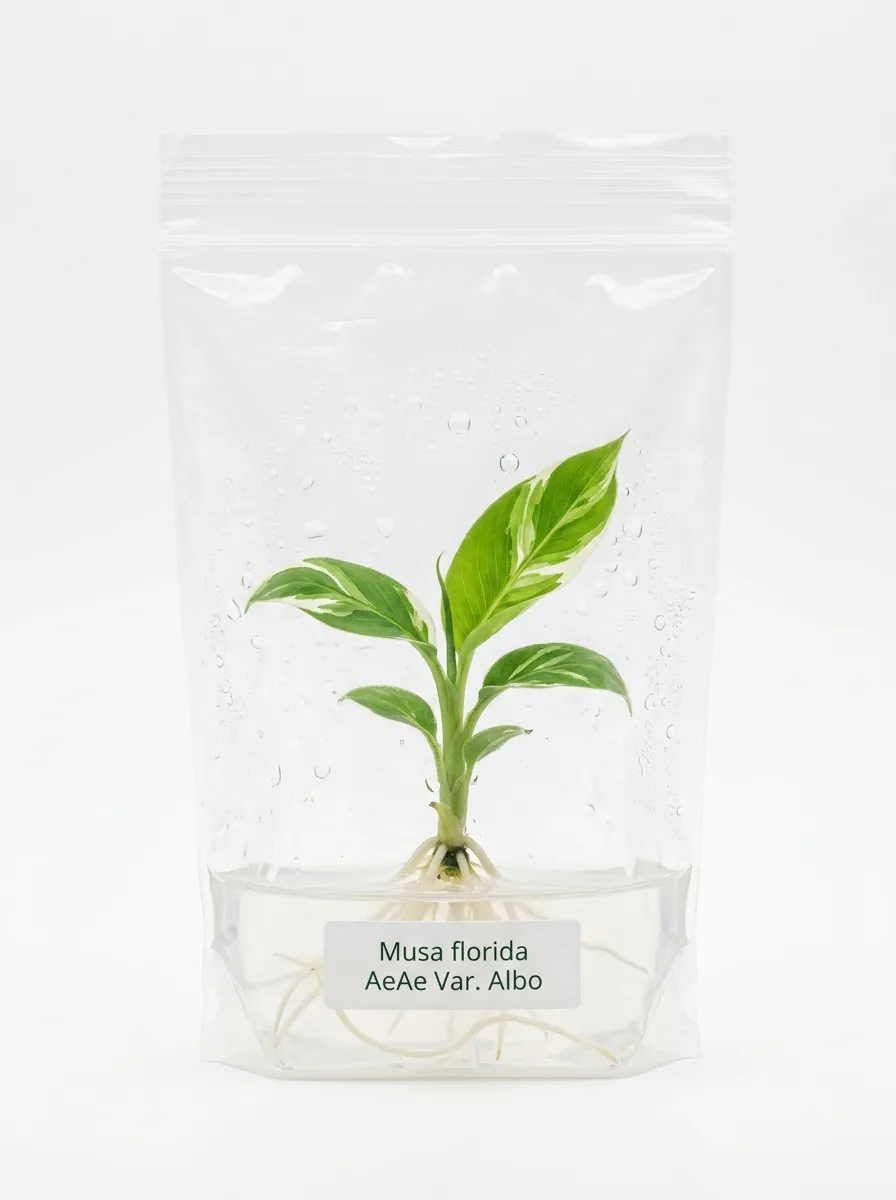
What Is Musa florida AeAe?
Musa florida AeAe is a rare variegated banana prized by plant collectors worldwide. Its exact origin remains debated among growers and researchers. Many trace this variety back to Southeast Asia, where wild bananas first developed. Additionally, some believe it later reached Hawaii, where it earned the nickname “Hawaiian AeAe.” Consequently, its striking white-and-green striping made it a favorite among royalty and collectors alike. Today, this banana remains difficult to source, which adds to its global appeal.
Aesthetic Features Musa florida AeAe Var. Albo
This variety belongs to the genus Musa, known for its large tropical foliage and diverse ornamental forms. Additionally, this particular variegated form stands out for its dramatic color contrast.
Leaf Structure Musa florida AeAe Var. Albo
The leaves grow large and paddle-shaped, typical of the banana family. Furthermore, each leaf displays bold white and cream streaks against deep green. This variegation pattern differs slightly from leaf to leaf, making every plant unique. Moreover, collectors value this natural variation as part of the plant’s charm.
Color and Pattern Musa florida AeAe Var. Albo
The stem and petioles carry the same white striping seen on the leaves. Additionally, some specimens show bright pink ridges along the stalks. This combination of white, green, and pink creates a striking visual display. Primarily, this coloring is the main reason collectors seek this variety.
Growth Habit Musa florida AeAe Var. Albo
This banana grows moderately fast under warm, humid conditions. Consequently, it needs consistent heat to maintain steady growth. Unlike common fruiting bananas, this variety requires more careful attention. Moreover, variegated leaves contain less chlorophyll, which slows overall vigor compared to solid green bananas.
Why Choose Tissue Culture Over Seeds or Cuttings
Tissue culture offers major advantages over traditional propagation methods. Furthermore, this variegated banana rarely produces viable seeds, making tissue culture the most practical option.
Genetic Consistency
Tissue culture plantlets share identical genetics with the mother plant. This process, called true-to-type propagation, keeps the exact variegation pattern intact. Consequently, buyers receive a plant that matches the original parent stock closely. Additionally, this consistency removes the guesswork common with seed-grown bananas.
Disease-Free Guarantee
Every plantlet grows inside a sterile lab environment. This controlled setting — a space free from pests, fungi, and bacteria — eliminates common banana diseases. Moreover, Panama disease and other soil-borne pathogens have no chance to spread through tissue culture stock. Consequently, collectors gain long-term peace of mind.
Global Plantlet Delivery & Phytosanitary Certification
Induare Agro ships living plant material safely to collectors worldwide. Furthermore, every shipment follows strict international plant health standards.
Packaging and Shipping
Each plantlet travels inside a sealed, sterile pouch with agar-based nutrient gel. Additionally, this packaging protects the roots and prevents contamination during transit. Induare Agro ships every order through trusted global express couriers. Consequently, buyers receive their plants quickly and in stable condition.
Buyer Peace of Mind
Every shipment includes an official Phytosanitary Certificate — a document confirming the plant is pest-free and legally approved for export. Moreover, this certificate allows smooth customs clearance in most countries. Induare Agro stands behind every plantlet with full transparency.
How to Acclimatize Musa florida AeAe
Step 1: Open the sterile pouch carefully in a clean, indoor space. Avoid direct sunlight during this first step.
Step 2: Rinse the roots gently with lukewarm water. This removes leftover agar gel completely.
Step 3: Plant the plantlet in a light, well-draining seedling mix. Keep humidity high using a clear cover or propagator.
Step 4: Place the plant in bright, indirect light. Avoid direct sun until new growth appears.
Step 5: Gradually reduce humidity over 2–4 weeks. Consequently, the plant adjusts safely to normal room conditions.


