
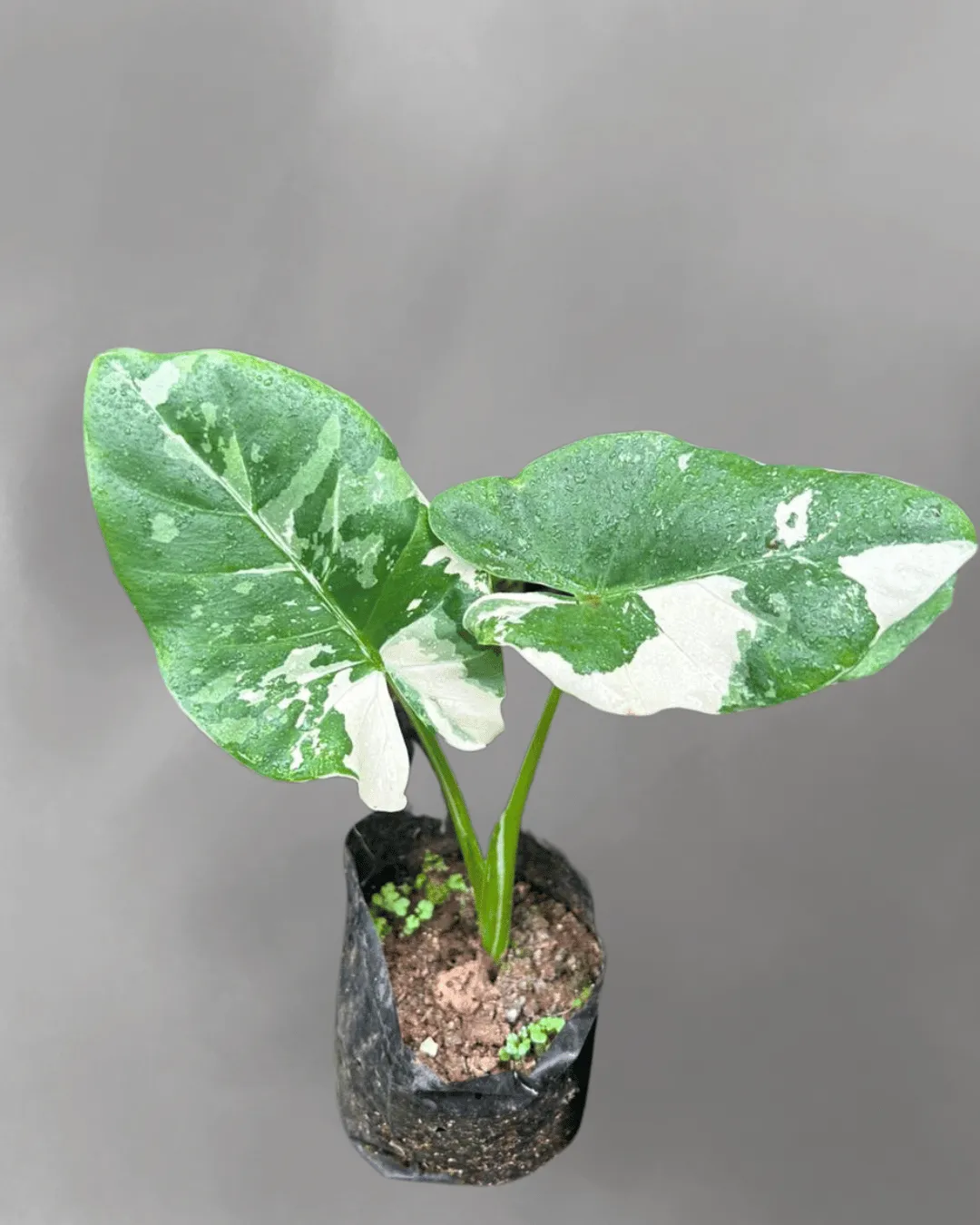
What Is Alocasia macrorrhiza Variegata?
Alocasia macrorrhiza Variegata is one of the rarest and most dramatic foliage plants in the world. It belongs to the Araceae family and is native to the tropical and subtropical regions of Southeast Asia, the Pacific Islands, and eastern Australia. Furthermore, the species grows naturally in humid rainforests where warmth, shade, and moisture are constant throughout the year. Collectors across Europe, North America, and East Asia prize this plant above almost all other aroids.
What makes this variety truly special is its variegation. Variegation means the leaves display two or more colors — in this case, deep glossy green mixed with large patches of creamy white. Primarily, this coloring happens because of a natural genetic change in the plant’s cells. No two leaves are ever the same. Consequently, every single plant is one of a kind — a fact that drives enormous demand worldwide.
Additionally, this plant is extremely difficult to source. It cannot be mass-produced in the same way as regular green Alocasia. Furthermore, seeds are available only in limited quantities during certain seasons. Induare Agro works directly with verified Southeast Asian growers to source these seeds legally and professionally. Consequently, Induare Agro is one of the very few suppliers in the world offering this variety through a fully documented export process.
Aesthetic Features Alocasia macrorrhiza Variegata
Alocasia macrorrhiza Variegata is a bold, imposing plant. It grows upright and commands attention in any space. The overall form is tall and structured. Furthermore, it can reach 3–4 metres in height when fully grown in ideal conditions. The spread of the plant can reach up to 1–3 metres wide. Consequently, it works beautifully as a statement plant in gardens, conservatories, hotel lobbies, and large indoor spaces.
Leaves
The leaves are the star feature of this plant. Each one is large, glossy, and broadly heart-shaped or arrow-shaped. They grow on thick, rigid stalks that hold the leaf face upward and outward. Furthermore, each leaf can exceed one metre in length at full maturity. The deep green base color is broken up by irregular patches of creamy white. Additionally, these white patches contain no green pigment — called chlorophyll — which means they cannot absorb sunlight. Consequently, the plant needs extra care and consistent feeding to stay healthy and vibrant. The stems themselves can also show variegation. Moreover, this gives the entire plant — not just the leaves — a highly decorative look.
Flowers and Fruit
Alocasia macrorrhiza Variegata can produce flowers in the right conditions. The flower grows on a structure called a spathe — a curved, hood-like leaf — which is green and turns yellow over time. Inside sits the spadix — a thin, upright spike — which is white when fresh. Furthermore, the spathe and spadix together form the full flower unit. After flowering, the plant produces small red fruits. Additionally, each fruit holds seeds inside. Primarily, the plant is grown for its dramatic foliage rather than its flowers or fruit.
Growth Pattern and Dormancy
This plant is evergreen in warm, stable climates. It keeps its leaves year-round when temperatures stay above 15°C. Furthermore, it grows actively during the warm months. In cooler seasons, growth slows down significantly. Primarily, this rest period allows the plant’s underground stem — called a rhizome — to store energy. Consequently, the plant re-grows strongly when warmer conditions return. Additionally, the rhizome produces new growth points over time, which can be divided to create new plants.
Global Seed Delivery & Phytosanitary Certification
Induare Agro is a professional botanical seed exporter based in Indonesia. The company sources rare and exotic Southeast Asian plant species for collectors and institutions worldwide. Furthermore, Induare Agro follows a strict, fully documented export process for every order. Consequently, buyers in more than 50 countries can receive their seeds legally, safely, and on time.
Packaging and Shipping
Induare Agro wraps every seed carefully in moisture-control material. Cushioned express packaging protects the seed throughout the entire journey. Shipments go out via Global Express couriers such as DHL and EMS. Additionally, most international orders arrive within 5–14 business days. Furthermore, every parcel includes an official Phytosanitary Certificate. This document is issued by Indonesia’s Plant Health Authority. It confirms that the seeds are free from pests, disease, and controlled pathogens. Consequently, it meets the import requirements of customs offices in the EU, USA, UK, Australia, Japan, and most other countries worldwide.
Buyer Peace of Mind
Induare Agro puts full compliance at the centre of every shipment. The Phytosanitary Certificate and commercial invoice travel with every parcel. Furthermore, this complete documentation ensures smooth, fast customs clearance at every destination. Additionally, the Induare Agro team provides after-sales growing support. Primarily, the goal is to make sure every collector receives a healthy seed — and has everything they need to grow it into a thriving plant.
How to Grow Alocasia macrorrhiza Variegata
Growing Alocasia macrorrhiza Variegata from seed requires patience and attention. Furthermore, growers in tropical and subtropical climates will find it most straightforward. Collectors in cooler regions can succeed indoors with a warm, humid setup. Follow these steps for the best results:
Step 1 — Seed Preparation Soak the seed in warm water (25–28°C) for 12–24 hours before planting. Additionally, this softens the seed coat and helps water reach the inside faster.
Step 2 — Growing Medium Mix 40% coco coir, 30% orchid bark, and 30% perlite for a light, well-draining blend. Consequently, this mix holds moisture while allowing the roots to breathe freely.
Step 3 — Sowing Plant the seed about 1–2 cm deep in a small pot with drainage holes. Furthermore, keep the growing mix evenly moist — not wet — throughout the sprouting stage.
Step 4 — Temperature Maintain a temperature of 22–28°C at all times. Primarily, consistent warmth is the most important factor for successful germination. A heated propagation mat works very well in this stage.
Step 5 — Humidity Keep humidity above 60% around the pot at all times. Additionally, a clear plastic dome or humidity tent placed over the pot helps maintain the right level. High humidity is essential for this species.
Step 6 — Light Place the pot in bright, indirect light. Furthermore, avoid direct sunlight at this stage. Strong direct sun can scorch the seedling and slow early growth significantly.
Step 7 — Watering Water the seedling when the top layer of soil begins to feel dry. Consequently, this avoids the two biggest risks: root rot from overwatering and stress from drying out. Never let the pot sit in standing water.
Step 8 — Feeding and Ongoing Care Apply a balanced liquid fertiliser at half strength every 4 weeks during the active growing season. Additionally, a fertiliser higher in nitrogen supports strong, large-leaf development. Furthermore, repot the plant each year into a slightly larger container to give the rhizome more room to grow.
© Induare Agro — Indonesia’s professional rare seed exporter.
