
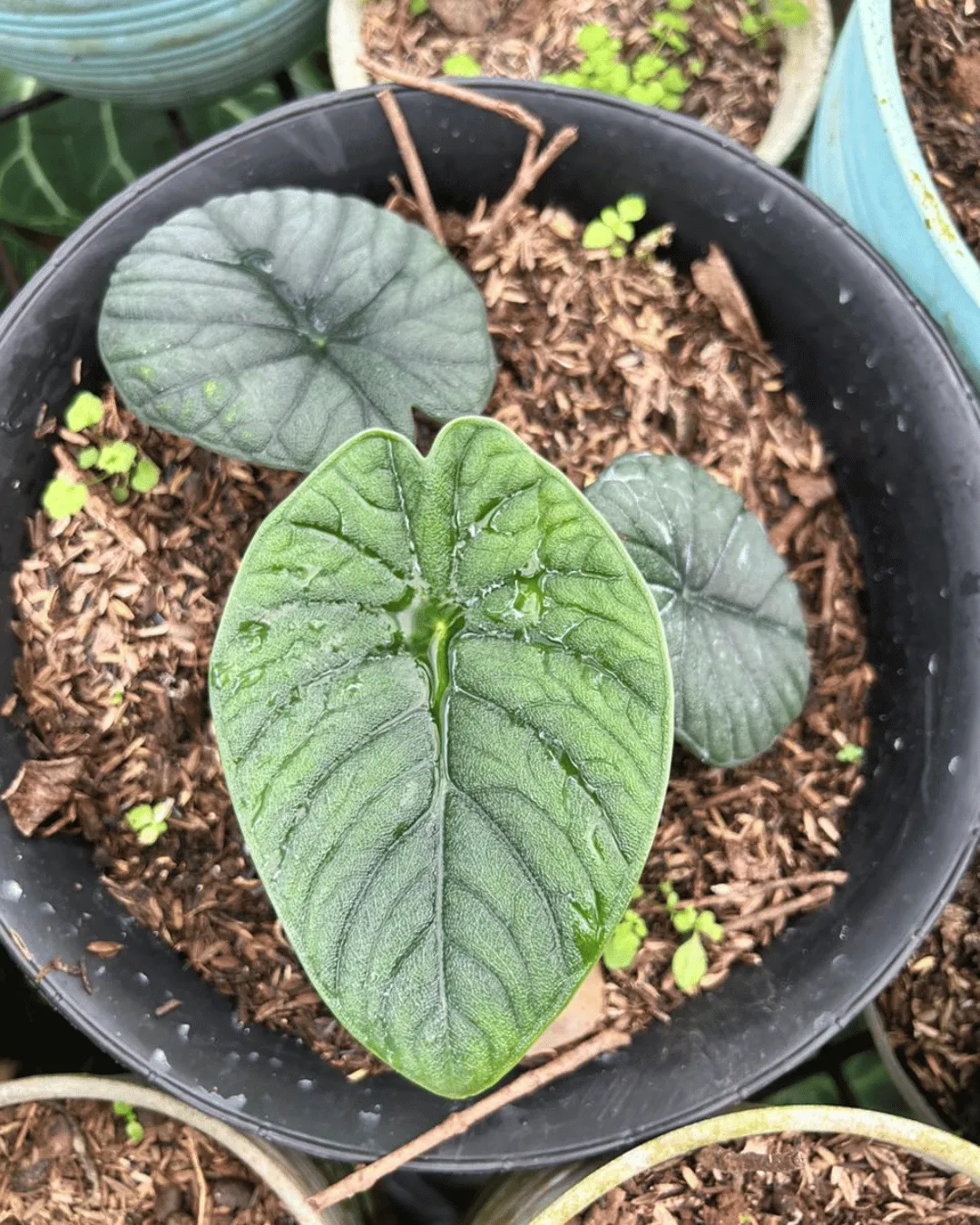
What Is Alocasia melo badak?
Alocasia melo badak is one of the rarest jewel aroids in the world. It is native to Sabah, in Malaysian Borneo. The plant grows on rocky, mineral-rich slopes at elevations between 120 and 400 metres. Furthermore, it lives in a very specific type of soil called ultramafic substrate — a rare, mineral-heavy rock environment found only in certain parts of Borneo. This means the plant is adapted to conditions that very few other species can survive.
The name melo refers to the plant’s thick, bumpy leaves — which look like the wrinkled skin of a cantaloupe melon. Additionally, the name badak comes from the Malay word for rhinoceros. Consequently, this plant is widely known as the Rhino Skin Alocasia — a name that perfectly describes the tough, deeply textured surface of its extraordinary leaves.
Collectors worldwide place this species at the top of their wish lists. Furthermore, its extreme rarity in the wild and limited availability on the global market make it one of the most sought-after aroids in existence. Induare Agro offers authenticated seeds of this remarkable species. Primarily, every seed is fresh, organic, and backed by full export documentation. This gives collectors worldwide a legal and verified path to growing this rare Bornean jewel.
Aesthetic Features Alocasia melo badak
Alocasia melo badak is a compact, deeply textured plant unlike any other in the aroid world. It reaches a mature height of 30–50 cm. This makes it a perfect size for indoor collections, plant cabinets, and small tropical displays. Furthermore, its small size does not reduce its impact. Every single leaf commands attention on its own.
Leaf Texture and Colour
The leaves are the defining feature of this plant. They are thick, stiff, and heavily corrugated — meaning the surface is covered in deep ridges and channels. Additionally, the texture feels almost like carved stone or a car tyre. Many people pick up the leaf and assume it is plastic. The colour of young leaves is a bright jade green. Furthermore, as the leaves mature, they deepen to a rich blue-green or dark slate tone. This colour shift adds another layer of visual drama as the plant grows. The surface channels are bold and dark, creating a strong contrast against the green blade.
Leaf Shape and Size
Each leaf blade is wide and nearly round in shape. It measures 18–25 cm in length and up to 15 cm in width. The leaf stalk — called a petiole — is pale green and smooth. It grows 14–19 cm long and shows faint burgundy markings near the base. Consequently, even the leaf stalk adds to the plant’s visual character. The plant typically holds 3–4 leaves at a time, growing in a tight, upright cluster from a short central stem.
Flowers and Growth Habit
Alocasia melo badak does produce flowers. However, they are small, cream-coloured, and appear infrequently. The flower consists of a spadix — a small central spike — wrapped in a spathe — a hood-like outer leaf bract. Furthermore, the flowers have no fragrance. Consequently, this plant is grown entirely for its extraordinary leaf display rather than its blooms. The plant is perennial, meaning it regrows year after year from its underground corm — a bulb-like storage organ beneath the soil. Additionally, it grows at a moderate pace, producing one dramatic new leaf at a time.
Global Seed Delivery & Phytosanitary Certification
Induare Agro is a professional botanical seed exporter based in Indonesia. The company specialises in rare, exotic, and hard-to-source Indonesian plant species. Furthermore, Induare Agro ships to collectors, botanical gardens, and plant institutions in more than 50 countries worldwide. Every order follows a strict, fully documented export process.
Packaging and Shipping
Induare Agro wraps every seed carefully in moisture-control material. Cushioned express packaging keeps the seeds safe throughout the full transit journey. Shipments go out via Global Express couriers such as DHL and EMS. Additionally, most international orders arrive within 5–14 business days. Furthermore, every parcel includes an official Phytosanitary Certificate. This certificate is issued by Indonesia’s Plant Health Authority. It confirms that the seeds are pest-free, disease-free, and meet all international plant import standards. Consequently, it satisfies customs requirements in the EU, USA, UK, Australia, Japan, and most other regulated markets.
Buyer Peace of Mind
Induare Agro takes legal compliance seriously. Every order ships with full documentation — including the Phytosanitary Certificate and a commercial invoice. Furthermore, this means customs clearance is smooth and fast at every destination. Additionally, the Induare Agro team provides after-sales growing guidance. Primarily, the goal is to make sure every collector successfully sprouts and establishes their rare Alocasia melo badak from day one.
How to Grow Alocasia melo badak
Alocasia melo badak rewards growers who respect its natural rocky habitat. Furthermore, it grows well in containers in tropical, subtropical, and controlled indoor environments. Follow these steps for the best results from seed to established plant.
Step 1 — Seed Preparation Rinse the seed gently in clean water before planting. Additionally, soak it in warm water (25–28°C) for 12–24 hours to soften the outer coat and encourage faster sprouting.
Step 2 — Growing Medium Use a highly aerated, fast-draining mix: 40% orchid bark, 30% perlite, and 30% coco peat or fine compost. Consequently, this replicates the rocky, low-nutrient soil of its Bornean native habitat.
Step 3 — Sowing Plant the seed just below the surface — no more than 1 cm deep. Furthermore, place it in a small pot with drainage holes. Keep the medium lightly moist at all times during germination.
Step 4 — Temperature and Humidity Maintain a temperature of 22–28°C and humidity of 60–80% at all times. Primarily, warmth and humidity are the two most important factors for successful germination and early growth.
Step 5 — Light Place the pot in bright, indirect light. Additionally, avoid any direct midday sun. A. melo badak grows naturally under forest canopy, so filtered light best matches its needs.
Step 6 — Watering Let the top layer of the growing medium dry out between waterings. Furthermore, this plant is more drought-tolerant than most aroids. Never let the pot sit in standing water, as this causes corm rot.
Step 7 — Dormancy The plant may enter a rest period — called dormancy — especially in cooler or darker months. Consequently, leaf growth slows or stops during this time. Reduce watering slightly and do not fertilise until new growth resumes.
Step 8 — Fertilising Apply a diluted, balanced liquid fertiliser (NPK 10-10-10 or similar) every 4 weeks during the active growing season. Additionally, a mineral-rich fertiliser suits this species well, given its natural origin in mineral-rich soils.
© Induare Agro — Indonesia’s professional rare seed exporter.
