
What Is Alocasia Sarian?
Alocasia sarian is a striking tropical hybrid plant with roots in the lush rainforests of the Philippines. It is a cross between two native Philippine species — Alocasia zebrina and Alocasia micholitziana. The plant is named after Zac B. Sarian, a respected agricultural journalist from the Philippines. Furthermore, this hybrid does not occur naturally in the wild. It was developed in cultivation and has only been widely known for around twenty years. Consequently, true seeds are rare and difficult to source outside of Southeast Asia.
Alocasia sarian belongs to the family Araceae — also called the aroid family. Additionally, it grows as a rhizomatous perennial. A rhizome is an underground stem that stores energy and drives new growth. Primarily, collectors seek this plant for its monumental leaf size and bold visual presence. Mature plants can reach 5 to 10 feet tall indoors and even taller in ideal outdoor conditions. Moreover, the leaves alone can grow up to 5 feet long and 4 feet wide. This makes Alocasia sarian one of the most dramatic foliage plants available to collectors worldwide.
Induare Agro sources these rare seeds directly from Indonesia. Indonesia sits at the heart of tropical biodiversity. Consequently, seeds collected here carry strong genetic heritage and natural vigor. Furthermore, the humid equatorial climate of Indonesia produces seeds with excellent germination potential. This is why Alocasia sarian from Induare Agro is considered export-quality by serious collectors.
Aesthetic Features Alocasia Sarian
Alocasia sarian is a visually commanding plant. Every part of it — from leaf to stem — tells a story of tropical power and elegance. Below are the key aesthetic traits that make this hybrid a must-have.
Leaf Structure
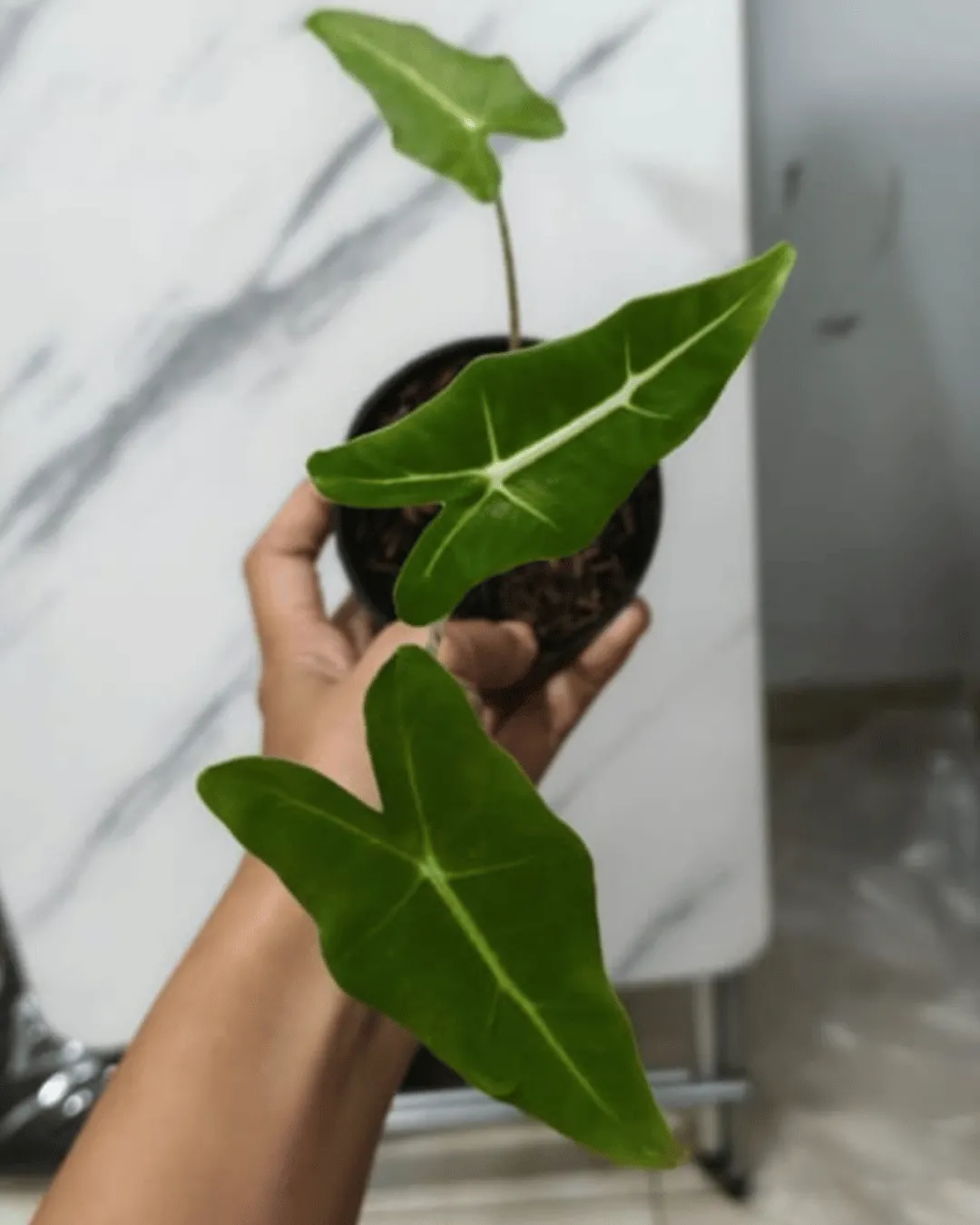
The leaves of Alocasia sarian are its most celebrated feature. They are large, glossy, and deep green in color. Each leaf is shaped like a pointed arrowhead or elongated heart, similar to an elephant’s ear. This is why the plant is commonly called the Elephant Ear. Furthermore, the surface of each leaf is heavily ribbed with bold white veins. These veins run from the center outward, creating a striking contrast against the dark green background. Additionally, the leaf edges are slightly wavy, giving each leaf a natural, organic energy.
The leaves sit on tall, cylindrical petioles — the long stalks that connect each leaf to the main stem. Moreover, these petioles display a distinctive tiger-stripe or zebra-stripe pattern. The pattern consists of alternating bands of light and dark color. This feature comes from the Alocasia zebrina parent and is one of the most recognizable traits of the Sarian hybrid. Consequently, even a single mature leaf on a patterned stem is enough to stop anyone in their tracks.
Flower and Fruit
Alocasia sarian produces flowers, but they are subtle compared to its leaves. The flower consists of a spathe and a spadix. A spathe is a hood-like outer leaf that wraps around the bloom. A spadix is a finger-like central spike that carries the tiny true flowers. Additionally, the flowers carry no strong scent. They are typically pale green or cream in color and are often partially hidden behind the large leaf petioles.
Furthermore, flowering in cultivation is uncommon, especially indoors. However, when pollination occurs, the plant can produce small clusters of red or orange berries. These berries are toxic and should be kept away from children and pets. Primarily, Alocasia sarian is grown for its extraordinary foliage rather than its blooms. Moreover, collectors value this plant precisely because the leaves — not the flowers — are the true spectacle.
Dormancy Cycle
Alocasia sarian enters a natural rest period, known as dormancy, during cooler months. During dormancy, the plant slows its growth significantly. Additionally, it may drop some or all of its leaves. This is a normal, healthy response — not a sign that the plant is dying. Consequently, growers should reduce watering during this period to avoid root rot.
The plant stores energy in its underground rhizome — the thick horizontal stem beneath the soil. Furthermore, once temperatures rise again in spring, the plant uses that stored energy to push out fresh new growth. Moreover, this dormancy-and-revival cycle is one reason why Alocasia sarian seeds and rhizomes are considered particularly valuable. Each dormant plant carries full growth potential, ready to burst into life with the right conditions.
Global Seed Delivery & Phytosanitary Certification
Induare Agro is committed to safe, legal, and professional global seed exports. Every order is handled with care from harvest to arrival. Primarily, the goal is to ensure that seeds reach collectors in perfect condition — wherever they are in the world.
Packaging and Shipping
Each seed is carefully selected for freshness and viability. Additionally, seeds are cleaned, dried to an optimal moisture level, and prepared for long-distance transit. Furthermore, Induare Agro uses secure, climate-appropriate packaging to protect seeds from moisture, heat, and impact during shipping.
All international orders ship via Global Express courier services. Consequently, delivery times are fast and trackable. Moreover, express shipping reduces the time seeds spend in transit, which directly protects seed viability. Every parcel includes full tracking details so buyers can monitor their shipment from Indonesia to their door.
Buyer Peace of Mind
Every order from Induare Agro includes an official Phytosanitary Certificate. A Phytosanitary Certificate is an official government-issued document. It confirms that the seeds have been inspected and are free from pests and diseases. Additionally, it certifies that the seeds meet the import requirements of the destination country.
Furthermore, this certificate is issued by Indonesia’s relevant agricultural authority. Consequently, buyers can clear customs without delays or complications. Moreover, the Phytosanitary Certificate protects both the buyer and the destination country’s plant biosecurity. Induare Agro believes that every rare plant collector deserves legal, stress-free access to the world’s most exceptional seeds.
How to Grow Alocasia Sarian
Follow these steps to germinate and grow your Alocasia sarian seed successfully.
Step 1 — Prepare the Soil Use a light, well-draining potting mix. A blend of peat moss, perlite, and coconut coir works well. Avoid heavy soils that retain too much water.
Step 2 — Sow the Seed Press the seed about 1 cm (half an inch) deep into moist soil. Place the pot in a warm location with temperatures between 22–28°C (72–82°F). Cover loosely with a plastic bag or humidity dome to retain moisture.
Step 3 — Maintain Warmth and Humidity Keep the soil consistently moist but never soggy. Aim for indoor humidity above 60%. A heat mat can speed up germination significantly.
Step 4 — Provide Indirect Light Once the seedling emerges, move it to a bright spot with indirect light. Avoid direct sunlight, which can scorch young leaves. Overhead lighting is ideal for balanced, upright growth.
Step 5 — Fertilize During Growth Begin feeding with a diluted liquid fertilizer once the plant has two or three established leaves. Fertilize every two weeks during spring and summer. Reduce feeding in autumn and stop completely in winter.
Step 6 — Repot as Needed When the plant outgrows its pot, move it to a container one size larger. Use fresh potting mix. Additionally, handle the rhizome with care during repotting to avoid shock.
Step 7 — Manage Dormancy If the plant drops leaves in cooler months, reduce watering and stop fertilizing. Keep it warm and wait. Furthermore, new growth will return when temperatures rise in spring.
