
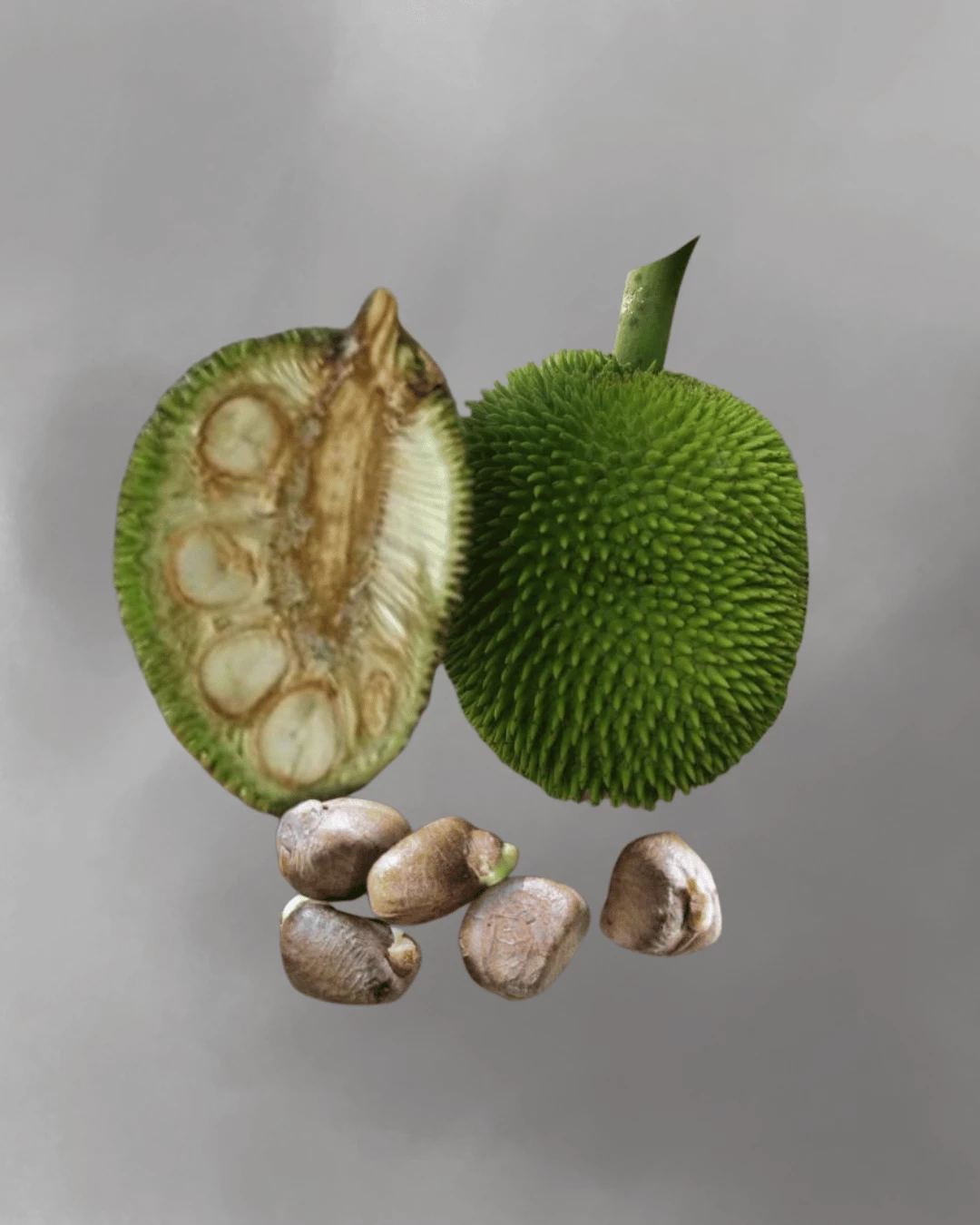
What Is Artocarpus camansi?
Artocarpus camansi, commonly known as the Breadnut, is a rare tropical tree with deep roots in Pacific island history. It is native to New Guinea, the Maluku Islands of Indonesia, and the Philippines. Austronesian sailors carried this species across the Pacific thousands of years ago. Consequently, it became one of the most important food trees in tropical island cultures. Today, it remains an underutilised yet nutritionally powerful species. Furthermore, it is the direct wild ancestor of the breadfruit (Artocarpus altilis), which Polynesian farmers selectively bred to be seedless. That makes Artocarpus camansi a true living ancestor — botanically irreplaceable. Additionally, serious collectors prize it for its rarity, fast growth, and incredible productivity. A single mature tree can produce 600–800 fruits per year. This species thrives in lowland tropical forests, riverbanks, and freshwater swamps. Moreover, it adapts to a wide range of tropical soils. Its combination of rarity, history, and practical value makes it a top-tier choice for exotic plant collectors and agroforestry specialists alike.
Aesthetic Features Artocarpus camansi
The Artocarpus genus includes some of the most impressive canopy trees in the tropical world. Artocarpus camansi is no exception. It combines dramatic size with bold foliage and unique fruit architecture. Furthermore, every part of the tree contains a white milky latex — a striking visual feature common to the Moraceae family.
Leaf Structure
Artocarpus camansi produces very large, deeply lobed leaves. Each leaf measures roughly 40–90 cm (16–35 inches) long and up to 50 cm (20 inches) wide. The lobes are shallow and broadly spaced, giving each leaf a bold, sculptural appearance. Additionally, the leaf surface is thick and glossy with a deep green colour. Young leaves emerge in a lighter, lime-green tone before darkening with age. Primarily, these oversized leaves make the tree a dramatic focal point in any tropical garden or collection.
Flower and Fruit
The tree produces separate male and female flower clusters on the same plant. The male flower cluster is elongated — about 15–25 cm long — and appears first. Consequently, timing between male and female flowering is important for fruit set. The female flower cluster is round, about 5–7 cm wide, and develops into the mature fruit. The fruit is oval to round, measuring 7–12 cm in diameter, and weighs approximately 800 grams. Moreover, its green skin is covered in soft, flexible spines — a key difference from its relative, the breadfruit. Each fruit contains between 12 and 150 large seeds. Furthermore, those seeds are high in protein, low in fat, and taste similar to chestnuts when roasted or boiled. The seeds average 2.5 cm long and weigh 7–10 grams each.
Tree Form and Growth Habit
Artocarpus camansi grows into a moderately fast-growing evergreen tree. It typically reaches 10–15 metres tall, with some trees exceeding that height in ideal conditions. The trunk can reach 1 metre in diameter at maturity. Additionally, the tree forms buttress roots — wide, flattened extensions at the base of the trunk that provide stability. The branching structure is more open and spreading than the related breadfruit tree. Primarily, this open canopy allows strong light penetration to lower layers. The tree holds its leaves year-round and does not go through a true dormancy period. Consequently, it remains a productive and visually impressive specimen throughout all seasons.
Global Seed Delivery & Phytosanitary Certification
Induare Agro is committed to responsible, professional, and fully legal global seed export. Furthermore, we understand that collectors and growers worldwide need absolute confidence in the quality and legality of every seed they receive.
Packaging and Shipping
Induare Agro ships all seeds via Global Express courier services. Each seed is carefully prepared and packed to preserve viability during international transit. Additionally, we use proven moisture-control packaging methods to protect seeds across long distances and varying climates. Every order includes a full Phytosanitary Certificate issued by Indonesian plant health authorities. Consequently, your seeds comply with international plant import regulations. Moreover, our team follows all ISPM 15 standards and Indonesian export protocols. We provide tracking information for every shipment so you can monitor your order at every step.
Buyer Peace of Mind
Induare Agro serves collectors, botanical gardens, universities, and commercial growers in over 50 countries. Furthermore, our Phytosanitary Certificate removes legal risk at customs in nearly all destination countries. Additionally, our team provides full documentation support if your country’s customs authority requires additional paperwork. We believe every buyer deserves clarity, safety, and professional service. Primarily, our goal is to make rare Indonesian seeds accessible to the world — legally, safely, and with care. Consequently, buying from Induare Agro means choosing a supplier that takes compliance as seriously as quality.
How to Grow Artocarpus camansi
Step 1 — Soak the Seed Soak fresh seeds in warm water for 24 hours before planting. This softens the seed coat and speeds up germination.
Step 2 — Prepare the Growing Medium Use a well-draining mix of loamy soil with organic compost. Aim for a neutral to slightly alkaline pH between 6.1 and 7.4.
Step 3 — Plant the Seed Place the seed 2–3 cm deep in a small nursery pot. Keep the pot in a warm, humid environment with indirect light.
Step 4 — Germination Germination typically occurs within 2–4 weeks at temperatures between 25–35°C. Keep the soil consistently moist but never waterlogged.
Step 5 — Seedling Care Provide 20–50% shade for young seedlings. Gradually increase sun exposure as the plant establishes over the first 3–6 months.
Step 6 — Transplanting Transplant to a permanent location or large container once the seedling reaches 30–50 cm tall. Choose a sunny, open site with deep, fertile soil.
Step 7 — Long-Term Care Water regularly but allow the soil to drain between waterings. Established trees tolerate short dry seasons of 3–4 months. Furthermore, they can withstand strong winds and will re-sprout after wind damage.
