
What Is Mangifera caesia?
Mangifera caesia is a majestic tropical fruit tree. It is native to the wet lowland rainforests of Borneo, Sumatra, and the Malay Peninsula. Locally, it is known as binjai in Malay and wani in Balinese. Furthermore, it belongs to the Anacardiaceae family — the same plant family as the common mango and cashew.
This species is genuinely rare in the wild. The IUCN Red List classifies it as Near Threatened due to ongoing habitat loss from deforestation. Consequently, cultivated specimens and export-quality seeds are extremely difficult to source outside of Indonesia. Collectors across Europe, North America, and Asia actively search for this plant. Additionally, in 1999, Mangifera caesia was featured on a Malaysian postage stamp as a celebrated rare fruit — a testament to its cultural and botanical importance.
The tree can grow up to 30–45 metres tall in nature. It thrives in periodically flooded riverbanks and marshes below 450 metres elevation. Moreover, it requires consistent rainfall and warm tropical temperatures year-round. For collectors and growers, it represents both a living investment and a piece of Southeast Asian botanical heritage.
Aesthetic Features Mangifera caesia
Mangifera is one of the most diverse and celebrated genera in the tropical plant world. Mangifera caesia stands out even within this prestigious group. Its physical appearance is bold, elegant, and unlike any common mango you have encountered before.
Leaf Structure
The leaves of Mangifera caesia are elliptic to lanceolate — long, smooth, and pointed at the tips. Each leaf measures between 10 and 30 cm in length. Furthermore, they are thick and leathery in texture. The upper surface is glossy and medium green. The underside is paler. Primarily, young leaves emerge with a beautiful reddish flush before maturing to deep green. They cluster densely at the ends of stout branches, creating a rich, layered canopy. The petiole — the short stalk connecting the leaf to the branch — is thick and flattened, adding to the plant’s robust character.
Flower and Fruit
The flowers appear on terminal panicles — large, branching flower clusters — measuring 15 to 40 cm in length. Each individual flower is small, pale lilac to violet, and lightly fragrant. They bloom profusely, attracting bees and other pollinators. Consequently, a flowering Mangifera caesia is a spectacular sight in any garden or collection.
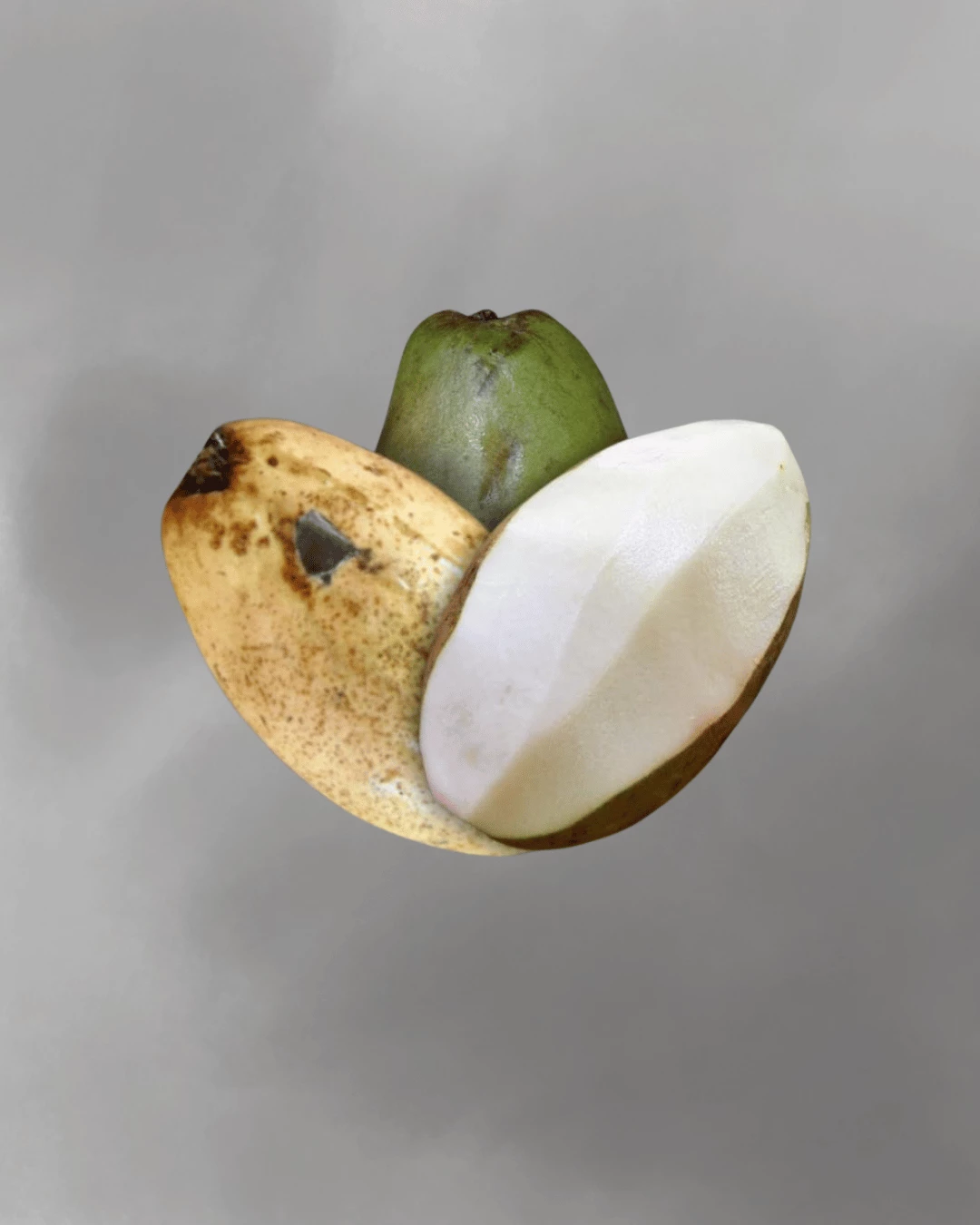
The fruit is equally impressive. It is an obovate-oblong drupe — meaning it is roughly egg-shaped and fleshy, similar to a large mango. Mature fruits measure 12–20 cm in length. The skin is very thin and shifts from green to pale yellowish-brown at ripeness. Moreover, the flesh inside is whitish, soft, and juicy — hence the common name “White Mango.” The aroma is strong and distinctive, often compared to durian. Ripe trees can produce thousands of fruits in a single season.
Deciduous Growth Cycle
Mangifera caesia is deciduous — meaning it sheds its leaves during part of the year. This is unusual among tropical fruit trees. Before new growth emerges, the tree stands tall and bare. It then sheds large bud scales — protective coverings that wrap tightly around new twigs and flower clusters. Furthermore, this dramatic seasonal cycle makes the plant visually striking throughout the year. Each phase of growth, from bare branches to lush canopy to heavy fruit, offers a unique display for the collector or botanist.
Global Seed Delivery & Phytosanitary Certification
Induare Agro is committed to safe, legal, and professional seed export. We supply genuine, fresh organic seeds directly from Indonesia. Additionally, every order meets international plant health standards from source to delivery.
Packaging and Shipping
Each seed is carefully cleaned, inspected, and prepared for long-distance transport. We pack seeds using professional moisture-controlled materials. Consequently, viability is protected throughout the shipping journey. We ship via Global Express courier services to ensure fast and trackable delivery. Moreover, every shipment includes full export documentation to comply with the import regulations of your country.
Buyer Peace of Mind
Every order from Induare Agro includes a valid Phytosanitary Certificate — an official government-issued plant health document. This certificate confirms your seeds are free from pests, diseases, and prohibited material. Furthermore, it allows smooth customs clearance in most countries worldwide. Primarily, this means you receive your seeds legally, safely, and without risk of confiscation. Additionally, our team is available to advise buyers on local import requirements before purchase.
How to Grow Mangifera caesia
Step 1 — Prepare the Seed Remove any remaining fruit pulp from the seed surface. Soak the seed in warm water for 24 hours to soften the outer coat.
Step 2 — Choose Your Growing Medium Fill a pot with well-draining, loamy soil rich in organic matter. A mix of 60% topsoil and 40% compost works well.
Step 3 — Plant the Seed Lay the seed on its side and plant it approximately 2–3 cm deep. Firm the soil gently around it.
Step 4 — Provide Warmth and Humidity Place the pot in a warm location with temperatures above 20°C. Maintain high humidity by misting the soil surface daily.
Step 5 — Water Regularly Keep the soil consistently moist but never waterlogged. Check soil moisture by inserting a finger 2–3 cm deep before each watering.
Step 6 — Wait for Germination Germination typically occurs within 2–6 weeks. Furthermore, seeds germinate best when fresh, so plant immediately after receiving your order.
Step 7 — Move to Larger Space Once the seedling reaches 30–40 cm, transplant it to a larger pot or prepared ground. Provide full sun and shelter from frost.
All seeds are supplied by Induare Agro — your trusted source for export-quality, rare exotic seeds from Indonesia.
