
What Is Mucuna macrocarpa?
Mucuna macrocarpa is a large, woody climbing vine. It belongs to the Fabaceae family — the same family as beans and peas. Botanists and collectors know it by its local name, Saba Ling. This plant is native to a broad arc of tropical and subtropical Asia. Its range stretches from the eastern Himalayas and India through Myanmar, Thailand, Vietnam, southern China, and Taiwan. It even reaches the Ryukyu Islands and Kyushu in Japan.
The plant grows in humid montane and riverine forests. It thrives at elevations between 800 and 3,000 meters above sea level. These are cool, misty, high-altitude environments. Very few climbing plants survive — and even fewer thrive — in such conditions. This makes Mucuna macrocarpa a genuinely rare and special find.
Furthermore, this species has attracted attention far beyond horticulture. Traditional Chinese medicine has used it for centuries. Scientists now study its medicinal compounds and growth chemistry. Additionally, the plant holds ornamental value that is hard to rival. Older specimens can produce up to 90 flower clusters at once. Each cluster hangs directly from the main stem in a dramatic natural display. Consequently, Mucuna macrocarpa is a living showpiece that rewards patient growers with extraordinary spectacle.
Moreover, the seeds of this plant have a remarkable survival feature. Their hard outer coat allows them to float on ocean currents. Seeds have been found washed up on beaches far from their native range. This natural dispersal strategy speaks to the plant’s resilience and adaptability. For collectors of rare exotic seeds, Mucuna macrocarpa represents both a scientific curiosity and a spectacular centerpiece plant.
Aesthetic Features Mucuna macrocarpa
Mucuna is a genus of around 100 tropical vines. Mucuna macrocarpa stands out even within this impressive group. Its visual impact combines bold floral drama with lush, dense foliage. Every part of this plant makes a statement.
Leaf Structure
The leaves of Mucuna macrocarpa are trifoliate. This means each leaf is made up of three separate leaflets. The leaflets are large and oval-shaped. They give the entire plant a full, lush, and tropical appearance. The undersides of younger leaves carry a fine, rusty-coloured fuzz. This is the source of one of its other common names — the Rusty-leaf Mucuna. The stems are thick and woody. They twine tightly around any available support as the vine climbs upward toward the light.
Additionally, the leaf petioles — the stalks connecting each leaf to the stem — are long and flexible. This gives the canopy a slightly layered, overlapping look. The overall silhouette is dense and green. It provides an excellent backdrop for the plant’s spectacular flowers.
Flower and Fruit
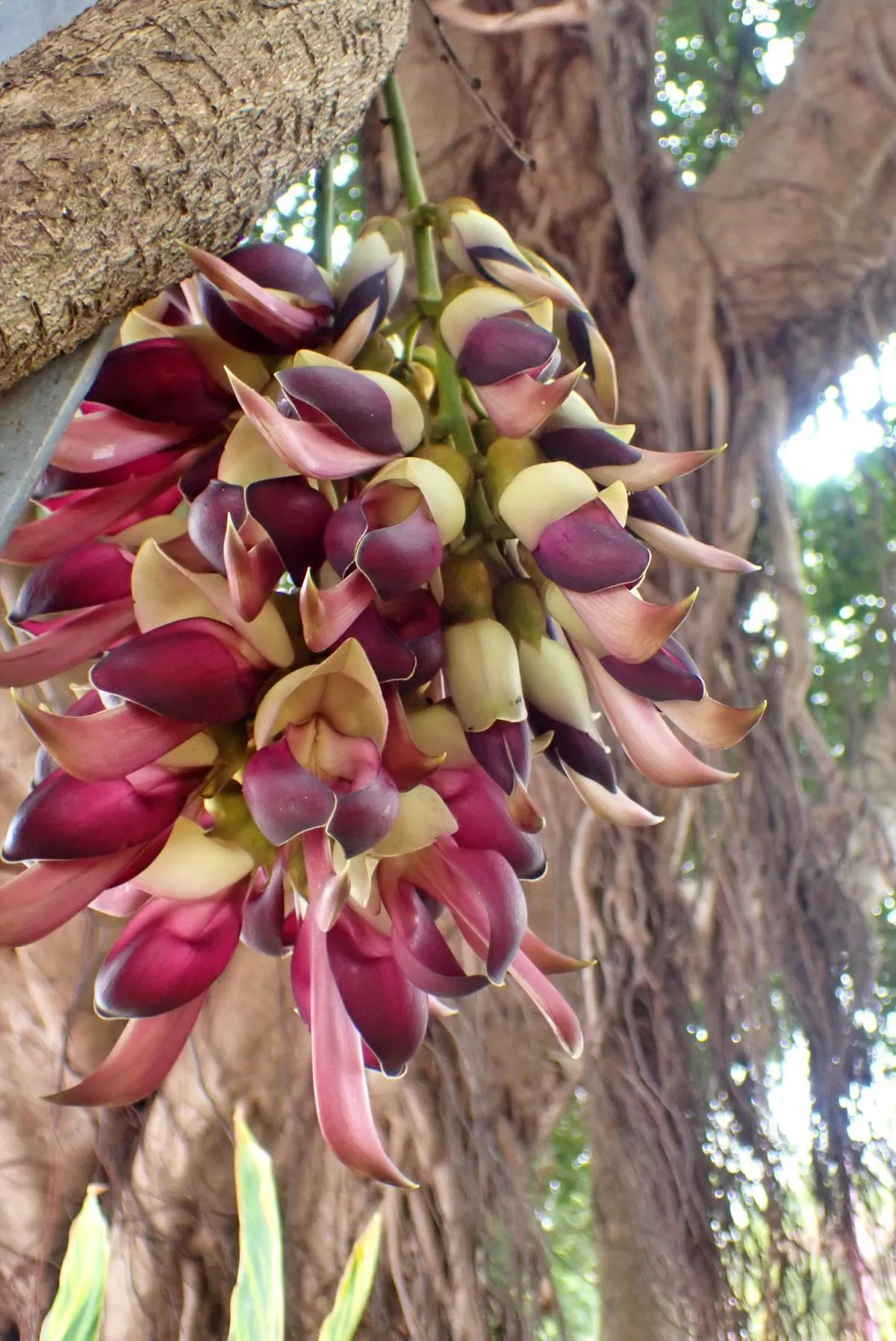
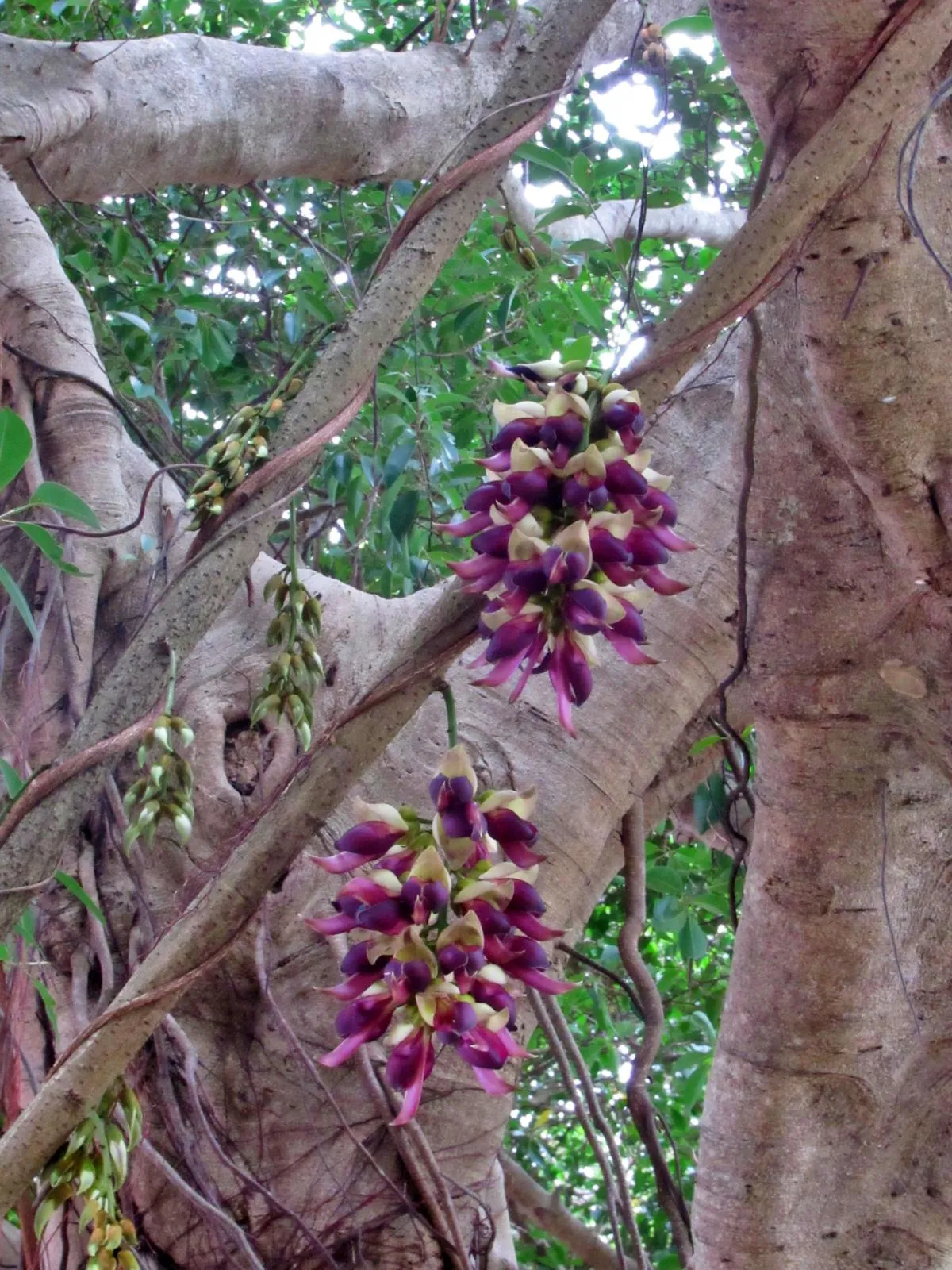
The flowers of Mucuna macrocarpa are its most prized feature. They are purple-red and yellowish-green, with a distinctive parrot-beak shape. This hooked, beak-like form is typical of plants pollinated by bats and large moths. The flowers hang in clusters — called racemes — that can reach up to 20 cm in length. Primarily, what makes this truly special is the phenomenon of cauliflory. Cauliflory is when flowers grow directly on the trunk or main woody branches, rather than on the tips of new growth. This creates the dramatic effect of flower chains cascading straight from the vine’s main body.
Furthermore, mature plants can produce up to 90 flower clusters simultaneously. The flowering season peaks around early spring. After flowering, large seed pods develop. Each pod can contain between 6 and 15 large, disc-shaped seeds. The sap of the vine turns a deep reddish-brown when exposed to air. This is the source of its Chinese name, which translates as “blood vine.”
Seed and Dormancy Cycle
The seeds of Mucuna macrocarpa are large and disc-shaped. They have a very hard outer seed coat — the testa. This tough coating evolved to protect the seed during long ocean voyages. It also means seeds can stay viable for extended periods under the right storage conditions. Moreover, this hard coat requires scarification — a process of gently nicking or sanding the seed surface — before sowing. This mimics the natural wear a seed would experience in nature.
The plant itself is semi-deciduous in cooler climates. It may drop some leaves during its rest period. In temperate climates, it can be grown indoors or in a heated greenhouse. It needs regular pruning to manage its vigorous growth.
Global Seed Delivery & Phytosanitary Certification
Induare Agro is committed to professional, legal, and responsible seed export. Every order is handled with care from the moment of harvest to the moment it arrives at your door. We understand that rare exotic seeds represent an investment for serious collectors. We treat every shipment accordingly.
Packaging and Shipping
Each seed is cleaned, inspected, and carefully packaged for long-distance shipping. We use protective materials that maintain seed viability throughout the journey. Shipments travel via Global Express courier services. This ensures fast and trackable delivery to over 100 countries worldwide.
Furthermore, Induare Agro prepares full documentation for every international order. This includes all paperwork required for smooth customs clearance. We have extensive experience in botanical export from Indonesia. Our team ensures every shipment complies with international plant trade regulations.
Buyer Peace of Mind
Every order of Mucuna macrocarpa seeds from Induare Agro includes a Phytosanitary Certificate. This is an official government-issued document. It certifies that the seeds have been inspected and found free from pests and diseases. Most countries require this certificate for the import of plant material.
Moreover, a Phytosanitary Certificate is the mark of a professional, export-grade supplier. It protects you as the buyer. It also supports the legal and sustainable trade of rare botanical material. Induare Agro is proud to meet this international standard on every single order.
How to Grow Mucuna macrocarpa
Follow these steps to give your Mucuna macrocarpa seed the best possible start.
Step 1 — Scarify the Seed Gently nick or sand the hard outer coat of the seed. Use fine sandpaper or a nail file. Be careful not to damage the inner seed — the endosperm.
Step 2 — Soak the Seed Place the scarified seed in lukewarm water for 24 hours. This softens the coat and triggers germination.
Step 3 — Prepare Your Growing Medium Fill a pot with a well-draining seed-raising mix. A mix of coco coir and perlite works well. The pot must have drainage holes at the bottom.
Step 4 — Sow the Seed Plant the seed at a depth of 3–5 cm. Water gently and keep the soil evenly moist. Do not let it dry out completely between waterings.
Step 5 — Provide Warmth and Light Place the pot in a warm, bright spot. A minimum temperature of 15°C (59°F) is required. Germination typically occurs within 2–4 weeks.
Step 6 — Support the Vine Once the seedling reaches 15–20 cm in height, provide a climbing support. A trellis, bamboo pole, or established tree works well. The vine grows vigorously and will climb eagerly.
Step 7 — Prune Regularly Prune the vine to control its size and shape. Remove dead or damaged stems as needed throughout the growing season.
