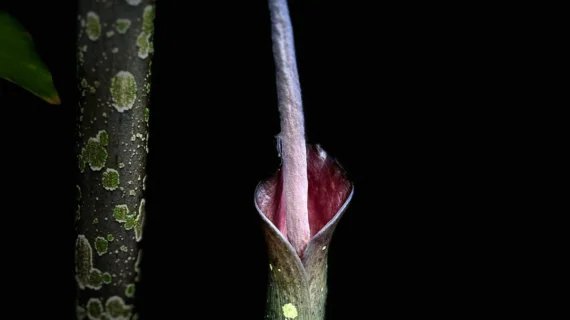
Amorphophallus borneensis: The Enigmatic Giant Aroid of Borneo’s Forests
Deep within the semi-open forests of Kalimantan, a striking botanical giant quietly emerges from the forest floor. Amorphophallus borneensis (Engl.) Engl. & Gehrm. is a rare, endemic aroid. Its dramatic proportions and intricate morphology place it among the most compelling members of its genus. Botanists first formally described it in the Pflanzenreich monograph of 1911. Since then, the species continues to captivate researchers and plant enthusiasts for its remarkable floral architecture.
Taxonomic Identity of Amorphophallus borneensis
Amorphophallus borneensis belongs to the family Araceae. Engler originally described it, and Engler & Gehrmann later revised the binomial authority. Its protologue appears in Pflanzenr. 48 (IV.23C) (1911): 79.
Recognized synonyms include:
- Amorphophallus borneensis var. winkleri Engl.
- Hydrosme borneensis Engl.
These synonyms reflect historical reclassifications. Eventually, taxonomists consolidated the species under its current accepted name.
Morphological Description
Underground Storage Organ and Leaf
The tuber of Amorphophallus borneensis takes a depressed globose form. It reaches up to approximately 20 cm in diameter and does not produce offset structures. The plant bears a solitary leaf on a robust petiole. That petiole extends up to 200 cm in length and up to 8 cm in diameter. Its surface shows a deep green to near-black background with large, oval, ring-shaped emerald green spots. Those toward the lower section appear slightly elevated and have a crust-like texture.
The lamina reaches up to 200 cm in diameter. Its leaflets are elliptic to elongate-elliptic, typically 15 cm long and up to 10 cm wide, and they terminate in an acuminate tip.
Inflorescence and Peduncle
The inflorescence of Amorphophallus borneensis is solitary. It sits on a long peduncle that ranges from 38 to 110 cm or potentially longer. At the base, the peduncle measures 1.6–4 cm in diameter. The surface is largely smooth, though slight rugosity appears near the base. Furthermore, it displays purplish or blackish-green coloration with large oval or rounded whitish and blackish-green confluent spots. Numerous small brownish-purple dots also appear across the surface. Near the base, the margins of the larger spots rise slightly and appear lichen-like.
Spathe
The spathe is ovate, 21–45 cm long and 19–40 cm in diameter. It carries a single prominent longitudinal fold. The margins roll inward and display a few large sinuses. Externally, the base surface is dull green with a greyish hue. Scattered pale green rounded spots appear there, some with a darker green center, along with small punctiform blackish-green markings.
Internally, the lower portion is maroon. It transitions upward to pale green or whitish with a pale brownish-violet hue. The outer limb surface shows dull dirty reddish-brown to dark brown with small pale or blackish spots. The inner limb surface is a glossy dark brown to dark reddish-brown. At the base, broad and partly flattened ridges bear numerous small, shallow conical warts.
Spadix and Floral Zones
The spadix is sessile and 30–73 cm long. Notably, it exceeds the spathe in length. The female zone is slightly conic, 5–15 cm long and 3–6 cm in diameter at the base. Its flowers are generally well-spaced, though occasional clustering occurs. Between the female and male zones, an irregular transitional zone of approximately 0.5–1 cm sometimes appears. This zone bears occasional female, male, or bisexual flowers.
The male zone is cylindric, 4–8 cm long and 1.5–5 cm in diameter. It sometimes carries a slightly expanded apex and hosts congested flowers. In addition, the appendix is elongate-fusiform and acute, ranging from 20 to 63 cm long and 3–9 cm in diameter. It shows a pale brownish to greyish-brown color. Its verruculate surface bears shallow grooves and depressions. Near the base, a few shallow conical staminodes appear.
Female Flowers
Each ovary is subglobose to depressed-globose. It measures 2.5–4 mm in diameter and 2–2.5 mm tall. The base is white, while the upper portion is brownish-purple. Each ovary is bilocular and holds one basal ovule per locule.
The style measures 3–5 mm long and 1–1.5 mm in diameter. It is brownish-purple and its surface carries flat, broad, shallow verrucae with distinctly conic epidermal cells. The stigma is oval to subtriangular in cross-section, 1.5–3 mm in diameter and 1–2 mm tall. It is shallowly bilobed with a minutely verrucate-echinate surface. Rounded lobes in greyish or yellowish tones separate by a shallow, elongate transversal or Y-shaped groove.
Male Flowers
Each male flower carries 4–6 stamens. Filaments measure 0.5–1 mm long and are basally or entirely connate, and whitish. Anthers reach 2–3 mm in length, with a rectangular cross-section and a truncate apex of approximately 1.5 × 2.5 mm. The connective tissue is brownish or pale greyish-green and slightly sunken. Pores are apical, whitish, and elongate.
Fruit
The fruiting portion is cylindric, up to 35 cm long and 5 cm in diameter. Berries grow in congested clusters. Each berry is globose, approximately 1 × 1 cm, and holds one or two seeds. They turn reddish upon maturity.
Distribution of Amorphophallus borneensis
Amorphophallus borneensis is endemic to Borneo. Specifically, it occurs in the South, East, and Central Kalimantan provinces of Indonesia. Additionally, researchers have reported sightings from East Malaysia (Sabah and Sarawak). However, those populations remain unverified at the taxonomic level. As a result, the actual range of the species may extend slightly beyond the currently documented area.
For verified occurrence data and georeferenced records, refer to GBIF – Amorphophallus borneensis and the Plants of the World Online (POWO) – Kew.
Habitat
This species favors semi-open environments. In particular, it grows along logging roadsides or in garden backyards, at elevations between 200 and 350 m above sea level. It does not typically appear in dense, closed-canopy primary forest. This suggests a notable degree of adaptability to disturbed or forest-edge habitats.
Taxonomic Notes
On the island of Borneo, no other Amorphophallus species combines an exceptionally long spadix with a long peduncle. Therefore, A. borneensis stands out as morphologically distinct and relatively straightforward to identify within its range. The source literature further notes that no other Bornean congener shows this character combination. Consequently, the risk of misidentification remains low when both features appear together.
That said, the potential overlap with East Malaysian populations remains an open research question. Future field collections and molecular studies may be necessary to fully resolve the distributional extent of the species.
References
- Engler, A. & Gehrmann, K. (1911). Amorphophallus borneensis. In: Das Pflanzenreich 48 (IV.23C): 79.
- Kew Science. Amorphophallus borneensis (Engl.) Engl. & Gehrm. – Plants of the World Online. Available at: https://powo.science.kew.org/
- GBIF Secretariat. Amorphophallus borneensis occurrence data. Global Biodiversity Information Facility. Available at: https://www.gbif.org/


