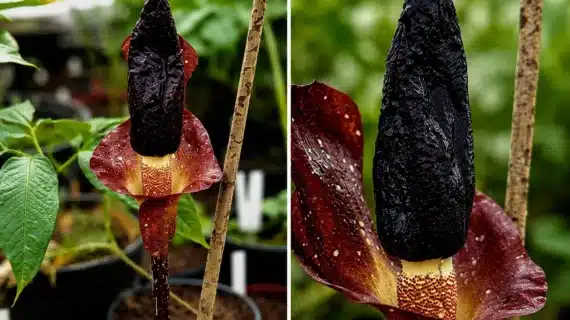
Amorphophallus manta: The Dark Giant of Harau Valley in West Sumatra
Rising dramatically from the forest floor of a single valley in West Sumatra, Amorphophallus manta Hett. & Ittenbach is one of the most visually striking aroids known from the Indonesian archipelago. Hetterscheid and Ittenbach formally described it in 1994 in the journal Blumea. Its glossy, dark purple to near-black appendix and broadly ovate spathe give it an almost otherworldly appearance — one that immediately separates it from its closest relatives. Confined to the Harau Valley and a part of West Malaysia, this species occupies a remarkably restricted range. Its combination of limited distribution, dramatic aesthetics, and taxonomic distinctiveness makes A. manta a compelling subject for both botanists and plant enthusiasts.
Taxonomic Identity of Amorphophallus manta
Amorphophallus manta belongs to the family Araceae. Hetterscheid and Ittenbach described it in Blumea 39 (1/2) (1994): 263. No synonyms are currently recognized for this species.
Morphological Description
Tuber and Leaf
The tuber of Amorphophallus manta is subglobose, reaching up to approximately 8 cm in diameter and 7 cm in height. It produces no offset structures. The plant bears a single solitary leaf. The lamina reaches up to about 70 cm in diameter and is subpedate in arrangement. The anterior main segment is undivided. Posterior segments carry leaflets mainly on the acroscopic side of the rachises. The rachises are winged throughout but only shortly so.
Leaflets are elongate-elliptical to elongate-obovate, 8–20 cm long and 3–8 cm wide. They are acuminate at the apex, with an undulate margin. The upper surface is dark brownish-green with scattered white orbicular spots. The margin itself is reddish-pink, making the leaflets visually distinctive even outside the flowering season.
Inflorescence and Peduncle
The inflorescence of Amorphophallus manta is solitary and long-peduncled. The peduncle reaches 24–30 cm in length and 1.2–1.7 cm in diameter. Its color is dark reddish-brown, marked with numerous small blackish-green elongate short spots and scattered larger elliptic dirty-whitish spots. This peduncle patterning closely mirrors the petiole.
Spathe
The spathe is broadly ovate, 14–19 cm long and 11–20 cm in diameter. It is broadly acute at the apex. The base is strongly convolute. The limb spreads basally, then suddenly bends forward and curves back again. The external base surface is dirty brownish-green with numerous small punctiform blackish-green spots and a few slightly larger dirty-white spots. Internally, the base is dark purple, transitioning upward into a creamy zone. The outer limb surface at the center matches the base, while the margins and top are brownish-purple with rounded white spots. The inner limb surface is dark maroon with rounded white spots. The base interior is verrucate, with conical warts.
Spadix and Floral Zones
The spadix of Amorphophallus manta is sessile and slightly longer than the spathe, measuring 16–22 cm in total. The female zone is cylindric, 2.8–3.5 cm long and 1.5–2.5 cm in diameter. Its flowers are distant. The male zone is obconic, 3.5 cm long and 2–3 cm in diameter at the top. Its flowers are slightly distant, and some upper flowers are sterile.
The appendix is shortly stipitate, with a stipe 4–10 mm long and yellowish-white. The appendix body is 10–14 cm long and 3–5.5 cm in diameter. It is fusiform-conic and subacute, slightly or more distinctly dorso-ventrally compressed. The surface is glossy dark purple, rugulose, and carries many irregular shallow depressions. This dark, compressed, glossy appendix is the most visually dramatic feature of the species.
Female Flowers
Each ovary is globose to depressed-globose, approximately 2 mm in diameter and about 1.7 mm tall. Each ovary is (1–)2–3-locular. The lower half is dirty white and the upper half is purple. The style is very short to nearly absent, measuring 0.1–0.3 mm long and approximately 1 mm in diameter. The stigma is sessile and hemispheric, 1–1.4 mm in diameter and approximately 1 mm tall. It carries 2 or 3 very shallow lobes and is brownish-grey.
Male Flowers
Each male flower carries 3–5 stamens. Stamens reach approximately 2 mm in length. Filaments are approximately 1 mm long, connate, and forming a cushion-like mass together. Anthers measure 1–1.7 mm in diameter and approximately 1 mm long. They are hemispheric and yellow, with dark purple coloring around the apical, elongate pores.
Distribution of Amorphophallus manta
Amorphophallus manta grows in West Sumatra, Indonesia, where researchers know it only from the Harau Valley. It also occurs in West Malaysia. This combination of an extremely restricted Sumatran locality and a separate Malaysian population makes the biogeography of the species particularly noteworthy.
For verified occurrence data and georeferenced records, refer to GBIF – Amorphophallus manta and the Plants of the World Online (POWO) – Kew.
Habitat
In the Harau Valley, Amorphophallus manta grows across high and undulating hill terrain at elevations between 500 and 850 m above sea level. The topography of this valley, with its dramatic ridges and steep forested slopes, creates the specific microhabitat conditions this species depends on.
Taxonomic Notes
In inflorescence morphology, Amorphophallus manta most closely resembles A. angulatus. However, several consistent characters distinguish them clearly. A. angulatus reaches at most half the size of A. manta. Furthermore, the leaf lamina of A. manta is subpedate in arrangement, while that of A. angulatus is subradiate, with much shorter rachises. Additionally, the petiole of A. manta is rounded in cross-section, whereas the petiole of A. angulatus is angulate to ribbed.
In smaller flowering specimens of A. manta, the spathe limb margin may remain un-reflexed, and the appendix becomes less swollen and more elongate. This juvenile inflorescence form differs visually from the typical mature appearance. The same variation in young specimens also occurs in A. angulatus, adding a layer of complexity to field identification of immature plants of both species.
Photo Reference

References
- Hetterscheid, W.L.A. & Ittenbach, S. (1994). Amorphophallus manta Hett. & Ittenbach. In: Blumea 39 (1/2): 263.
- Kew Science. Amorphophallus manta Hett. & Ittenbach – Plants of the World Online. Available at: https://powo.science.kew.org/taxon/urn:lsid:ipni.org:names:979847-1
- GBIF Secretariat. Amorphophallus manta occurrence data. Global Biodiversity Information Facility. Available at: https://www.gbif.org/species/2871760
-


