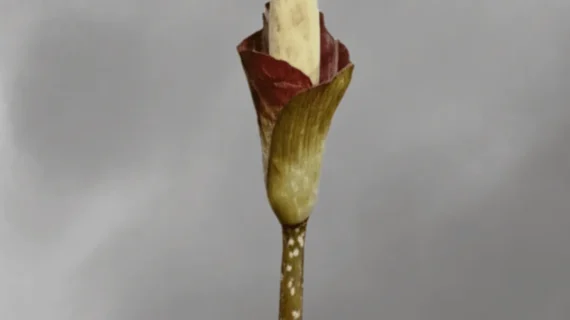
Amorphophallus decus-silvae: The Towering Forest Ornament of West Java
Few plants command attention the way Amorphophallus decus-silvae Backer & Alderw. does. This giant aroid holds the distinction of being the tallest Amorphophallus species native to Java. Its name — meaning “ornament of the forest” — reflects its imposing presence and architectural grandeur. Botanists formally described it in 1920 in the Bulletin du Jardin Botanique de Buitenzorg. Today, it remains a rare species, confined to secondary forests in restricted parts of West Java and Nusa Kambangan island. For botanists and plant collectors alike, it is nothing short of extraordinary.
Taxonomic Identity of Amorphophallus decus-silvae
Amorphophallus decus-silvae belongs to the family Araceae. Backer & Alderwerelt described it in Bull. Jard. Bot. Buitenzorg III, I (1920): 369. No synonyms are currently recognized for this species.
Its protologue forms the sole taxonomic foundation, and the species has remained monotypic in its classification since the original description.
Morphological Description
Tuber and Leaf
The tuber of Amorphophallus decus-silvae is depressed-globose. It reaches at least 30 cm in diameter — and potentially more — and may carry slightly raised areas on its surface. Large tubers can weigh 20 kg or more. The plant produces no offset structures. Like other giant members of the genus, it bears a single solitary leaf.
The petiole is massive, extending 200–300 cm in length and 13–20 cm in diameter. Its color is greyish to greyish-green. Numerous small, dark spots cover the lower portion, mostly confluent and closely spaced. These become more scattered and elongate upward, transitioning to larger whitish spots with greenish-brown centers. The surface is smooth toward the upper portion but rugose toward the base.
The lamina reaches 300–400 cm in diameter. All rachises carry narrow wings across their full length. Leaflets are elliptic to elongate-elliptic, acuminate to long-acuminate, 20–32 cm long and 6–10 cm wide. Their upper surface is green.
Inflorescence and Peduncle
The inflorescence of Amorphophallus decus-silvae is long-peduncled. The peduncle extends 105–130 cm in length. This long peduncle, combined with the enormous spadix, gives the species its remarkable vertical stature.
Spathe
The spathe is campanulate, erect, and broadly ovate. It measures (50–) 70–75 cm in length and 45–50 cm in diameter. Externally, the surface is olive-green or greyish-purple with both larger and smaller pale green or dark spots. Internally, the base is purple. The middle section transitions to pale green, and the remainder is purple. Within the base, numerous small, more-or-less ridge-like warts appear, often in confluent arrangements.
Spadix and Floral Zones
The spadix of Amorphophallus decus-silvae is sessile. It measures (50–) 105–120 cm in length. Notably, it equals or exceeds the spathe in length. The female zone is (7–) 15–22 cm long. It measures (5–) 7 cm in diameter at the base and 4–6.5 cm at the top. The shape is subcylindric to conic, and flowers are arranged in widely separated spirals or irregular patterns.
The male zone is strongly obconic, 4.5–7.5 cm long and 5–5.5 cm in diameter at the base. At its top, it broadens to approximately 13 cm in diameter. Flowers in this zone are congested. Furthermore, the appendix is elongate fusiform-conic and subobtuse. It is shallowly folded and measures approximately (40–) 90 cm in length. The surface is minutely rugose. At first the appendix appears reddish, then transitions to dirty yellow or greyish-yellow.
Female Flowers
Each ovary is subglobose to ovate, with a depressed base. In cross-section it is circular, approximately 4 mm in diameter and 3.5 mm tall. Each ovary is bilocular, with one basal ovule per locule. The style is 4–4.5 mm long. It tapers from 1 mm in diameter at the base to 0.5 mm at the apex, forming a tape-ring. The stigma is very small and punctiform, 0.7–0.8 mm in diameter and approximately 0.8 mm tall. It is shallowly bilobed and minutely rugulose.
Male Flowers
Each male flower carries 3–6 stamens. Stamens reach 2–2.5 mm in length. Filaments are 0.5–1.3 mm long and either free or very shortly connate at the base. Anthers are 1.2–1.5 mm long and 1.5–3 mm in diameter. They are truncate and subrectangular in cross-section. Pores are oval or rounded, approximately 0.1–0.2 mm long. The connective is flat.
Distribution of Amorphophallus decus-silvae
Amorphophallus decus-silvae is endemic to West Java and Nusa Kambangan island, Indonesia. Within this range, it grows only in restricted and isolated localities. As a result, its overall population size is very limited.
For verified occurrence data and distribution records, refer to GBIF – Amorphophallus decus-silvae and the Plants of the World Online (POWO) – Kew.
Habitat
This species grows in secondary forest. Its occurrence in disturbed rather than pristine primary forest suggests a degree of tolerance for habitat modification. However, it still depends on relatively intact forest structure to support its large biomass and specific ecological requirements.
Taxonomic Notes
Amorphophallus decus-silvae holds a remarkable distinction: it is the tallest Amorphophallus species known from Java. In overall morphology, it closely resembles A. gigas, an endemic species of Sumatra. Both share enormous dimensions and very similar vegetative and floral structures.
Nevertheless, researchers can distinguish them by specific floral details. A. decus-silvae produces smaller stigmas (0.7–0.8 mm versus 1–1.4 mm), longer and more slender styles (4–4.5 mm versus 2–3 mm), shorter stamens, and anthers with very obtuse angles and rounded rather than elongated pores. These subtle but consistent differences reliably separate the two species.
Furthermore, A. decus-silvae grows in restricted parts of West Java only. Its rarity in both the field and botanical collections makes every confirmed observation scientifically significant.

References
- Backer, C.A. & Alderwerelt van Rosenburgh, C.R.W.K. van (1920). Amorphophallus decus-silvae Backer & Alderw. In: Bull. Jard. Bot. Buitenzorg III, I: 369.
- Kew Science. Amorphophallus decus-silvae Backer & Alderw. – Plants of the World Online. Available at: https://powo.science.kew.org/
- GBIF Secretariat. Amorphophallus decus-silvae occurrence data. Global Biodiversity Information Facility. Available at: https://www.gbif.org/


