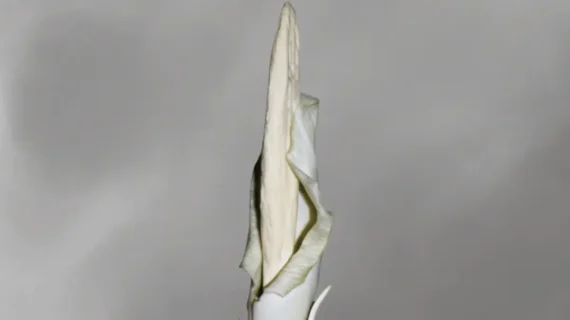
Amorphophallus eburneus: The Ivory Aroid of Borneo’s Limestone Forests
Hidden within the crevices of Borneo’s karst limestone outcrops, Amorphophallus eburneus Bogner presents one of the most ecologically specialized members of its genus. This creamy-white-spathed aroid grows in an extreme and fragile habitat: deep inside limestone cracks blanketed by leaf litter, at low elevations in Kalimantan and East Malaysia (Sarawak). Bogner formally described it in 1989 in the journal Willdenowia. Its name, meaning “ivory-white,” refers to the pale, luminous color of its spathe — a striking contrast against the dark recesses of its rocky home. Botanists and conservationists now regard this species as a limestone obligate with a very restricted range.
Taxonomic Identity of Amorphophallus eburneus
Amorphophallus eburneus belongs to the family Araceae. Bogner described it in Willdenowia 18 (1989): 441–443. No synonyms are currently recognized for this species.
The protologue covers both its morphological description and its ecological context. Notably, researchers later placed it within an informal “Eburneus Group” of white-flowered limestone specialists in Sarawak, though this grouping remains informal in current taxonomy.
Morphological Description

Tuber and Leaf
The tuber of Amorphophallus eburneus is depressed-globose. It reaches up to about 35 cm in diameter and up to 20 cm in height. Mature tubers weigh up to approximately 7 kg. The skin is pale greyish-brown, corky in texture, and divided into numerous small, angulate fields by narrow grooves. The tuber produces no offset structures. The plant bears a single solitary leaf.
The petiole is very turgid, reaching up to approximately 120 cm long and 10 cm in diameter. Its surface is smooth and uniformly pale green, occasionally carrying a few scattered whitish-greenish spots. The lamina is moderately dissected, up to about 240 cm in diameter. Its rachises carry wings only from the distal basal branchings outward. Leaflets are elliptic to elliptic-lanceolate, 12–60 cm long and 5.5–21 cm wide. They are mid to pale green, coriaceous, and long-acuminate at the apex.
Inflorescence and Cataphylls
The inflorescence of Amorphophallus eburneus is short-peduncled. It is largely hidden within a cluster of approximately six cataphylls. These cataphylls are lanceolate, pale olive-brown to whitish-greenish with pale brownish flushes. The largest reach up to about 35 cm long and 10 cm in diameter.
The peduncle measures 15–20 cm long and approximately 2.5 cm in diameter. It is pale green and entirely concealed by the surrounding cataphylls.
Spathe
The spathe is erect and infundibuliform-ovate. At the base it is strongly convolute and hidden by cataphylls. A shallow constriction separates the base from the limb. The limb is slightly spreading and acute, with revolute margins, measuring 20–23 cm long and 19–21 cm in diameter.
Externally, the spathe surface is creamy white. The upper margins sometimes show faint purple flushing. Internally, the base is dark purple and then creamish. The limb interior is creamish with or without a pale purple flush. The interior of the base carries numerous irregular, shallow warts and some shallow grooves.
Spadix and Floral Zones
The spadix of Amorphophallus eburneus slightly exceeds the spathe in length. It is shortly stipitate and measures 21–26 cm in total. The female zone is slightly conic, 2.5–3 cm long and 2–2.5 cm in diameter. Its flowers are slightly or variably spaced.
The male zone is cylindric, 4–5 cm long and 1.5–2 cm in diameter. Flowers in this zone are congested. Furthermore, the appendix measures 14–18 cm long and 1.5–3 cm in diameter. It is terete or laterally compressed and acute. The color is creamish, turning pale yellowish during male anthesis. The surface is rugulose with scattered, short, shallow grooves. Notably, the appendix emits a smell of fish during both female and male anthesis.
Female Flowers
Each ovary is depressed-pyriform to oblong, 2.5–4 mm in diameter and 4–5 mm tall. It is unilocular, or rarely bilocular. The apex divides into three narrow lobes. The base is white or pale green, while the remainder is dark purple. The stigma is thin and strongly sinuous. It is stellate and approximately bilobed, partly sunken between the three ovary lobes. Its surface is densely scaberulate and dirty greyish with purple hues. It measures 1.5–2.5 mm in diameter and 0.5–1 mm tall, and is approximately quadrangular in cross-section.
Male Flowers
Each male flower carries 4–6 stamens. These often run elongate and parallel to the spadix axis, connate with flowers above and/or below. Stamens reach approximately 1 mm in length and 1–2 mm in diameter. Filaments are approximately 0.5 mm long and connate. Anthers measure approximately 0.5 mm long. They are free or connate, and truncate to subtruncate. Pores are apical, free or connected within a flower or between flowers, and then irregularly elongate.
Fruit and Seed
Berries are very large and elongate, slightly angulate, approximately 4.5 × 2 cm, red, and single-seeded. Seeds are elongate-conical, approximately 3.5 cm long and 1.2 cm in diameter at the germination point, tapering to 0.7 cm at the opposite end. The seed skin is brownish.
Distribution of Amorphophallus eburneus
Amorphophallus eburneus occurs in Kalimantan (possibly West Kalimantan) and in East Malaysia (Sarawak). Its distribution within Sarawak centers on the Padawan and Tebedu areas, where it grows on karst limestone. The species appears to be strictly tied to limestone substrates across its range.
For verified occurrence data and georeferenced records, refer to GBIF – Amorphophallus eburneus and the Plants of the World Online (POWO) – Kew.
Habitat
This species grows on limestone, specifically inside deep limestone cracks filled with accumulated leaf litter, at an altitude of approximately 100 m above sea level. Its growth within the interior of rock fissures makes it highly specialized. Consequently, it is entirely dependent on the continued integrity of the karst limestone ecosystem for its survival.
Taxonomic Notes
Hetterscheid and Ittenbach (1996) drew attention to a striking morphological anomaly in Amorphophallus eburneus: a remarkable size disparity between its enormous leaf and its comparatively small inflorescence. This combination is unusual within the genus and may reflect an adaptation to the shaded, resource-limited conditions of its limestone crack habitat.
Additionally, researchers working on white-flowered Bornean aroids place A. eburneus within an informal “Eburneus Group” alongside other limestone-restricted Sarawak endemics. Nevertheless, this grouping lacks formal taxonomic status. The species remains distinctive within the broader genus due to its creamy-white spathe, fish-scented appendix, very large fruits, and strict limestone obligate ecology.
References
- Bogner, J. (1989). Amorphophallus eburneus Bogner. In: Willdenowia 18: 441–443.
- Hetterscheid, W.L.A. & Ittenbach, S. (1996). Everything you always wanted to know about Amorphophallus, but were afraid to stick your nose into! Aroideana 19: 7–131.
- Kew Science. Amorphophallus eburneus Bogner – Plants of the World Online. Available at: https://powo.science.kew.org/
- GBIF Secretariat. Amorphophallus eburneus occurrence data. Global Biodiversity Information Facility. Available at: https://www.gbif.org/


