Amorphophallus prainii: The Shape-Shifting Aroid of Sumatra and Beyond
Amorphophallus prainii rewards patient observers with a puzzle: no two specimens quite look alike. Hook. f. first described this species in 1893, in the Flora of British India. Since then, botanists have documented remarkable variation within a single species, especially in the shape of its flowering structure. Soil conditions, tuber size, and growth stage all seem to play a role. As a result, a small plant and a mature one can look almost unrelated at first glance, yet both belong firmly to the same Amorphophallus lineage.
Getting to Know Amorphophallus prainii
Three synonyms trail this species through the taxonomic literature: Amorphophallus bintangensis, Amorphophallus loerzingii, and Amorphophallus panomensis. Each name likely reflects a moment when researchers, faced with an unusually shaped specimen, assumed they had found something new. In fact, Amorphophallus prainii simply adapts its form to local conditions more than most of its relatives. This flexibility makes it both a fascinating subject for study and a frequent source of taxonomic confusion.
Morphological Description

Tuber and Leaf
The tuber sits flattened and rounded, ranging from 4 to 25 centimeters across and 2.5 to 15 centimeters tall. Dark brown skin covers an orange interior, while thickened, ring-like scars mark old root positions. Over time, the tuber multiplies through gradual splitting or offsetting rather than producing separate cormlets. A single leaf usually emerges, though paired leaves occasionally appear. The petiole stretches an extraordinary 10 to 210 centimeters, mottled with small blackish-green spots and larger creamy-white patches against a variable whitish, greenish, or reddish-brown background. Near the base, a bluish-purple hue often appears.
Inflorescence and Spathe
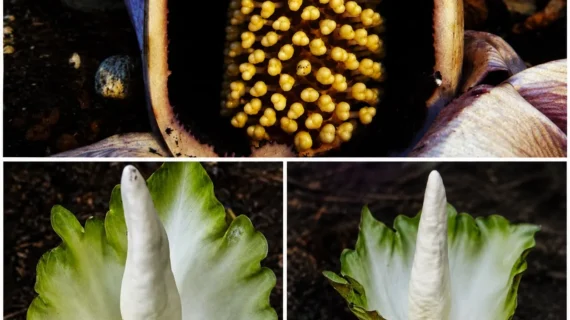
A short peduncle, similarly colored but usually paler than the petiole, supports a solitary inflorescence. This peduncle measures 3 to 20 centimeters, occasionally reaching 35 centimeters, and lengthens noticeably once fruit develops. The spathe forms a bell-shaped, broadly oval bowl, typically 10 to 25 centimeters across, though exceptional specimens reach 40 centimeters. Color varies widely: the outer base ranges from yellowish green with whitish streaks to a purplish tone with pale spots, while the inner surface deepens to dark maroon. During female anthesis, small ridge-like warts inside the spathe base secrete fluid that pools and collects there.
Spadix and Appendix
The spadix generally exceeds the spathe in length once the plant matures, spanning 9 to 55 centimeters on a short stipe. A cylindrical or conic female zone leads into a congested male zone, which itself gives way to the appendix — the true showpiece of variability in this species. Depending on plant size, the appendix ranges from nearly globose to broadly ovate and fusiform, sometimes laterally compressed with longitudinal folds or a network of shallow grooves. Its creamy white to pale sulphur-yellow surface heats up noticeably when the spathe opens, releasing a strong, gaseous odor to attract pollinators.
Reproductive Structures and Fruit
Within the female zone, depressed, two-locular ovaries carry a single basal ovule per chamber, topped by a distinct style and a large, two-lobed stigma in pale lemon to creamy tones. Male flowers cluster with three to five stamens each, bearing creamy-white, quadrangular anthers around 2 to 3.2 millimeters long. After pollination, the plant produces red or orange-red elongated berries, each holding one or two seeds. Interestingly, these seeds sometimes germinate while still inside the berry.
Distribution
Amorphophallus prainii occurs naturally in Indonesia, specifically Sumatra and East Kalimantan, as well as southern Thailand and the Malay Peninsula. This relatively broad range sets it apart from many narrowly endemic species in the genus. Both Plants of the World Online (Kew) and the Global Biodiversity Information Facility (GBIF) list similar distribution records, reflecting the species’ presence across multiple Southeast Asian regions.
Habitat
This species favors lowland forests, though it also tolerates open and rocky sites. It grows across a wide elevational range, from sea level up to 850 meters. Consequently, Amorphophallus prainii adapts to a broader set of environmental conditions than many of its more habitat-restricted relatives.
Taxonomic Notes
Botanists consider Amorphophallus prainii highly variable, particularly in the size and shape of its inflorescence parts. Soil conditions around the tuber appear to drive much of this variation. Consequently, the appendix alone can range from nearly spherical in small plants to strongly inflated in mature ones. Despite this variability, one feature remains a reliable identifier: the pale, bell-shaped spathe. Field botanists still use this trait to recognize the species even amid its many other inconsistencies.
References
- Hook. f. (1893). Amorphophallus prainii. Flora of British India 6: 516 (protologue).
- Plants of the World Online, Royal Botanic Gardens, Kew. https://powo.science.kew.org/
- Global Biodiversity Information Facility (GBIF). https://www.gbif.org/
-


