
What Is Annona muricata?
Annona muricata — commonly known as Soursop — is a rare and iconic tropical plant. It originates from Central and South America, including Mexico, the Caribbean, and the northern regions of South America. The plant grows naturally in humid, lowland tropical forests. Furthermore, it thrives in warm coastal environments and fertile volcanic soils.
Soursop has been cultivated since pre-Columbian times. Indigenous communities across the Americas used it for food and traditional medicine. Today, it remains one of the most globally sought-after rare exotic plants. Collectors, growers, and botanists prize it for its unique appearance and extraordinary fruit.
Annona muricata is now widely grown across tropical Asia, Africa, and the Pacific. Additionally, it holds a strong presence in Indonesia, where the climate suits it perfectly. However, genuine organic seeds with proper documentation remain rare. Induare Agro provides verified, export-quality seeds directly from Indonesia.
Consequently, sourcing Annona muricata seeds from a trusted Indonesian supplier gives buyers a significant advantage. Indonesia’s tropical climate produces vigorous, high-viability seeds. Moreover, buyers receive full phytosanitary documentation for legal international import.
Aesthetic Features Annona muricata
The visual character of Annona muricata is bold and unmistakable. Every part of this plant commands attention — from its glossy canopy to its dramatic spiked fruits. Furthermore, the tree brings genuine tropical grandeur to any garden or collection.
Leaf Structure
The leaves of Annona muricata are oblong and oval in shape. They measure between 8 and 16 cm in length. Additionally, each leaf has a deep, glossy dark-green surface on top. The underside is paler, creating a two-tone effect that is visually striking.
The leaves are smooth and leathery to the touch. Furthermore, they release a mild, pleasant aroma when gently bruised. The leaf arrangement along each branch is alternating and well-spaced. Consequently, the tree forms a dense, lush canopy even at a young age.
Young branches are softly hairy when they first emerge. Moreover, the overall form of the tree is upright and elegant. Annona species are widely admired for their clean tropical silhouette.
Flower and Fruit
The flowers of Annona muricata are fleshy and waxy in texture. They are typically pale yellow-green and grow directly from the trunk and branches — a feature called cauliflory. Primarily, this unusual growth pattern makes the flowers highly visible and easy to observe.
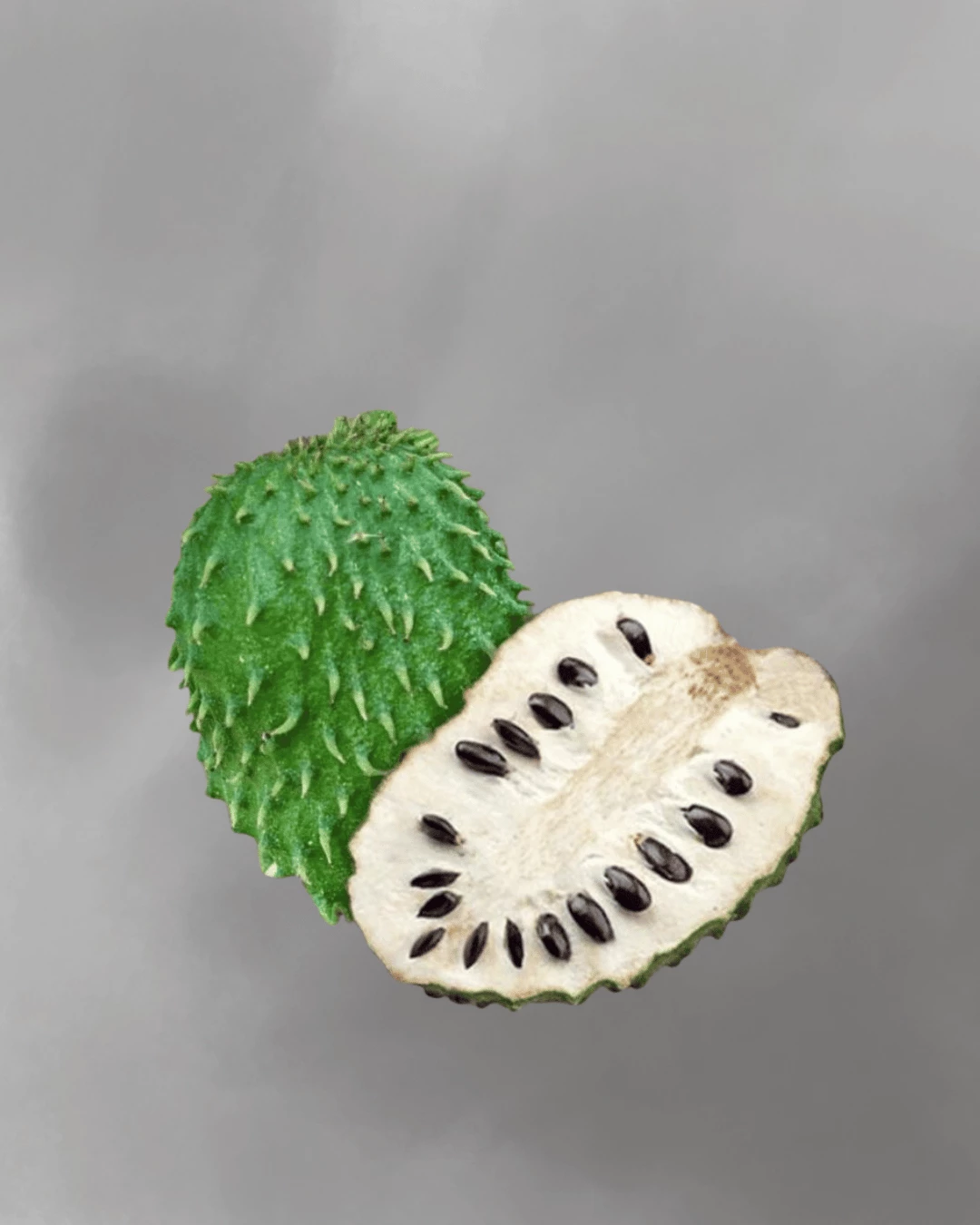
The fruit is the true showpiece of this plant. It is large, irregularly oval, and can reach up to 30 cm in length. Furthermore, the outer skin is dark green and covered in soft, curved spines — giving it an exotic, almost prehistoric appearance.
Inside, the fruit contains a soft, creamy white pulp. The flavor is a tropical blend of strawberry, pineapple, and citrus with a smooth, custard-like texture. Consequently, Soursop is considered one of the most exciting rare fruits in the world. Additionally, each large fruit contains between 50 and 200 dark brown to black seeds.
Growth Habit and Tree Form
Annona muricata is a small to medium-sized evergreen tree. It typically reaches between 8 and 10 metres in height at full maturity. Primarily, it grows in an upright, branching form with a broad crown. Moreover, the tree maintains its foliage year-round, providing a consistently lush display.
The tree begins to bear fruit within 3 to 5 years from seed. Furthermore, with proper care it can produce fruit multiple times per year in tropical climates. Consequently, it is both an ornamental showpiece and a highly productive fruiting tree.
Global Seed Delivery & Phytosanitary Certification
Induare Agro takes international seed delivery seriously. Every order is prepared with care, precision, and full legal compliance. Furthermore, our seeds meet the highest export standards required for global botanical trade.
Packaging and Shipping
Induare Agro ships all seeds via Global Express courier services. Additionally, every package is carefully prepared to protect seed viability during transit. Seeds are cleaned, dried to optimal moisture levels, and packed in professional materials. Consequently, buyers receive seeds in prime germination-ready condition.
Furthermore, all shipments include a valid Phytosanitary Certificate issued by the Indonesian Plant Quarantine Authority. This certificate confirms that the seeds are free from pests, diseases, and regulated organisms. Moreover, it satisfies the import requirements of most countries worldwide.
Tracking information is provided for every order. Primarily, this ensures buyers can monitor their shipment from Indonesia to their destination. Induare Agro processes orders promptly to maintain seed freshness.
Buyer Peace of Mind
Buying rare exotic seeds internationally requires trust and documentation. Consequently, Induare Agro provides full transparency on every shipment. Our Phytosanitary Certificate protects buyers from legal complications at customs. Furthermore, it proves the seeds are organic, clean, and legally exported.
Moreover, Induare Agro follows all ISPM-15 regulations for international plant material shipping. Additionally, our team is available to answer any customs or documentation questions before and after purchase. We have successfully delivered rare plants and exotic seeds to collectors across Europe, the Americas, Asia, and beyond.
Primarily, our goal is to make acquiring rare Indonesian plants simple and stress-free. Induare Agro stands behind every seed we sell.
How to Grow Annona muricata
Step 1 — Prepare Your Seeds Soak the Annona muricata seeds in warm water for 24 to 48 hours before planting. This softens the hard outer seed coat and improves germination rates. Discard any seeds that float, as they may not be viable.
Step 2 — Choose the Right Soil Fill a small pot with a well-draining, slightly acidic potting mix (pH 5.5–7.0). Add organic compost or well-rotted manure to improve nutrient content. Good drainage is critical — Annona muricata does not tolerate waterlogged roots.
Step 3 — Sow the Seeds Plant each seed approximately 1 cm deep in the prepared mix. Cover lightly and water gently. Place the pot in a warm, humid location with indirect bright light.
Step 4 — Maintain Warmth and Moisture Keep the soil consistently moist but never saturated. Maintain a temperature between 25°C and 30°C (77°F–86°F) for best results. Germination typically occurs within 3 to 8 weeks.
Step 5 — Transplant When Ready When seedlings develop three or more true leaves, they are ready to move. Transplant into a larger container or directly into warm, well-drained garden soil. Protect young plants from cold winds and temperatures below 5°C (41°F).
Step 6 — Ongoing Care Water deeply once or twice per week during the growing season. Fertilise every 4 to 6 weeks with a balanced organic fertiliser. Prune lightly to shape the tree and encourage strong branch structure.
