
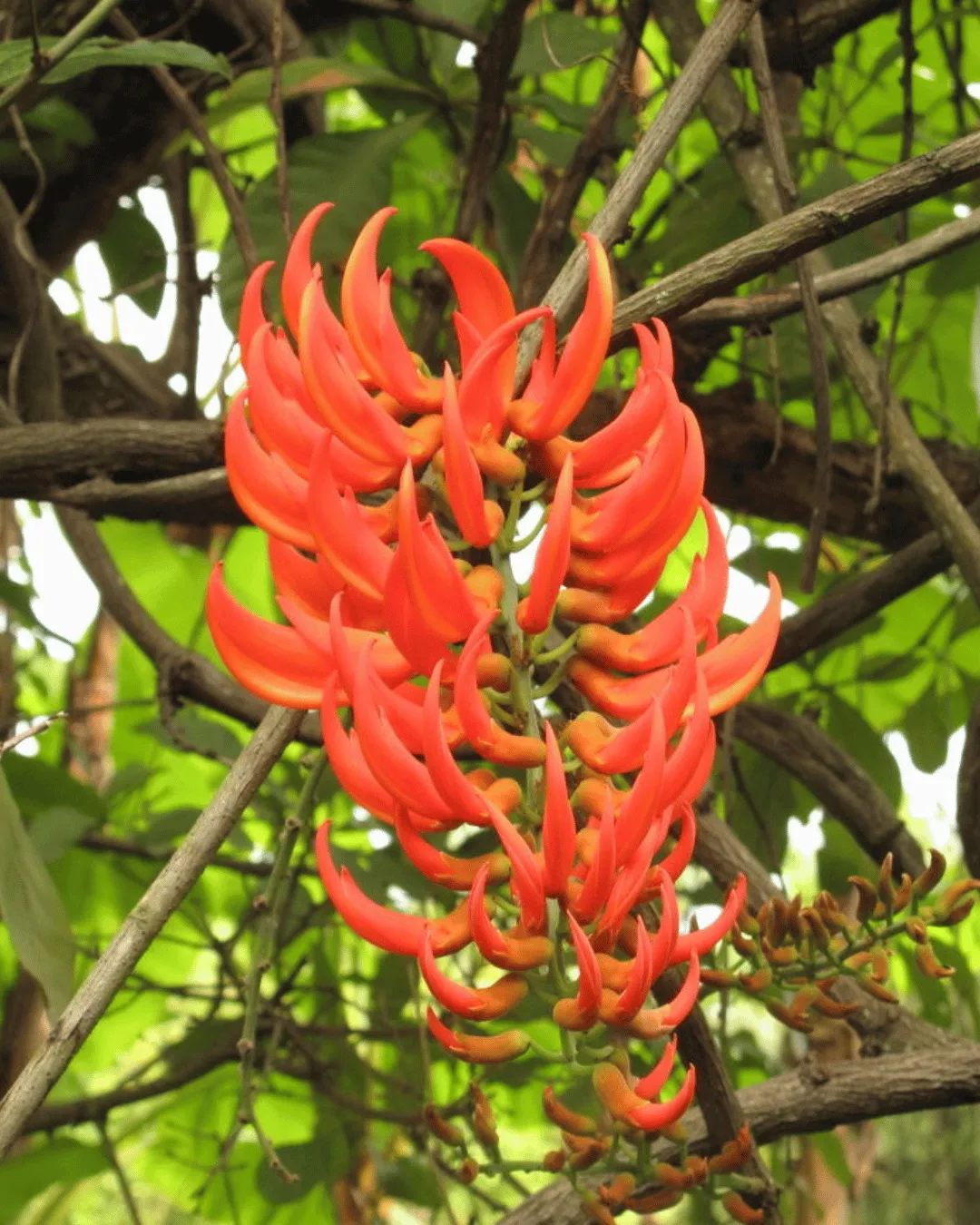
What Is Mucuna bennettii?
Mucuna bennettii is one of the most spectacular flowering vines on the planet. It is commonly known as the Red Jade Vine, the New Guinea Creeper, and the Flame of the Forest. This fast-growing climber is native to the tropical rainforests of Papua New Guinea. Furthermore, its natural range extends from Sulawesi through Papua New Guinea to Vanuatu — covering a stretch of the Pacific Islands known for extraordinary biodiversity.
The species was formally described by the Victorian government botanist Ferdinand von Mueller in 1876. Additionally, six other red-flowered Mucuna species are found in Indonesia and Papua New Guinea. Consequently, M. bennettii is often confused with close relatives such as Mucuna novo-guineensis and Mucuna warburgii. However, the seeds of M. bennettii are clearly distinct — measuring 21–36 mm in length, smaller than those of M. novo-guineensis.
In the wild, the vine climbs tall forest trees, reaching heights of 10–20 metres. Furthermore, there are reports of mature plants growing to over 30 metres in ideal conditions. The Red Jade Vine is one of the most sought-after ornamental climbers in the world. Primarily, this is because its flower clusters can reach over one metre in length. No other commonly available vine produces a comparable floral display. Induare Agro now offers verified, fresh seeds of this extraordinary species — a rare and fully documented opportunity for serious plant collectors worldwide.
Aesthetic Features Mucuna bennettii
Mucuna bennettii is a large, woody, evergreen climbing vine. It grows fast and produces thick, twining stems that wrap around any available support. The overall appearance is bold, lush, and deeply tropical. Furthermore, each part of the plant — from its glossy leaves to its extraordinary flowers — contributes to one of the most dramatic plant displays available to collectors today.
Leaves and Stems
The leaves are compound — meaning each leaf consists of three oval-shaped leaflets arranged together on a single stalk. Furthermore, the leaflets are smooth, glossy, and bright green. They can grow up to 15 cm in length. Additionally, the stems are strong and woody at the base as the plant matures. They twine and wrap firmly around poles, trees, or trellises. Consequently, the plant builds a dense and vigorous structure over time. The foliage is evergreen, meaning the plant keeps its leaves throughout the year in warm climates.
Flowers
The flowers of Mucuna bennettii are the reason this vine is globally famous. They are fiery scarlet to orange-red in colour. Each individual flower is claw-shaped — curved and hooked like a talon. Furthermore, the flowers grow in large, pendulous clusters — called racemes — that hang downward from the vine like chandeliers. Each raceme can reach 90 cm to over one metre in length. Additionally, a single mature vine can carry dozens of these hanging clusters at the same time. Consequently, a flowering M. bennettii creates one of the most breathtaking visual displays in the entire plant kingdom. The flowers are rich in nectar and attract birds — especially sunbirds and honeyeaters — as their main pollinators. Flowering typically begins at or around the two-year mark on a well-grown plant.
Seeds and Pods
After pollination, the vine produces large, flat seed pods. Furthermore, each pod holds 1–3 seeds. The seeds are large, flat, and oval — measuring 21–36 mm in length. Additionally, the seed coat is hard and dark brown. Primarily, this hard coat protects the seed during dispersal. It also means that seed preparation before planting is an important step — which is covered in the growing guide below.
Global Seed Delivery & Phytosanitary Certification
Induare Agro is a professional botanical seed exporter based in Indonesia. The company supplies rare, exotic, and hard-to-source tropical plant seeds to collectors, growers, and botanical institutions in more than 50 countries. Furthermore, Induare Agro operates with a strict, fully documented export process from harvest to delivery. Every single order meets the legal requirements of international plant import regulations.
Packaging and Shipping
Induare Agro packs every seed with care. Each seed is wrapped in moisture-control material before being placed in cushioned express packaging. This protects the seed throughout the full transit journey. Shipments go out via Global Express couriers such as DHL and EMS. Additionally, most international orders arrive within 5–14 business days. Furthermore, every parcel includes an official Phytosanitary Certificate. This document is issued by Indonesia’s Plant Health Authority. It confirms the seeds are free from pests, disease, and regulated pathogens. Consequently, it satisfies the import rules of customs offices in the EU, USA, UK, Australia, Japan, and most other regulated markets worldwide.
Buyer Peace of Mind
Induare Agro puts legal compliance first. Every order ships with the Phytosanitary Certificate and a full commercial invoice. Furthermore, this complete document set ensures smooth, fast customs clearance at every international destination. Additionally, the Induare Agro team provides after-sales growing support at every stage. Primarily, the mission is simple — help every collector successfully germinate and establish their rare Mucuna bennettii from the very first seed.
How to Grow Mucuna bennettii
Mucuna bennettii is a rewarding plant to grow from seed. Furthermore, growers in tropical, subtropical, and warm temperate climates can all achieve great results. The key is to replicate the warm, humid conditions of its native Papua New Guinea rainforest. Follow these steps carefully for the best outcome.
Step 1 — Seed Preparation Nick or lightly sand the hard outer seed coat before soaking — this is called scarification. Additionally, soak the seed in warm water (28–30°C) for 24–48 hours. This softens the coat and dramatically speeds up sprouting.
Step 2 — Growing Medium Use a rich, well-draining mix: 50% loamy potting soil, 30% compost, and 20% perlite or coarse sand. Consequently, this supports strong root development while preventing waterlogging at the base of the seedling.
Step 3 — Sowing Plant the seed 2–3 cm deep in a pot with good drainage holes. Furthermore, keep the soil evenly moist throughout the germination period. Do not allow it to dry out completely at any stage.
Step 4 — Temperature Maintain a consistent temperature of 24–30°C for best germination results. Primarily, warmth is the single most important factor for successful sprouting. A heated propagation mat works well in cooler climates.
Step 5 — Light Place the germinating seed in bright, indirect light. Additionally, protect young seedlings from harsh direct midday sun in the first few weeks. Gradually move to full sun exposure as the plant grows stronger.
Step 6 — Watering Keep the soil consistently moist during the active growing phase. Furthermore, ensure the pot drains freely after every watering. Never let the pot sit in standing water, as root rot is the main risk factor.
Step 7 — Climbing Support Provide a strong trellis, pole, or pergola once the seedling reaches 20–30 cm tall. Consequently, the vine will begin to twine and climb rapidly. A large tree or a heavy-duty pergola makes the ideal long-term support structure.
Step 8 — Fertilising Apply a balanced organic fertiliser (NPK 15-15-15) every 4–6 weeks during the growing season. Additionally, a phosphorus-rich feed supports flower development. Furthermore, keep the root zone mulched and shaded — roots prefer cool, moist conditions even when the top of the plant is in full sun.
© Induare Agro — Indonesia’s professional rare seed exporter.
