
What Is Artocarpus altilis?
Artocarpus altilis, commonly known as Sukun in Indonesia, is one of the most important tropical fruit trees on Earth. It belongs to the Moraceae family — the same family as jackfruit and mulberry. The tree originated in the region stretching from New Guinea and the Maluku Islands of Indonesia to the Philippines. Furthermore, humans first domesticated this species around 3,000 years ago in the western Pacific. Consequently, it holds deep cultural and agricultural roots across Southeast Asia and the Pacific Islands.
Today, Sukun is cultivated across the tropics — from Indonesia and the Philippines to the Caribbean and Central America. Additionally, it is recognised globally as a sustainable food crop. The fruit is starchy and filling, much like a potato or freshly baked bread — which is exactly how it got its English name, breadfruit. Primarily, Induare Agro offers this species as an Indonesian-origin seed, sourced fresh from local growers. Furthermore, each seed ships with full export documentation, making Induare Agro one of the most reliable sources for this species outside of its native range.
Aesthetic Features Artocarpus altilis
Artocarpus altilis is a large, handsome evergreen tree. It has a broad, spreading canopy and a thick trunk that can reach up to 1.2 metres in diameter at full maturity. The bark is smooth and pale in color. Consequently, the tree has a clean, striking appearance that makes it attractive even as a standalone garden specimen.
Leaves
The leaves of Artocarpus altilis are one of its most dramatic features. They are very large — often reaching 50 to 90 cm in length. Furthermore, they are deeply divided into 7 to 11 pointed lobes, giving them a bold, sculptural look. The upper surface is dark, glossy green. Additionally, the underside is paler and slightly rough to the touch. Consequently, these leaves give the tree a lush, tropical character that is immediately recognisable.
Flowers and Fruit
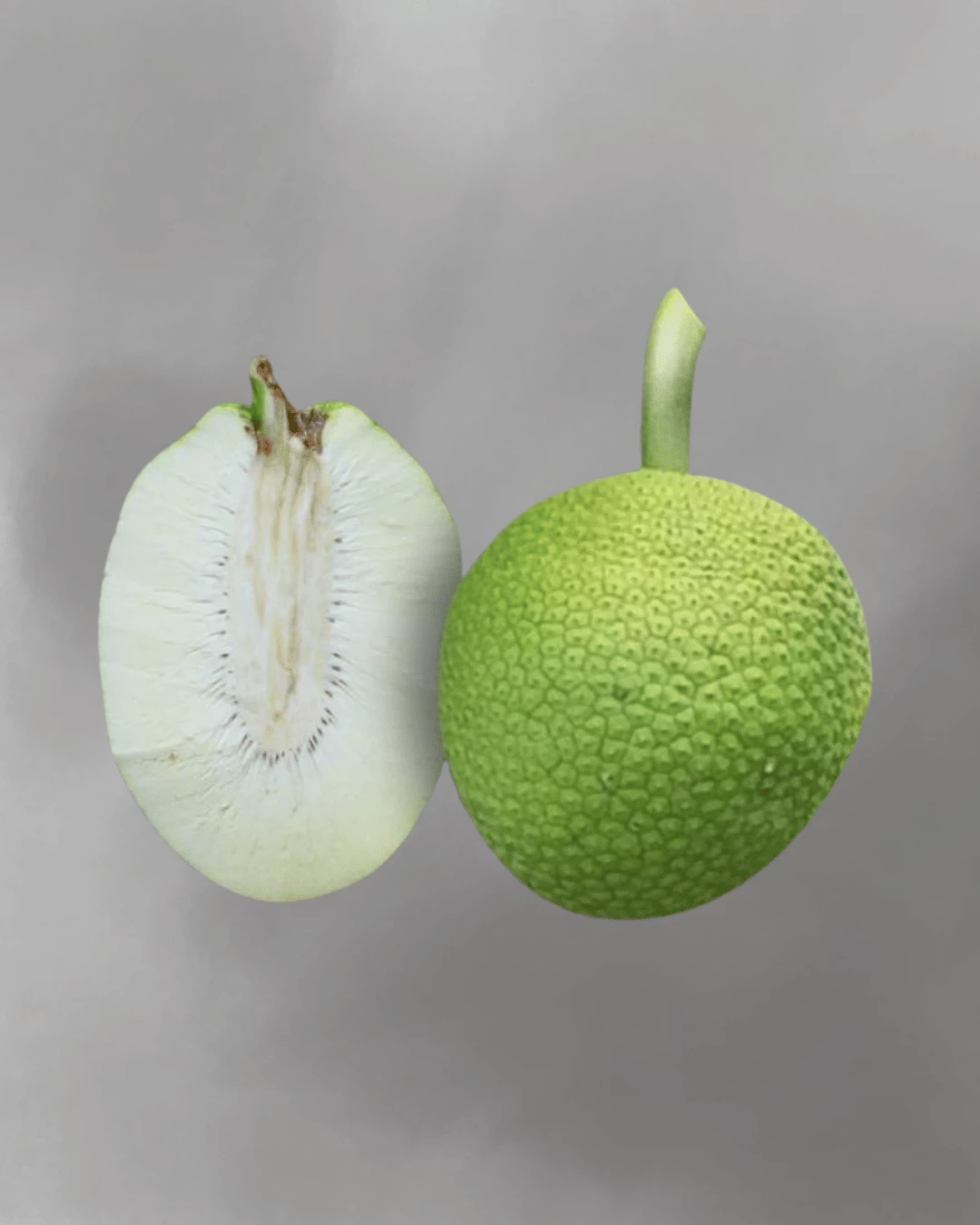
The tree produces separate male and female flowers on the same plant. Male flowers appear first as long, club-shaped yellow clusters. Furthermore, female flowers develop into the fruit directly — there is no separate pollination event needed. The fruit is large, round to oval in shape, and measures 10 to 30 cm in diameter. Additionally, the outer skin is green and covered in small, hexagonal bumps. When ripe, the flesh inside turns creamy white or pale yellow. Primarily, the flesh is starchy and firm when unripe — ideal for cooking like a vegetable. When fully ripe, it becomes softer and mildly sweet. The fruit is exceptionally nutritious. It is high in carbohydrates, vitamin C, potassium, and dietary fibre.
Tree Size and Canopy
Artocarpus altilis grows into a tall, full-canopy tree. In the wild and in open gardens, it typically reaches 12 to 20 metres in height. Additionally, in containers or small plots, growers can manage its size through pruning. Furthermore, the canopy spreads wide and provides dense shade. Consequently, this tree serves multiple roles at once: food producer, shade tree, ornamental specimen, and ecological asset.
Global Seed Delivery & Phytosanitary Certification
Induare Agro is a professional botanical seed exporter based in Indonesia. The company specialises in connecting rare and culturally significant Indonesian plant species with collectors, researchers, and growers worldwide. Furthermore, Induare Agro handles every aspect of the export process — from seed selection to final delivery documentation. Primarily, the goal is to make international seed sourcing simple, legal, and reliable.
Packaging and Shipping
Induare Agro wraps every seed in moisture-control material before packing. Cushioned express packaging keeps the seeds safe throughout the journey. Shipments go via Global Express couriers such as DHL and EMS. Additionally, most international orders arrive within 5–14 business days. Furthermore, every parcel includes the official Phytosanitary Certificate. This document is issued by Indonesia’s Plant Health Authority. Consequently, it confirms the seeds are free from pests, disease, and regulated pathogens. It satisfies customs requirements in the EU, USA, UK, Australia, Japan, and most other regulated markets.
Buyer Peace of Mind
Induare Agro includes a full set of export documents with every order. The commercial invoice, packing list, and Phytosanitary Certificate all travel with the parcel. Furthermore, this makes customs clearance smooth and straightforward for the buyer. Additionally, the Induare Agro team provides growing support after purchase. Primarily, the aim is to ensure that every seed ordered from Induare Agro reaches its destination safely — and grows successfully.
How to Grow Artocarpus altilis
Artocarpus altilis is a strong, fast-growing tree. Furthermore, growers in tropical and subtropical climates will find it easy to establish from seed. Follow these steps for the best germination results.
Step 1 — Seed Preparation Fresh Sukun seeds lose viability quickly, so plant as soon as possible after receiving. Additionally, soak the seed in warm water (25–28°C) for 24 hours before sowing to soften the outer coat.
Step 2 — Growing Medium Use a rich, well-draining mix: 50% loamy potting soil, 30% coarse sand or perlite, and 20% compost. Consequently, this gives the seedling strong drainage and good early nutrition.
Step 3 — Sowing Plant the seed 2–3 cm deep in a pot with drainage holes. Furthermore, keep the soil consistently moist but never waterlogged throughout the sprouting stage.
Step 4 — Temperature Maintain temperatures between 22°C and 35°C for optimal sprouting. Primarily, warm conditions are essential — Sukun does not sprout well in cool or fluctuating temperatures.
Step 5 — Light Place the pot in a warm, bright spot with indirect light. Additionally, once the seedling reaches 15 cm in height, move it to full sun gradually.
Step 6 — Watering Water deeply but allow the top layer of soil to dry slightly between sessions. Furthermore, mature Sukun trees tolerate brief dry periods well, but seedlings need consistent moisture.
Step 7 — Transplanting Move the seedling to a large garden bed or container once it reaches 20–30 cm in height. Consequently, more root space leads to faster growth and earlier fruiting.
Step 8 — Fertilising Apply a balanced organic fertiliser (NPK 10-10-10) every 6–8 weeks during the growing season. Additionally, a potassium-rich feed during fruit development greatly improves fruit size and quality.
© Induare Agro — Indonesia’s professional rare seed exporter.
