
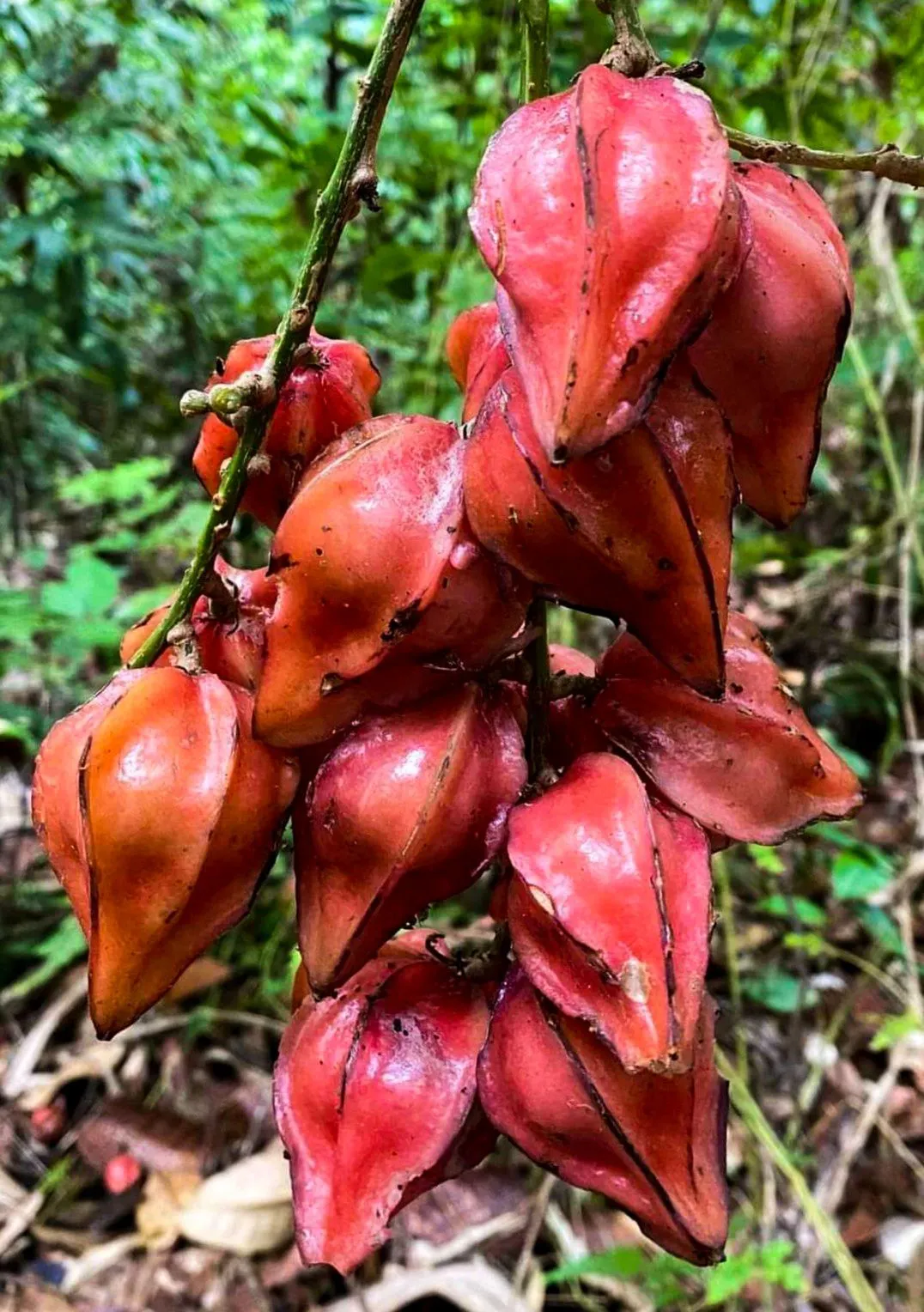
What Is Baccaurea angulata?
Baccaurea angulata is a rare tropical fruit tree native to the island of Borneo. It grows wild in the lowland and hill forests of Indonesian Kalimantan, Malaysian Sarawak and Sabah, and Brunei Darussalam. The tree thrives in riverine and mixed dipterocarp forests at elevations from sea level up to 800 metres. It is entirely endemic to Borneo, meaning it grows naturally nowhere else on earth. This makes it one of the most sought-after rare plants in Indonesia and a top prize for exotic plant collectors worldwide.
The species carries several local names. The Iban people of Sarawak call it uchong. In Kalimantan, locals know it as pidau or belimbing darah — which translates to “blood starfruit.” Furthermore, global collectors and botanists know it simply as the Red Angled Tampoi. Its extreme rarity, edible fruit, and striking appearance make it a must-have for any serious rare plant enthusiast.
Additionally, this species holds cultural importance. Local Bornean communities have harvested it from the wild for generations. They eat the fruit fresh, use it in traditional cooking, and dry the skin as a souring agent for soups. Consequently, seeds rarely leave the island through formal export channels. Induare Agro changes that by offering export-quality seeds with full legal documentation.
Aesthetic Features Baccaurea angulata
Baccaurea is a genus of flowering plants in the family Phyllanthaceae. This genus includes over 100 species across tropical Asia and the Pacific. Among them, Baccaurea angulata stands out for its extraordinary appearance. Moreover, no other Baccaurea species produces a fruit quite like it.
Leaf Structure
The leaves of Baccaurea angulata are smooth and oval in shape. Each leaf measures 12–30 cm long and 4–14 cm wide. Primarily, the leaf surface is glossy and deep green. The leaves grow alternately along sturdy branches. They form a dense, attractive canopy that provides rich tropical shade. Additionally, the leaf margin is slightly wavy, giving the tree a lush, layered look. This makes the tree visually appealing even before it fruits.
Flower and Fruit
The flowers of Baccaurea angulata grow directly on the trunk and branches — a growth pattern called cauliflory — meaning flowers and fruits emerge straight from the bark, not from new branch tips. Cream to yellow flower clusters appear along the bole (the lower main trunk) and major branches. The tree is dioecious — meaning male and female flowers grow on separate trees. Consequently, you need at least one male and one female tree for fruit production.
The fruit is the star of the show. Furthermore, it is unlike any other fruit in the genus. Each berry is 5–6 cm long, with a distinctive star-shaped cross-section when cut open. The skin is thick and bright red at full ripeness. Immature fruits start dark purple and shift to vivid red as they ripen. Inside, the seeds sit within a white arillode — a juicy, fleshy coating around the seed — which is sweet and sour in taste. Thousands of fruits can ripen on a single tree at once. Additionally, the trunk turns visually red from a distance when fully laden with fruit.
Growth Habit and Fruiting Timeline
Baccaurea angulata is a medium to large tropical tree. It reaches 6–21 metres in height at full maturity. However, it begins flowering as early as three years from seed. Primarily, the tree grows on sandy or lateritic — iron-rich — soils in partial to full shade. The flowering season runs from May to November. Moreover, fruits ripen from November through January, making it a late-season fruiting tree. The tree grows at a relatively fast rate for a forest species, which makes it rewarding for patient collectors. The bole — the lower trunk — can reach 10–40 cm in diameter on mature specimens.
Global Seed Delivery & Phytosanitary Certification
Induare Agro is Indonesia’s trusted source for rare exotic seeds and rare plants. We operate from the heart of Kalimantan, the Indonesian portion of Borneo. Furthermore, we are fully committed to legal, safe, and professional global exports.
Packaging and Shipping
We ship every order via Global Express courier. This ensures fast, tracked delivery to collectors and growers worldwide. Additionally, every seed is carefully selected for freshness and viability before packing. We use professional packaging materials that protect seeds from moisture, pressure, and temperature changes during transit. Consequently, your seeds arrive in the best possible condition. Furthermore, we have successfully shipped rare Indonesian plants and exotic seeds to buyers across Europe, North America, Australia, and Asia.
Buyer Peace of Mind
Every order from Induare Agro includes a Phytosanitary Certificate issued by the Indonesian government. This is an official plant health document. It confirms that your seeds have passed phytosanitary — plant health — inspections and are free from pests and diseases. Moreover, it is required by most countries for legal import of plant material. This means you can receive your seeds with confidence and without customs complications. Additionally, our team handles all export paperwork on your behalf. You simply place your order and we manage the rest.
How to Grow Baccaurea angulata
Step 1 — Prepare Your Growing Medium Use a well-draining, rich tropical soil mix. A blend of garden soil, coconut coir, and perlite works very well.
Step 2 — Soak the Seeds Soak seeds in warm water for 24 hours before planting. This softens the seed coat and speeds up germination.
Step 3 — Plant at the Correct Depth Plant each seed 1–2 cm deep in a small pot or seed tray. Keep the soil moist but never waterlogged.
Step 4 — Provide Warmth and Humidity Place your pot in a warm spot with temperatures between 25–35°C. High humidity speeds up germination. A plastic dome or propagation tent helps retain moisture.
Step 5 — Wait for Germination Germination typically occurs within 2–6 weeks. Furthermore, patience is key — some seeds may take slightly longer.
Step 6 — Transplant When Ready Once your seedling has 3–4 true leaves, transplant it to a larger container or into the ground. Additionally, provide partial shade during the first growing season.
Step 7 — Plan for Pollination Remember, Baccaurea angulata is dioecious. Consequently, you will need at least one male and one female tree to produce fruit. Plan your collection accordingly from the start.
