
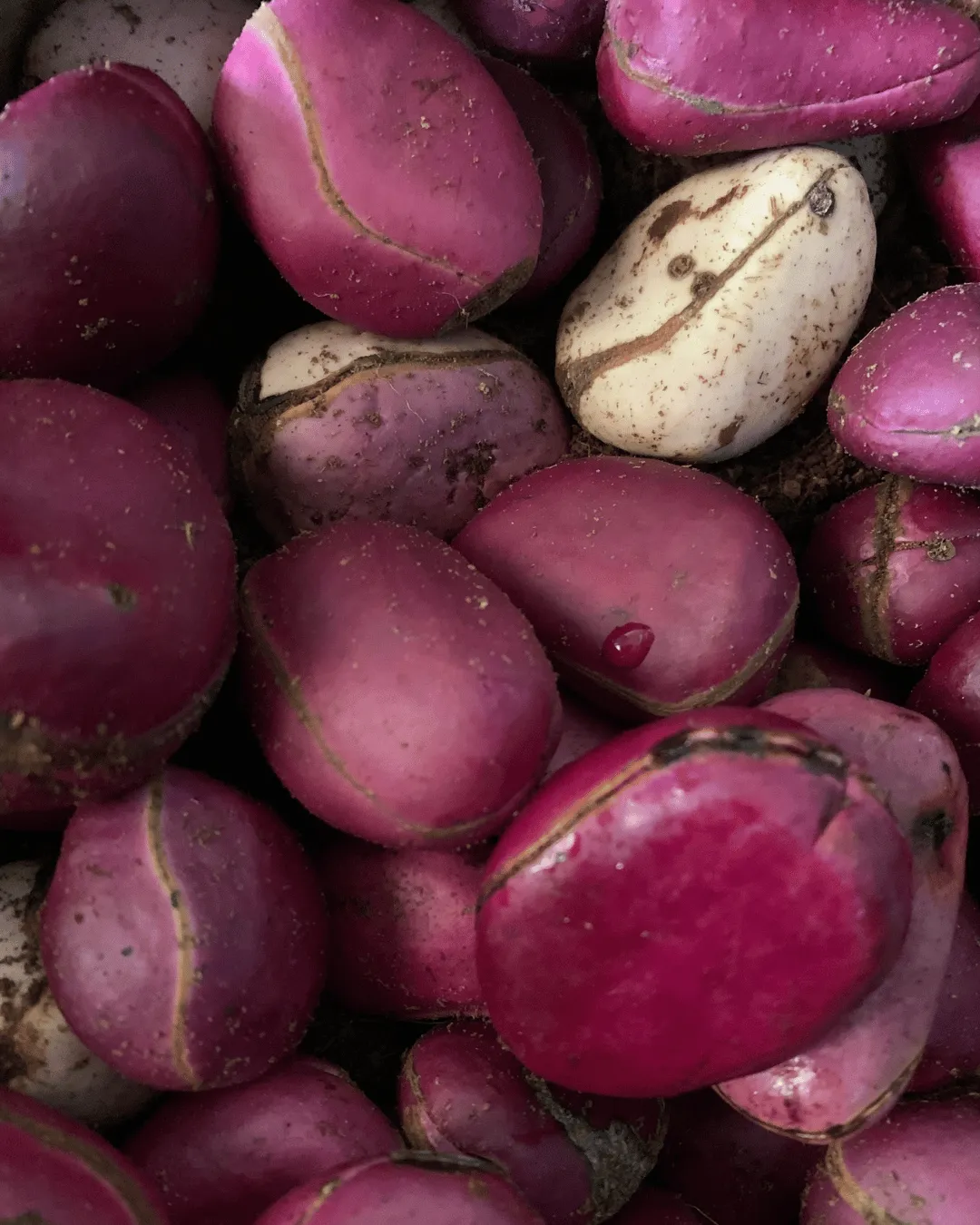
What Is Cola nitida?
Cola nitida is the scientific name for the Kola Nut tree — a rare and iconic tropical evergreen native to West Africa. It originates from the lowland rainforests of Sierra Leone, Liberia, Ivory Coast, Ghana, and Nigeria. Furthermore, it thrives at altitudes below 300 metres, in deep, fertile soils with well-distributed annual rainfall of 1,200–1,800 mm. This makes it a true child of the humid tropics.
Cola nitida is globally sought-after for many reasons. Its seeds contain 2–4% caffeine, making them powerful natural stimulants. Additionally, the tree has centuries of cultural significance — its nuts are used in African weddings, naming ceremonies, and traditional medicine. Collectors and ethnobotanists prize it for its rarity outside its native range.
The name “cola” in popular soft drinks like Coca-Cola traces directly back to this species. Moreover, Cola nitida is closely related to Theobroma cacao — the cocoa tree — placing it in a prestigious family of commercially important tropical plants. Consequently, owning a seed of Cola nitida means growing a piece of living global history.
Outside West Africa, this tree remains genuinely rare. It has been introduced to parts of Brazil, India, Sri Lanka, and the Americas — but it is almost impossible to find as a seed for private collection in Southeast Asia. Induare Agro bridges that gap, offering export-quality, organically grown seeds with full documentation.
Aesthetic Features Cola nitida
Cola nitida is not just a useful plant — it is a stunning tropical tree. Its appearance impresses at every growth stage. Furthermore, the tree develops a commanding canopy and a deeply textured trunk that draws attention in any tropical garden or collection.
Leaf Structure
The leaves of Cola nitida are large, simple, and alternate — meaning they grow in a staggered pattern along each branch, one at a time. Each leaf is oblong and leathery in texture, with smooth, wavy margins and no teeth along the edges. Additionally, leaves can reach up to 33 cm (about 13 inches) in length. They are deep glossy green on the upper surface, making the canopy visually rich and lush.
The leaf stalks (petioles) give each leaf graceful movement in the tropical breeze. Young trees grow slowly and develop dense, shade-tolerant foliage. Primarily, this leaf structure allows the tree to maximise sunlight capture under the dense rainforest canopy, which is exactly the habitat it evolved in.
Flower and Fruit
The flowers of Cola nitida are small but striking. They grow in clusters from the leaf axils — the joint where leaf meets stem. Flowers have no petals; instead, they display a yellow calyx — the outer cup-shaped layer — with bold red nectar guides inside. Male flowers are cup-shaped and about 2 cm across. Female flowers are larger, reaching 5 cm in diameter.
Consequently, the fruit that follows is one of the most remarkable features of the plant. The fruit is a star-shaped aggregate — a cluster of up to 5 fleshy pods (called follicles) arranged in a star pattern. Each pod can grow up to 13 cm long and 7 cm wide. When ripe, the pods split open naturally, revealing seeds wrapped in a white seed coat. The inner flesh of the seed — the kola nut of commerce — is mottled white, reddish-grey, or brown. Moreover, each fruit can contain up to 10 seeds.
Bark and Tree Form
Cola nitida grows into a tall, majestic evergreen tree reaching 12–20 metres (up to 27 metres in ideal conditions). The trunk can reach 1.5 metres in diameter in mature specimens. Additionally, older trees develop large, wing-like root flanges called buttresses — wide, flat extensions at the base of the trunk that provide extra support. These are a hallmark of large tropical rainforest trees.
The bark is thick, fibrous, and grey-brown in colour, with deep lengthwise cracks. When the bark is damaged, it reveals striking pinkish-red wood beneath. Furthermore, smaller branches are smooth and lighter in colour, providing a beautiful contrast to the rugged lower trunk.
Global Seed Delivery & Phytosanitary Certification
Induare Agro is committed to safe, legal, and professional seed export from Indonesia to collectors worldwide. We understand that buying rare seeds across borders requires trust. Consequently, every order we ship is prepared with the utmost care and full compliance with international plant health regulations.
Packaging and Shipping
Each Cola nitida seed is carefully prepared for long-distance global travel. We ship via Global Express courier services to ensure fast and reliable delivery. Additionally, seeds are packaged with moisture-appropriate materials to preserve viability during transit. We have dispatched rare and exotic seeds to collectors in Europe, North America, the Middle East, Asia, and beyond.
Furthermore, Induare Agro ensures that all packaging clearly identifies the plant species, origin, and quantity. This transparency helps customs clearance proceed smoothly in the destination country.
Buyer Peace of Mind
Every shipment from Induare Agro includes an official Phytosanitary Certificate issued by the competent Indonesian plant health authority. This document confirms that the seeds have been inspected, are free from pests and diseases, and comply with international phytosanitary standards.
Primarily, this certificate protects the buyer. It allows the seeds to pass through customs legally in most countries that accept plant imports. Moreover, it reflects Induare Agro‘s commitment to organic, export-quality products. We do not cut corners. We handle the paperwork so you can focus on growing.
How to Grow Cola nitida
Step 1 — Source Fresh Seeds Always start with fresh, viable seeds from a trusted supplier like Induare Agro. Cola nitida seeds lose viability quickly and must be planted soon after receipt.
Step 2 — Prepare the Growing Medium Use a well-draining, fertile tropical potting mix with a slightly acidic pH of 5.0–6.0. Additionally, mix in organic compost to improve nutrition and water retention.
Step 3 — Sow the Seed Plant the seed about 2–3 cm deep with the flat side facing down. Keep the soil consistently moist but never waterlogged. Germination typically takes 30–80 days under warm conditions.
Step 4 — Provide Warmth and Humidity Cola nitida requires warm temperatures of 21–35°C (70–95°F) to thrive. Consequently, place the pot in a warm, humid environment with indirect bright light for the first few months.
Step 5 — Shade Young Seedlings Young trees need some shade to establish well. Primarily, avoid placing seedlings in direct harsh midday sun. Furthermore, maintain high humidity around the plant by misting regularly.
Step 6 — Transplant to a Larger Container or Ground Once the seedling reaches 20–30 cm, transplant it to a larger pot or directly into tropical garden soil. Space trees 5–8 metres apart if planting multiple specimens. Moreover, ensure the planting site receives good light and has no waterlogging risk.
Step 7 — Fertilise and Maintain Feed with a balanced organic fertiliser during the growing season. Additionally, water deeply and consistently, especially during dry periods. Be patient — Cola nitida is a slow grower but a long-lived, rewarding tree.
