
What Is Mangifera griffithii?
Mangifera griffithii is a rare wild mango tree native to the lowland rainforests of Indonesia, Malaysia, and Borneo. It belongs to the family Anacardiaceae — the same family as the common mango. Furthermore, it grows deep inside mixed dipterocarp forests at elevations up to 400 metres. The species is known locally in West Kalimantan, Indonesia, as Rawah. In Malaysia, it goes by Rawa, Asem Raba, or Wahab depending on the region.
This tree is not found in commercial orchards. It does not fruit every year. Consequently, seeds are extremely difficult to obtain outside of its native habitat. When fruits do appear in local markets, they command premium prices due to their scarcity. Additionally, the species has drawn attention from botanical gardens, conservation programs, and rare plant collectors globally.
Mangifera griffithii can grow 20 to 40 metres tall. The trunk reaches up to 80 cm in diameter. Moreover, the tree forms a broad, dense canopy that dominates the forest roof. This makes it one of the most visually impressive members of the entire Mangifera genus. Primarily, collectors and tropical plant enthusiasts seek this species for its rarity, its scientific value, and its spectacular fruit display.
Wild populations are concentrated in Sumatra, Borneo, and the Malay Peninsula. Habitat loss and limited cultivation mean that Mangifera griffithii is becoming increasingly rare. Therefore, owning a seed of this species represents a rare chance to grow and preserve a living piece of Indonesian botanical heritage.
Aesthetic Features Mangifera griffithii
Mangifera is a genus of around 64 tropical tree species. Most people know only Mangifera indica, the common mango. However, Mangifera griffithii stands apart as one of the most visually striking and botanically distinctive members of the genus. Its appearance reflects millions of years of rainforest evolution. Furthermore, every part of this tree — from its leaves to its fruit — displays remarkable beauty.
Leaf Structure
The leaves of Mangifera griffithii are simple and oval in shape. They feel smooth and leathery to the touch. Each leaf is 5 to 18 cm long and 3 to 7 cm wide. Additionally, the leaves are dark green and arranged spirally along the branches. This spiral leaf pattern creates a dense, layered crown. Primarily, the leaves give the tree a polished, architectural look that stands out in any tropical garden or collection.
Young leaves often flush in shades of bronze or pale red before maturing to deep green. This colour change adds a second season of visual interest. Consequently, the tree provides beauty even when not in fruit.
Flower and Fruit
The flowers of Mangifera griffithii appear in clusters called panicles — branched flower heads — that grow 10 to 25 cm long. The flowers are small and whitish. They emerge from the tips and side joints of branches. Moreover, the flowering display covers the entire canopy when in season.
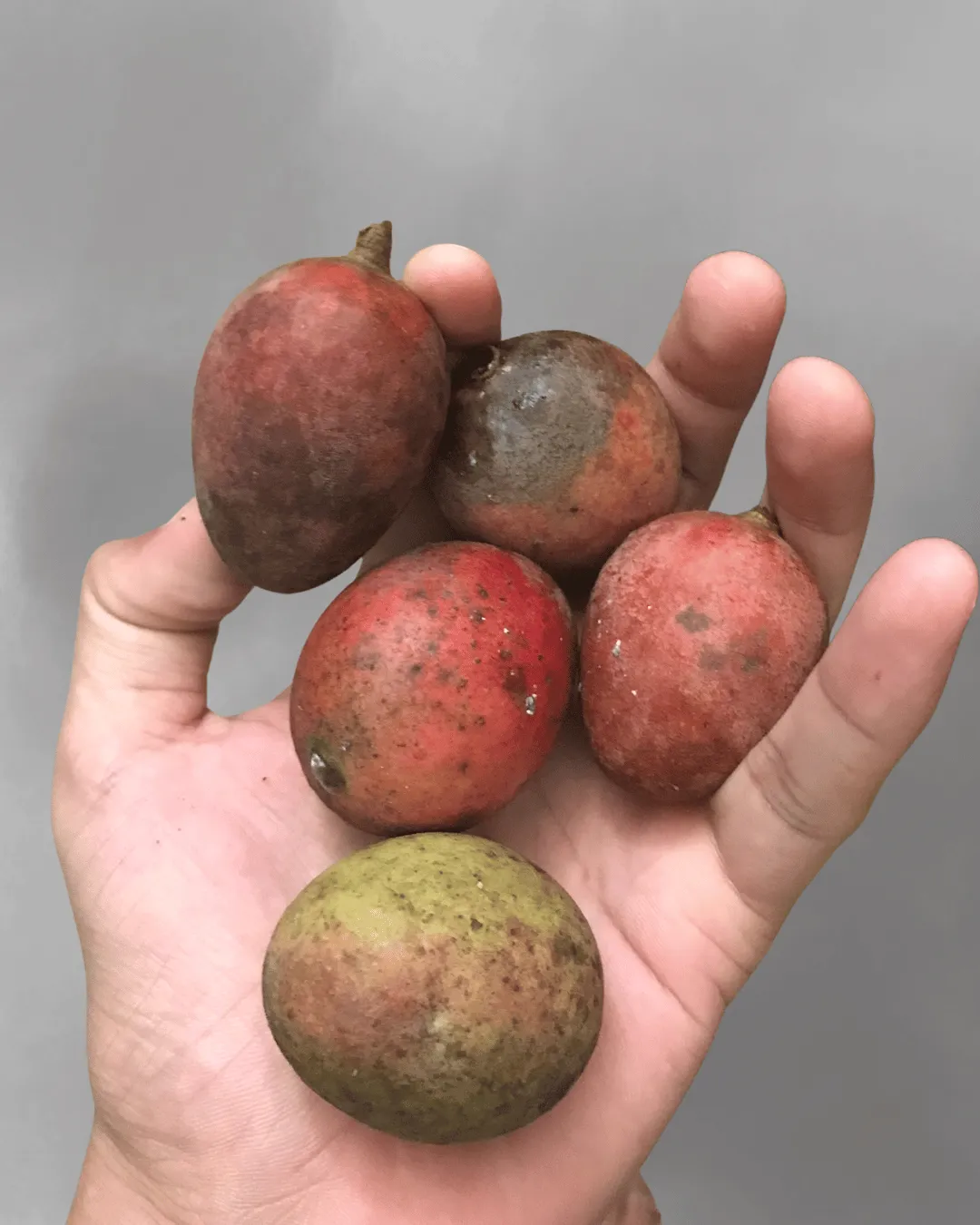
The fruit is a small, round to oval drupe — a fleshy fruit with a single seed inside, similar in structure to a plum or cherry. Each fruit is 2.5 to 3.5 cm long. The skin colour changes dramatically as the fruit ripens. It starts yellowish or pink, then turns rose-red, and finally becomes purplish-black at full ripeness. Furthermore, the inner flesh is orange-yellow, juicy, and aromatic. The flavour ranges from sweet to pleasantly sour. Primarily, the fruit is eaten fresh and is also used in local Indonesian and Malaysian dishes and sauces.
Bark and Tree Form
The bark of Mangifera griffithii is dark brown and rough in texture. The trunk is straight and clean, free of branches for more than half its height. Consequently, the tree has a tall, elegant form. The bole — the lower trunk section — can reach 80 cm in diameter in mature trees. Additionally, the tree grows without buttress roots, which are the wide, wing-like bases common in other rainforest trees. This gives it a clean, column-like base that adds to its visual appeal. Furthermore, the overall form is that of a true forest giant — powerful, stately, and rare.
Global Seed Delivery & Phytosanitary Certification
Induare Agro is a professional supplier of rare tropical seeds based in Indonesia. We export seeds to collectors, botanical gardens, universities, and enthusiasts around the world. Furthermore, we follow all international plant export regulations. Every seed order we ship meets the highest legal and biosecurity standards.
Packaging and Shipping
We ship all seeds via Global Express courier services. Consequently, your order reaches you quickly and safely. Each seed is carefully cleaned, moisture-checked, and packed for long-distance transit. We use professional packaging that protects seed viability during international shipping. Additionally, we track every shipment from our warehouse to your door. Furthermore, we notify you with tracking details immediately after dispatch.
Induare Agro prepares all export documentation in full compliance with Indonesian phytosanitary regulations and international IPPC standards. Primarily, this protects you and your country’s biosecurity system.
Buyer Peace of Mind
Every seed from Induare Agro ships with an official Phytosanitary Certificate issued by Indonesia’s Plant Quarantine Authority. This certificate confirms that your seeds are free from pests, diseases, and prohibited substances. Consequently, customs clearance in your country is straightforward and legally compliant.
Additionally, our seeds are organic and collected fresh from verified natural sources. We do not treat seeds with synthetic chemicals. Furthermore, we stand behind every product we ship. If you have concerns about your order, our team responds quickly. Moreover, we offer guidance on growing conditions to give your seeds the best possible start. Primarily, our goal is to connect the world’s collectors with Indonesia’s most extraordinary botanical treasures — legally, safely, and with full documentation.
How to Grow Mangifera griffithii
Step 1 — Prepare Your Seed Remove the seed from its packaging immediately upon arrival. Soak the seed in warm water for 24 to 48 hours. This softens the outer coat — the hard, fibrous layer around the seed — and encourages faster sprouting.
Step 2 — Choose the Right Growing Medium Fill a large pot or planting bag with a well-draining tropical mix. Use 60% coarse sand or perlite and 40% rich organic compost. Primarily, Mangifera griffithii needs loose, aerated soil that holds some moisture but never becomes waterlogged.
Step 3 — Plant the Seed Place the seed flat or on its side, 2 to 3 cm below the soil surface. Press the soil gently around it. Consequently, this keeps the seed in close contact with the growing medium for better moisture uptake.
Step 4 — Provide Warmth and Humidity Place your pot in a warm location with temperatures between 24°C and 35°C. Additionally, cover the pot with a clear plastic sheet or place it inside a humidity tent to maintain moisture. Mangifera griffithii comes from tropical rainforests. Therefore, it needs warmth and humidity to germinate well.
Step 5 — Water Carefully Water gently every two to three days. The soil should stay evenly moist — not wet. Furthermore, avoid letting the soil dry out completely, as this can halt germination.
Step 6 — Expect Germination Germination typically begins within 2 to 6 weeks under ideal conditions. Primarily, patience is key. Once the seedling emerges, move it to a bright but shaded position. Consequently, direct midday sun can scorch young seedlings.
Step 7 — Transition to Full Sun Gradually expose your young tree to more sunlight over several weeks. Additionally, feed it with a balanced tropical fertiliser once a month after the first two true leaves appear. Moreover, repot into a larger container or into the ground as the root system develops.
