
What Is Mangifera quadrifida?
Mangifera quadrifida is a rare wild mango native to the tropical rainforests of Borneo, Sumatra, and Peninsular Malaysia. It belongs to the family Anacardiaceae — the same family as the common mango. However, this species is far less known and far harder to find. Collectors and botanists prize it for its unusual deep-purple fruit and its towering forest canopy presence.
The name quadrifida means “cut into four” in Latin. This refers to a subtle feature of its flower structure. Furthermore, the species grows naturally in lowland forests and alongside riverbanks and swamp edges — habitats that are rapidly disappearing. Consequently, wild populations are shrinking due to large-scale deforestation across the region.
Additionally, Mangifera quadrifida holds cultural significance in Indonesian Borneo. Local communities in Kalimantan and Sumatra have long harvested its fruit for food. They eat it fresh with salt or prepare it as pickles and sambal. Moreover, the timber is used locally in construction. Despite this value, the tree remains largely unknown to the global horticultural market. That rarity makes each seed an exceptional acquisition for any serious plant enthusiast.
Induare Agro is proud to offer export-quality seeds of this iconic Indonesian rainforest species. We source directly from native regions in Indonesia. Consequently, every seed we supply comes from plants growing in their natural environment.
Aesthetic Features Mangifera quadrifida
Leaf Structure
Mangifera trees are known for their bold, elegant foliage. Mangifera quadrifida is no different. The leaves are simple and leathery in texture — firm and thick when touched. Each leaf is elliptic to lance-shaped, measuring between 6.5 and 30 cm long and 3 to 9 cm wide. They grow in whorls — circular clusters — at the tips of branches.
Juvenile leaves emerge in a warm bronze tone. They are soft and slightly drooping when young. Furthermore, as the leaf matures, it transitions to a deep, glossy dark green. This dramatic colour shift makes the tree visually striking throughout the year. The leaf stem, or petiole — the stalk connecting the leaf to the branch — measures 1 to 7 cm in length. Overall, the foliage creates a dense, rich-green canopy that provides excellent shade.
Flower and Fruit
The flowers of Mangifera quadrifida are small, white to greenish-white, and notably fragrant. They grow in dense pyramidal clusters called panicles — large, branching flower heads that extend from the tips of branches. Each individual flower is tiny. However, grouped together in their hundreds, they create a spectacular and aromatic display.
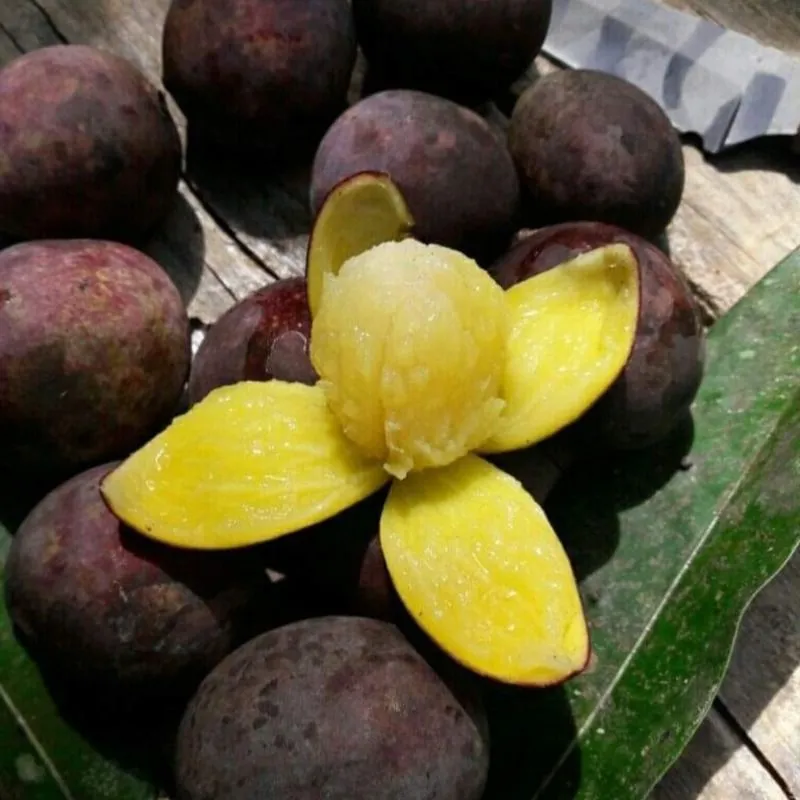
After pollination, the tree produces its most prized feature: the fruit. The fruit is a drupe — a fleshy stone fruit with a single large seed inside. Each fruit measures approximately 8 to 10 cm long and 5.5 to 7 cm wide. The skin is reddish-purple when ripe, dotted with small pale-brown spots called lenticels — tiny pores on the skin surface. The flesh inside is pale yellow to white, fibrous, and carries an acid-sweet flavour. Locally, the green fruit is used in sambal and pickles. The ripe fruit is eaten fresh with salt.
Tree Size and Form
Mangifera quadrifida is a medium to large evergreen tree. It typically grows between 10 and 32 metres tall. Occasionally, exceptional specimens may reach up to 51 metres in height. The trunk diameter at chest height is around 25 to 30 cm in mature trees. The bark is mildly scaly in texture.
Additionally, the tree produces a dense, spreading crown. This makes it an impressive landscape specimen in tropical gardens with adequate space. Moreover, the tree is well-suited to humid lowland climates with year-round warmth. It thrives along rivers and in swampy forest edges — conditions found across much of tropical Indonesia and Malaysia.
Global Seed Delivery & Phytosanitary Certification
Packaging and Shipping
Induare Agro ships Mangifera quadrifida seeds globally using trusted express courier services. We pack every seed with professional care. We use moisture-controlled, padded packaging to protect seed viability during long international transit. Furthermore, we act quickly after harvest. Fresh seeds are processed and dispatched within the shortest possible window to preserve germination potential.
We ship to collectors, botanical gardens, universities, and private growers worldwide. Additionally, our team has extensive experience handling rare tropical seed exports from Indonesia. We understand the specific requirements of each destination country. Consequently, delays caused by improper documentation are rare with our shipments.
Buyer Peace of Mind
Every order of Mangifera quadrifida from Induare Agro includes a valid Phytosanitary Certificate. This is an official plant health document issued by the Indonesian government authority. It confirms that the seeds have been inspected and meet the import standards of the receiving country.
Moreover, this certificate is essential for legal importation in most countries. Without it, customs authorities may confiscate or destroy plant material at the border. Consequently, every buyer can import with full legal confidence. Furthermore, Induare Agro complies with all CITES and national phytosanitary regulations. We are a trusted, transparent supplier committed to lawful and ethical trade of rare Indonesian plants.
How to Grow Mangifera quadrifida
Step 1 — Prepare Your Seeds Soak seeds in clean, warm water for 24 hours before planting. This softens the outer seed coat and encourages faster germination.
Step 2 — Choose the Right Growing Medium Use a well-draining, slightly acidic potting mix. Combine loamy soil with coarse sand or perlite for good drainage and aeration.
Step 3 — Plant at the Correct Depth Place the seed flat-side down, approximately 2 to 3 cm below the soil surface. Keep the soil evenly moist but never waterlogged.
Step 4 — Provide Warmth and Humidity Mangifera quadrifida needs consistent warmth. Maintain temperatures between 25°C and 35°C for best results. Place the pot in a humid, sheltered location with bright indirect light.
Step 5 — Wait for Germination Germination typically occurs within 2 to 4 weeks under ideal conditions. Once the seedling emerges, move it to a position with more direct sunlight.
Step 6 — Transplant Carefully Transplant to a larger container or into the ground when the seedling reaches 15 to 20 cm in height. Allow ample space for this large-growing tree to develop.
Step 7 — Water and Feed Regularly Water consistently during the growing season. Apply a balanced tropical fertiliser every 4 to 6 weeks. Reduce watering slightly during cooler or drier periods.
