
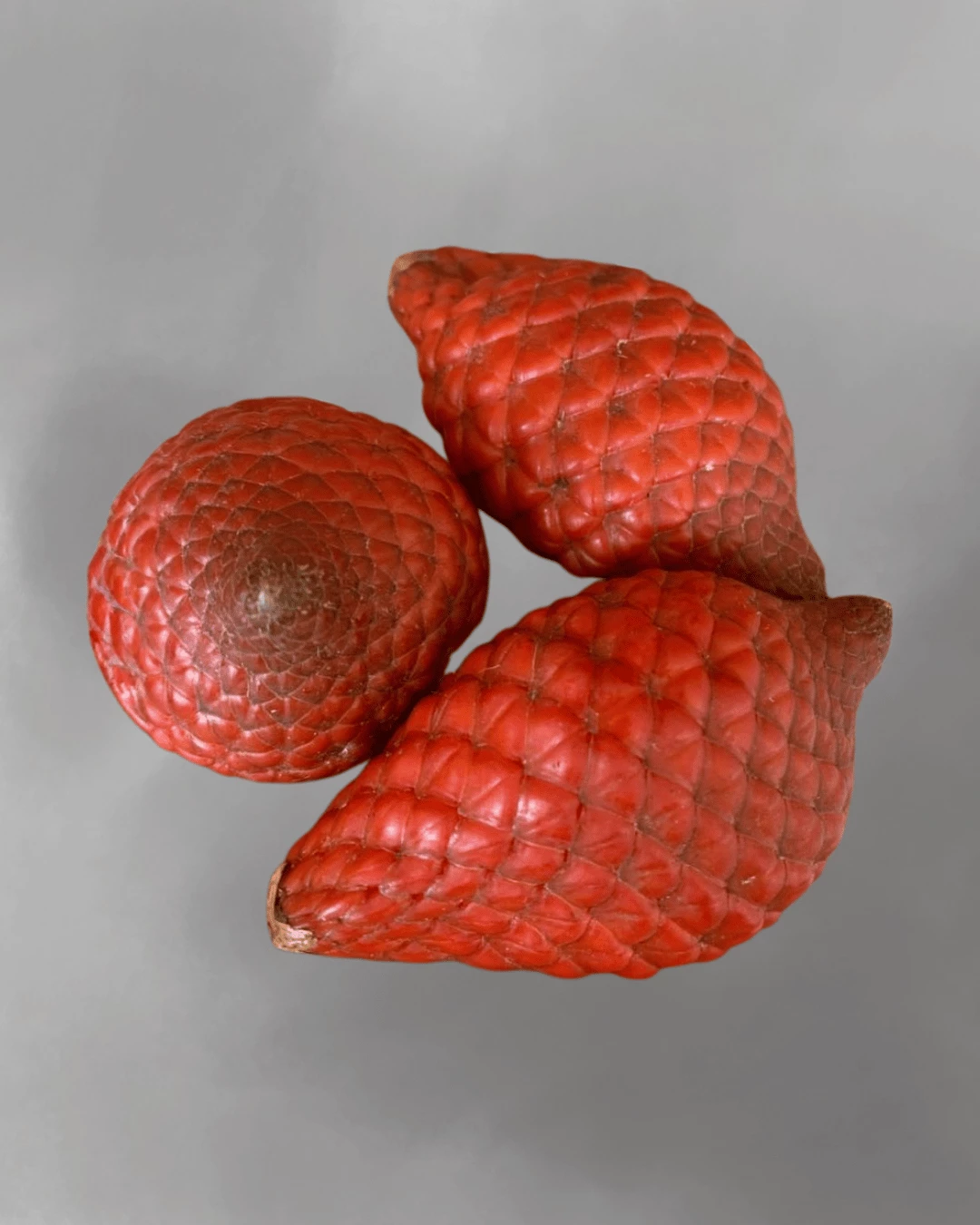
What Is Salacca affinis?
Salacca affinis is a rare and fascinating palm species from the family Arecaceae. It originates from the rainforests of Sumatra, Borneo, Peninsular Malaysia, Java, and Singapore. This plant grows naturally in the understory of tropical rainforests. It prefers habitats near ponds, swamps, and shaded forest floors.
The species is commonly known as the Red Snack Fruit, red salak, or buah ridan. Its scientific name carries meaning too. The word affinis comes from Latin, meaning “at the boundary.” This reflects how closely it resembles its relative, Salacca zalacca — the well-known common snakefruit.
Furthermore, Salacca affinis is extremely rare in cultivation outside its native range. In 2011, botanists rediscovered it in Singapore’s Nee Soon Swamp Forest. Scientists had previously believed it was locally extinct there. This discovery confirmed just how precious and vulnerable this species truly is.
Collectors around the world seek it out. Additionally, it is almost never available through standard plant nurseries. Consequently, fresh seeds from a reliable Indonesian supplier are genuinely difficult to find. Induare Agro sources these seeds ethically from within Indonesia. Moreover, every seed is fresh, organic, and carefully handled for maximum viability.
Aesthetic Features Salacca affinis
Salacca affinis is a visually dramatic plant. Its spiny, tropical architecture makes it an instant statement piece. Furthermore, it brings an authentic slice of the Southeast Asian rainforest into any collection.
Leaf Structure
The leaves of Salacca affinis are large and feathery. They can grow up to 3 metres tall, making the plant an impressive, full-bodied specimen. Each leaf is carried on a long stalk called a petiole — essentially a long stem supporting the leaf. These petioles are lined with sharp yellow-orange to brown spines. The spines grow in clusters of two to four and can reach up to 10 centimetres in length. The leaflets along each leaf are broad and grow in groups, giving the whole leaf a lush, plume-like appearance. Additionally, the topmost leaflets have toothed, almost torn-looking tips. This adds a wild, dramatic texture that no other common palm can match.
Flower and Fruit
Salacca affinis is a dioecious plant. This means it produces separate male and female plants. Male flower clusters — called inflorescences — are long and branched, reaching 50 to 100 centimetres. Female clusters are more compact, growing up to just 5 centimetres in length. Pollination leads to clusters of stunning egg-shaped fruit. Each fruit measures about 8 centimetres long and 4 centimetres wide. When fully ripe, the fruit turns a brilliant crimson red. The skin is covered in smooth, flat scales that resemble the skin of a snake — hence the name “snakefruit.” The flesh inside is sweet with a pleasant, slightly sour aftertaste. Moreover, the flavour is sweeter than the more common Salacca zalacca, which makes it even more prized by fruit collectors. Each fruit contains up to three pale seeds.
Spiny Habit and Rarity in Gardens
The entire plant is densely armed with long, strong spines. Primarily, this is why Salacca affinis is almost never seen in parks or public gardens. Consequently, it is mainly found only in specialist botanical gardens worldwide. This spiny habit is part of the plant’s identity and its appeal to serious exotic plant collectors. Furthermore, the stems are usually underground or creeping, which gives the plant a low, ground-hugging silhouette between its tall, dramatic leaves. The overall effect is bold, primeval, and highly distinctive.
Global Seed Delivery & Phytosanitary Certification
Induare Agro is committed to safe, legal, and professional seed exports. We ship rare Indonesian seeds to collectors and growers all over the world. Moreover, we meet all international plant trade regulations so you can import with confidence.
Packaging and Shipping
Every seed order is carefully prepared for international transit. We use protective, moisture-resistant packaging to keep seeds fresh during long-distance shipping. Additionally, we ship via Global Express courier services. This ensures fast, trackable delivery to your door. We ship to North America, Europe, Australia, Asia, and beyond. Furthermore, every shipment includes a valid Phytosanitary Certificate — an official government document that certifies the seeds are free from pests and plant diseases. This certificate is required for import into most countries.
Buyer Peace of Mind
We know that buying rare seeds internationally involves trust. Consequently, Induare Agro takes every step to protect your order and your peace of mind. Our Phytosanitary Certificate is issued by the Indonesian plant health authority. It accompanies every shipment, ensuring smooth customs clearance. Moreover, our seeds are 100% organic and free from synthetic treatments. We harvest only fresh seeds to maximise germination success. Additionally, we provide clear planting guidance with every order. Primarily, our goal is to see your rare plant thrive. We are proud to be a trusted source of export-quality, rare exotic seeds from Indonesia.
How to Grow Salacca affinis
Salacca affinis grows best in warm, humid, tropical or subtropical conditions. Additionally, it can be grown in containers indoors in cooler climates. Follow these steps for the best results.
Step 1 — Soak the Seeds Soak the fresh seeds in warm water for 24 hours before planting. This softens the outer seed coat and improves germination speed significantly.
Step 2 — Prepare the Potting Mix Use a rich, well-draining soil mix. Combine organic compost, peat or coco peat, and coarse sand or perlite in equal parts. The ideal soil pH is slightly acidic, between 5.0 and 6.5.
Step 3 — Plant the Seeds Sow each seed about 2 centimetres deep in the prepared mix. Place the pot in a warm, humid environment. Maintain a temperature above 21°C (70°F) at all times.
Step 4 — Water and Wait Keep the soil consistently moist but never waterlogged. Germination typically occurs within 15 days under optimal warm, humid conditions. Patience is essential — do not let the soil dry out.
Step 5 — Provide Shade Place seedlings in a shaded or semi-shaded location. Primarily, Salacca affinis grows under a forest canopy in the wild. Avoid direct, harsh sunlight, especially for young plants.
Step 6 — Ongoing Care Water regularly and maintain high humidity around the plant. Furthermore, feed monthly with a balanced organic fertiliser during the growing season. Protect the plant from temperatures below 20°C (68°F). Additionally, handle the plant with care — the spines are sharp. Use gloves when repotting or pruning.
