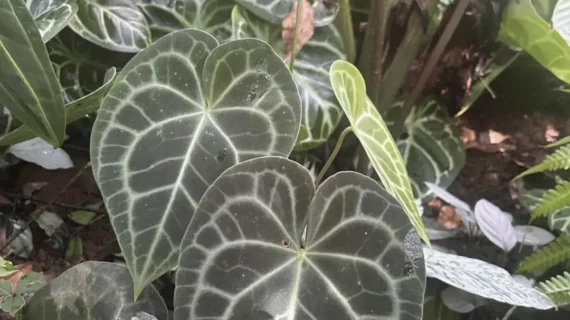
Anthurium clarinervium: A Rare Velvet-Leaved Aroid from Chiapas
Anthurium clarinervium immediately draws the eye with its deep green, heart-shaped leaves and luminous ivory veins that appear almost hand-painted onto every blade. This species belongs to the genus Anthurium, one of the largest and most diverse plant groups within the arum family, Araceae. Furthermore, its reticulate leaf venation is an uncommon trait among monocotyledons, which has made the species a favorite among collectors and horticulturists worldwide. Beyond its ornamental charm, however, Anthurium clarinervium also holds genuine scientific interest, since its narrow native range and rock-dwelling habit reveal how aroids adapt to demanding limestone environments. This article introduces the taxonomy, morphology, distribution, habitat, and horticultural value of Anthurium clarinervium in detail.
Taxonomic Overview of Anthurium clarinervium
Systematic Position
Anthurium clarinervium sits within the kingdom Plantae, order Alismatales, and family Araceae, alongside other aroids such as Philodendron and Monstera. The species was formally described by botanist Eizi Matuda in 1952, in the journal Anales del Instituto de Biología de la Universidad Nacional Autónoma de México, volume 22, page 375. Consequently, the accepted scientific name is written as Anthurium clarinervium Matuda, with “Matuda” standing as the author citation. Additionally, both the World Checklist of Vascular Plants and the GBIF Backbone Taxonomy recognize this name as the currently accepted taxon, without listing any widely used synonyms.
Taxonomic Notes and Relationships
Anthurium clarinervium belongs to section Andiphyllum, a smaller group that also contains Anthurium leuconeurum and Anthurium lezamae. Moreover, botanists once confused this species with A. leuconeurum because of their similar velvety foliage, though both are now treated as distinct taxa. Interestingly, despite its nickname “Velvet Cardboard Anthurium” and its superficial resemblance to the velvet-leaved Cardiolonchium section, Anthurium clarinervium is not classified within that group. Instead, its reticulate venation and karst-adapted growth habit set it apart taxonomically from true Cardiolonchium species such as A. crystallinum and A. regale.
Morphological Description
Foliage and Stem
The leaves of Anthurium clarinervium are ovate to heart-shaped, deeply lobed at the base, and covered in a thick, velvety, leathery texture. Blades typically measure 11 to 25.5 centimeters in length and 6.5 to 17 centimeters in width. The upper surface displays a deep forest-green color, while the underside appears noticeably paler. Primarily, what distinguishes this species is its network of ivory to pale green primary veins, roughly one centimeter wide, which stand out sharply against the dark leaf blade. The stems remain short and thick, typically 1 to 2 centimeters in diameter, and bear persistent, moderately leathery cataphylls near the growing point.
Inflorescence and Fruit
Anthurium clarinervium produces a modest inflorescence relative to its ornamental foliage. The spathe is pale green with violet-purple tinges and measures approximately 3.7 to 6.5 centimeters long, while the greenish spadix extends 4.7 to 7.5 centimeters. Following pollination, the plant develops bright orange berries, each containing numerous small seeds. As a result, natural regeneration in the wild depends heavily on seed dispersal across the rocky terrain the species calls home.


Distribution and Habitat
Geographic Range
Anthurium clarinervium is endemic to Mexico, occurring specifically within the state of Chiapas. According to POWO (Plants of the World Online, Kew), the species’ native range is restricted to this single Mexican state, and GBIF records confirm the same narrow distribution. Some horticultural sources mention possible occurrences extending toward northwestern Guatemala, though this remains anecdotal rather than formally documented in taxonomic literature.
Ecological Habitat
This species thrives in a highly specific ecological niche defined by karst topography, where limestone and dolomite outcrops dominate the landscape. Anthurium clarinervium usually grows as a lithophyte, rooting directly into thin layers of soil and decaying debris that accumulate between rocks, though it occasionally grows terrestrially as well. It occurs at elevations between roughly 760 and 1,160 meters, within seasonally dry tropical forest that transitions into humid, shaded understory pockets. Consequently, the plant depends on nutrients delivered by rainwater runoff and decomposing leaf litter rather than rich mineral soil.

Economic and Horticultural Value
Anthurium clarinervium carries considerable value in the global ornamental plant trade rather than in traditional ethnobotanical use. Its striking venation and compact, manageable size have positioned it as an entry point into the broader world of velvet-leaved aroids for collectors. Additionally, growers throughout Asia, Europe, and North America cultivate the species commercially, and companies such as Induare Agro source and export seeds and tissue-cultured specimens of related Anthurium species to international collectors. However, no documented traditional or medicinal ethnobotanical use of Anthurium clarinervium currently appears in the available scientific literature; data on this aspect remains unavailable.
Conservation Status
No formal IUCN Red List assessment for Anthurium clarinervium is publicly available at this time. Given its narrow endemic range within Chiapas and its dependence on specific karst microhabitats, however, the species likely warrants closer conservation monitoring. Data on population trends and current threat levels remains unavailable in the literature reviewed for this article.
References
-
- Plants of the World Online (Kew Science). Anthurium clarinervium Matuda. Available at: https://powo.science.kew.org/taxon/urn:lsid:ipni.org:names:15185-2
- GBIF Secretariat. Anthurium clarinervium Matuda, GBIF Backbone Taxonomy. Available at: https://www.gbif.org/species/2872501
- Matuda, E. (1952). Anthurium clarinervium. Anales del Instituto de Biología, Universidad Nacional Autónoma de México, 22: 375.
- Croat, T.B. (1983). A revision of the genus Anthurium (Araceae) of Mexico and Central America. Part I: Mexico and Middle America. Annals of the Missouri Botanical Garden, 70(2): 211–420.
- International Aroid Society. Anthurium clarinervium Matuda. Available at: https://www.aroid.org/anthurium/anthurium-clarinervium-matuda
- Wikipedia contributors. Anthurium clarinervium. Available at: https://en.wikipedia.org/wiki/Anthurium_clarinervium


