Amorphophallus tinekeae: The Shade-Dwelling Giant Aroid of Borneo’s Deep Forests

Amorphophallus tinekeae: The Shade-Dwelling Giant Aroid of Borneo’s Deep Forests

Amorphophallus tinekeae: The Shade-Dwelling Giant Aroid of Borneo’s Deep Forests

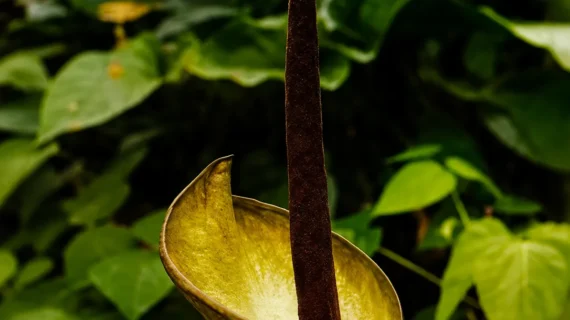
Hidden beneath the canopy of deep-shaded forest slopes in Borneo, Amorphophallus tinekeae Hett. & A.Vogel represents one of the more recently described aroids in the Indonesian and Malaysian flora. Hetterscheid and Vogel formally described it in 2001 in the journal Blumea. Its distribution spans East Malaysia (Sabah) and possibly North Kalimantan in Indonesia. A. tinekeae belongs to an exclusively Bornean species group and produces a strikingly elegant inflorescence: a broadly campanulate spathe that closes after anthesis and a long, slender, dark-maroon narrowly conic appendix. For collectors and botanists working in Bornean rainforest aroid diversity, this species occupies a distinctive and scientifically interesting position within its genus.


Taxonomic Identity of Amorphophallus tinekeae

Amorphophallus tinekeae belongs to the family Araceae. Hetterscheid & A.Vogel described it in Blumea 46 (2) (2001): 276. No synonyms are currently recognized for this species.


Morphological Description

Tuber and Leaf

The tuber of Amorphophallus tinekeae is subglobose, approximately 20 cm in diameter and 13 cm tall. It is off-white in color, with several raised areas on its surface. The petiole reaches up to 160 cm in length and 5 cm in diameter. Near the base it is slightly rugulose; otherwise the surface is smooth. The background color is off-white, nearly entirely covered by small, transverse, very dark blackish-green crack-like spots. Larger, elongate-elliptic, dirty whitish spots are also scattered across the surface, with or without a dirty olive-brown center.

The lamina reaches up to 160 cm in diameter. Its rachises are winged almost to the base. Leaflets are elliptic to elongate-elliptic, acuminate, 7–26 cm long and 3–9 cm in diameter. The upper surface is slightly leathery and glossy mid-green.

Inflorescence and Peduncle

The inflorescence of Amorphophallus tinekeae is short to medium-peduncled, and never distinctly longer than the spathe. The peduncle measures 13–36 cm long and 1–2 cm in diameter. Its surface is smooth and matches the petiole in coloration.

Spathe

The spathe is transversely oval, 18–35 cm long and 16–32 cm in diameter, and leathery in texture. The limb is oblique. After anthesis it actively curves forward, closing the spathe opening. The outer base surface has a lower half that is bright green with thin maroonish veins and a very few scattered small white spots. Upward, it is flushed with greyish to blackish maroon. The veins become prominently maroon to blackish-purple toward the top. The inner base surface is deep maroon. The central part is whitish-greenish. The upper inner portion is flushed with greyish maroon. The base within is densely verruculate with several lengthwise grooves. The outer limb surface is largely green with brownish-purple venation, flushed upward with dirty purplish-brown. The inner limb surface is pale green, with the margin flushed with dirty purplish-brown and incurved.

Spadix and Floral Zones

The spadix of Amorphophallus tinekeae is sessile and longer than the spathe, measuring 21–58 cm in total. The female zone is slightly conic, 2.5–7 cm long and 1.8–3 cm in diameter. Its flowers are congested or slightly distant. The male zone is slightly obconic, 3–6.5 cm long and 1.3–2.3 cm in diameter. Its flowers are congested.

The appendix is elongate and narrowly conic, 15.5–45 cm long and 1.3–3 cm in diameter at one-third from the base. It gradually tapers toward the acute top. The surface is dark maroon and slightly rugulose. The base carries a few narrow grooves. This long, slender, dark-maroon appendix is one of the most visually striking features of the species.

Female Flowers

Each ovary is depressed-globose, 3 mm in diameter and 2 mm tall. It is bilocular and dark maroon. The style is 4 mm long and 1 mm in diameter, and maroon. The stigma is laterally placed and highly asymmetrical. It is ovate in upper view, with a long axis of approximately 3 mm and a short axis of 2 mm, approximately 1 mm thick. It is one-lobed, with the lobe apical on the style and conic in shape. Below the lobe sits a shallow, slightly curved depression. The stigma surface is echinulate and dirty yellowish-brown.

Male Flowers

Each male flower carries 4–5 stamens. Stamens reach approximately 2 mm in length and 1.5–2 mm in diameter. Filaments are 1.2 mm long and half-connate. Anthers are 0.8 mm long, truncated, and off-white. Connectives are off-white or brownish. Pollen is psilate.

Fruit

The infructescence fruiting part reaches approximately 20 cm long and 1.5 cm in diameter. Berries are globose to depressed-globose, 9–12 mm in diameter and 8–9 mm long, and orange-red. Seeds are subglobose to unilaterally depressed, 7–8 mm in diameter, with a very deep short groove or shallow depression. The seed coat is minutely rugulose and ivory-white.


Distribution of Amorphophallus tinekeae

Amorphophallus tinekeae grows in East Malaysia (Sabah) and possibly in North Kalimantan, Indonesia. The Kalimantan record currently carries some uncertainty, hence the qualifier in the source literature. Further field collections from Indonesian Borneo would help confirm or clarify the species’ presence there.

For verified occurrence data and georeferenced records, refer to GBIF – Amorphophallus tinekeae and the Plants of the World Online (POWO) – Kew.


Habitat

This species grows on slopes in deep-shaded forest. Its strict preference for shaded, closed-canopy conditions distinguishes it from many disturbed-habitat generalists in the genus. Consequently, continued integrity of primary and near-primary forest in Borneo is essential for the long-term persistence of A. tinekeae populations.


Taxonomic Notes

Amorphophallus tinekeae belongs to an exclusively Bornean species group that also includes A. borneensis, A. lambii, and A. hewittii. Within this group, only A. borneensis has so far been confirmed from Kalimantan. The remaining members grow primarily in Sabah and Sarawak.

Among its closest relatives, A. tinekeae differs most clearly from A. borneensis in two ways. First, A. tinekeae carries a notably short peduncle — never distinctly longer than the spathe. Second, its spathe is a much more widely opening campanulate form compared to A. borneensis. These two characters together make field identification straightforward when flowering material is available.


Photo Reference

The following photographs illustrate Amorphophallus tinekeae (Photos: Wilbert Hetterscheid):

Amorphophallus tinekeae
Full inflorescence of Amorphophallus tinekeae showing the broadly campanulate, transversely oval spathe and the long, slender, dark-maroon appendix.
Amorphophallus tinekeae flower
Part of spathe removed, revealing the female and male floral zones and the base of the narrowly conic appendix.
Amorphophallus tinekeae pollen
Close-up of male (upper) and female (lower) flowers on the spadix.


References

  • Hetterscheid, W.L.A. & Vogel, A. (2001). Amorphophallus tinekeae Hett. & A.Vogel. In: Blumea 46 (2): 276.
  • Kew Science. Amorphophallus tinekeae Hett. & A.Vogel – Plants of the World Online. Available at: https://powo.science.kew.org/
  • GBIF Secretariat. Amorphophallus tinekeae occurrence data. Global Biodiversity Information Facility. Available at: https://www.gbif.org/
Amorphophallus titanum: The World’s Largest Inflorescence from Sumatra’s Rainforests

Amorphophallus titanum: The World’s Largest Inflorescence from Sumatra’s Rainforests

Amorphophallus titanum: The World’s Largest Inflorescence from Sumatra’s Rainforests

No plant on earth produces a larger unbranched inflorescence than Amorphophallus titanum (Becc.) Becc. This Sumatran giant holds a world record that has fascinated scientists and the public since Beccari first described it in 1879 in the Bulletin of the Tuscan Horticultural Society. Its inflorescence can reach up to 3.8 m in height, and its tuber can weigh up to 120 kg. The plant produces one leaf at a time — a single structure so large it resembles a small tree. When the inflorescence opens, it emits a powerful odor of rotting flesh to attract insect pollinators. Botanic gardens around the world draw thousands of visitors each time a titan arum blooms. Endemic to Sumatra, this species is both a botanical icon and an IUCN-listed endangered plant in the wild.


Taxonomic Identity of Amorphophallus titanum

Amorphophallus titanum belongs to the family Araceae. Beccari described it in Bull. Soc. Tosc. Ortic. 4 (1879): 46. Two synonyms are recognized:

  • Amorphophallus selebicus Nakai
  • Conophallus titanum Becc.

Both reflect earlier treatments before the species settled into its current accepted name and genus placement.


Morphological Description

Tuber and Leaf

The tuber of Amorphophallus titanum is depressed-globose, reaching 1 metre or more in diameter. Tubers weighing up to 120 kg have been recorded, including at the Botanical Gardens in Bonn, Germany. The surface is brown with many grouped accessory buds. The interior is dirty white, very soft, and greasy. The tuber produces no offsets. The plant bears a single solitary leaf per growing cycle.

The petiole is 1–5 m in length and 20–30 cm in diameter at the base. It is turgid and smooth, green or dark green, with large, oval to rounded, pale green spots. The lamina reaches up to 7 m in diameter. Leaflets are elongate-elliptic, up to 40 cm long and 20 cm wide, acuminate, leathery, and moderately glossy on the upper surface. A single leaf may last up to 16 months. After the leaf dies down completely, the tuber enters dormancy for 1 to 3 years before producing another leaf or an inflorescence.

Inflorescence and Peduncle

The inflorescence of Amorphophallus titanum is solitary and short-peduncled. The peduncle measures 30–70 cm long and 10–15 cm in diameter, colored like the petiole. In fruit, the peduncle elongates to approximately 150 cm. The total inflorescence height ultimately depends on tuber weight and can range from 85 cm up to 3.8 m — the record was recently measured at Cibodas Botanic Gardens. The smallest tuber recorded producing an inflorescence weighed 9 kg. Furthermore, leaves and inflorescences never appear simultaneously on the same plant.

Spathe

The spathe is campanulate and very broadly triangular, 40–160 cm long and up to 2 m in diameter. The limb is spreading and rim-shaped, with a plicate margin bearing many small, triangular, obtuse lobes. The veins of the limb are strongly developed and raised. The outer base surface is pale green with whitish spots, transitioning toward the margin into dirty purplish-brown. The inner base surface is purplish, above which a broad, dirty yellowish zone follows. The limb is dark purplish-brown. The base interior is verrucate. Notably, the entire spathe sheds at the fruiting stage.

Spadix and Floral Zones

The spadix of Amorphophallus titanum is sessile and much longer than the spathe, ranging from 1 to 3 m in length. The female zone is conic, 12–43 cm long and 8–17 cm in diameter. Flowers in the female zone are distant. The male zone is obconic, 6–35 cm long. At the base it measures 5.5–15 cm in diameter; at the top, 8–20 cm. Lower flowers in the male zone are slightly distant, while upper flowers are congested. The appendix is elongate-fusiform and obtuse, 80–200 cm long and 10–25 (–50) cm in diameter at the base. Its color is dirty yellowish-white or with a faint purplish hue. The surface carries one or a few irregular, shallow grooves and folds, and is densely rugose. The appendix heats up during bloom to volatilize scent compounds, drawing pollinators from a wide radius.

Female Flowers

Each ovary is ovate to approximately conic, about 6 mm in diameter and 6–8 mm tall. In cross-section it is circular. Each ovary is 2- or 3-locular, with one basal ovule per locule. The basal half is whitish; the remainder is brownish-purple. The style is slender, 14–22 mm long. At the base the diameter is approximately 3 mm; at the top it narrows to about 2 mm. The style is blackish-purple. The stigma is depressed-globose, approximately 2–3 mm in diameter and 1.5–2 mm tall. It is entire or with a very shallow central depression, greyish-brown or purple. The surface is densely verrucate.

Male Flowers

Each male flower carries 3–7 stamens. Stamens are 4–5 mm long. Filaments are 2–3 mm long and basally to nearly entirely connate. Anthers are 2 mm long and 1.5–4 mm in diameter, truncate, and whitish. Pores are apical, small, and oval at anthesis. Pollen is rounded and exine smooth, 110–140 µm in diameter.

Fruit

The infructescence is long-peduncled and slightly conic. The fruiting portion reaches up to 75 cm long and 30 cm in diameter. Berries number in the several hundreds, and are elongate, 4–5 cm long and 2–3.5 cm in diameter, 2-seeded. They ripen from orange-red to fiery red. All berries in one infructescence ripen near-simultaneously.


Distribution of Amorphophallus titanum

Amorphophallus titanum is endemic to Sumatra, Indonesia. Within Sumatra, it occurs across a range of elevations and forest types. However, its populations continue to face pressure from habitat loss.

For verified occurrence data and georeferenced records, refer to GBIF – Amorphophallus titanum and the Plants of the World Online (POWO) – Kew.


Habitat

Amorphophallus titanum grows frequently on very steep mountain slopes, in semi-open young secondary forest, and sometimes in backyards near forest edges. It is strongly adapted to steep terrain and grows well on limestone cliffs or in areas where soil erosion is regular. It tolerates a wide elevational range, from sea level up to approximately 1,200 m altitude.


Taxonomic Notes

Amorphophallus titanum holds an unparalleled place in botanical history. Its inflorescence attracts many visitors to botanic gardens whenever it blooms, and several institutions live-stream the blooming event. The inflorescence size directly reflects the weight of the tuber: heavier tubers produce taller inflorescences. Tubers recorded at 120 kg at the Bonn Botanical Gardens represent the upper known limit.

The species produces only one leaf per growing season. After that leaf dies down completely, the tuber enters a dormant period lasting 1 to 3 years. It then produces either another leaf or an inflorescence — never both at the same time. Furthermore, the smallest tuber recorded producing an inflorescence weighed just 9 kg, demonstrating that even younger, smaller tubers can flower under the right conditions. Consequently, the titan arum follows one of the most unusual growth and reproductive cycles in the entire plant kingdom.


Photo Reference

The following photographs illustrate Amorphophallus titanum (Photos: Tatang Rohana):

Amorphophallus titanum
Inflorescence of Amorphophallus titanum in bloom at Bogor Botanic Gardens, showing the broadly campanulate, deeply purple-lobed spathe and the towering appendix.

References

  • Beccari, O. (1879). Amorphophallus titanum (Becc.) Becc. In: Bull. Soc. Tosc. Ortic. 4: 46.
  • Yuzammi, Kurniawan, A., Asih, N.P.S., Erlinawati, I. & Hetterscheid, W. (2017). The Amorphophallus of Indonesia. Center for Plant Conservation Botanic Gardens, Indonesia.
  • Kew Science. Amorphophallus titanum (Becc.) Becc. ex Arcang. – Plants of the World Online. Available at: https://powo.science.kew.org/taxon/urn:lsid:ipni.org:names:84474-1
  • GBIF Secretariat. Amorphophallus titanum occurrence data. Global Biodiversity Information Facility. Available at: https://www.gbif.org/species/2871605
Amorphophallus spectabilis: The Rare Montane Aroid of West Java’s Cloud Forests

Amorphophallus spectabilis: The Rare Montane Aroid of West Java’s Cloud Forests

Amorphophallus spectabilis: The Rare Montane Aroid of West Java’s Cloud Forests

High in the montane forests of West Java, where cloud-forest slopes meet the upper limits of tropical vegetation, grows one of the island’s most elusive aroids. Amorphophallus spectabilis (Miq.) Engl. is endemic to West Java and confined to elevations between 1,200 and 1,800 m above sea level. Engler formally placed it in the current genus in 1879 in Monographiae Phanerogamarum. Despite its evocative name — meaning “remarkable” or “spectacular” — recent field expeditions across Java have failed to locate the species, raising serious concerns about its current status in the wild. Its combination of a glossy blackish-purple spathe, a very short style, and a spadix much shorter than the spathe makes it immediately recognizable among long-peduncled Javan aroids.


Taxonomic Identity of Amorphophallus spectabilis

Amorphophallus spectabilis belongs to the family Araceae. Engler described it in A. & C. DC., Monogr. phan. 2 (1879): 316. One synonym is currently recognized:

  • Conophallus spectabilis Miq.

This synonym reflects the original placement under the older genus Conophallus before taxonomic consolidation into Amorphophallus.


Morphological Description

Tuber and Leaf

The tuber of Amorphophallus spectabilis reaches up to 20 cm in diameter. The plant bears a single solitary leaf. The petiole is nearly smooth and dark green with grey and brown spots. It measures 100–150 cm in length. The lamina is 100–150 cm in diameter. Its rachises are narrowly winged in the distal portions and unwinged proximally. Leaflets are narrowly elongate-elliptic to elongate-elliptic, 13–30 cm long and 3–12 cm in diameter. They are long-acuminate, with a narrowly decurrent base and an acumen 2.5–4 cm long.

Inflorescence and Peduncle

The inflorescence of Amorphophallus spectabilis is solitary and long-peduncled. The peduncle matches the petiole in appearance and measures 120–220 cm in length — one of the longest peduncles among Javan aroids.

Spathe

The spathe is erect and elongate-ovate, 34–60 cm long and 15–25 cm in diameter. The apex is acute and bends forward, hanging over the appendix. The outer base surface is olive-green, almost entirely covered by confluent, rounded, bright pale green spots with a paler margin. These spots are sometimes accompanied by larger whitish areas. Upward, the outer surface turns purple. The inner base surface is dark purple, above which a pale whitish-greenish zone appears, followed by a dark purple upper zone. The outer limb surface is glossy blackish-purple with some strong ridges. The inner limb surface is glossy dark maroon, with an undulate margin. The inner base surface carries scattered warts, which are shallow and isolated or arranged in narrow ridges.

Spadix and Floral Zones

The spadix of Amorphophallus spectabilis is sessile and much shorter than the spathe, measuring 25–40 cm in total. This character — a spadix considerably shorter than its spathe — is the most immediately diagnostic feature of the species among long-peduncled Javan congeners. The female zone is cylindric, 2.5–8 cm long and 1–2 cm in diameter. Its flowers are congested or more or less distant. The male zone is obconic to elongate-obconic, 2–9 cm long and 1.5–4 cm in diameter at the top. Flowers are congested or in low-angled, not very distant spirals. Near the appendix base, a few elongate conical staminodes occur.

The appendix is elongate-fusiform-conic, 10–23 cm long and 2.5–6 cm in diameter. It is obtuse, subacute, or acute at the apex. Its color is pale brownish-purple or yellowish-brown. The surface is densely verruculate, with verrucae shortly elongate and especially distinct at the base.

Female Flowers

Each ovary is slightly depressed-globose, 2.5–4 mm in diameter and 1.5–2 mm tall. In cross-section it is circular to approximately quadrangular. Each ovary is unilocular and holds one basal ovule. The color ranges from entirely green to having a purple upper portion. The style is very short, 0.3–0.5 cm long and approximately 1 mm in diameter, and purple. The stigma is conical and asymmetric. It carries one peripheral large conical lobe with a deep, semi-circular groove at the base. Dark purple stylar tissue protrudes just beyond the top of this lobe and at several points along the margin. The stigma measures 1.5–2 mm in diameter and 1–2 mm tall.

Male Flowers

Each male flower carries 3–5 stamens. Stamens are 2.5–3 mm long and 1–2 mm in diameter. In cross-section they are approximately rectangular or haltere-shaped. Filaments are 0.8–1 mm long, with the lowermost flowers carrying longer filaments of approximately 1.3 mm. Filaments are basally to entirely connate. Anthers are approximately truncate, 1.5–2 mm long. In the lowermost flowers they are much shorter, approximately 0.7 mm. Their color is glossy dark purple. Connectives are broad and sometimes elevated. Pores are shortly elongate and apical or sublateral.

Fruit

Berries are suboblong, orange-red, and single-seeded.


Distribution of Amorphophallus spectabilis

Amorphophallus spectabilis is endemic to West Java, Indonesia. It grows at high elevation and occupies a naturally restricted range confined to the montane forest belt of this part of the island.

For verified occurrence data and georeferenced records, refer to GBIF – Amorphophallus spectabilis and the Plants of the World Online (POWO) – Kew.


Habitat

This species grows in the margins of montane forests at 1,200–1,800 m altitude. This high-elevation range places it in cloud-forest and sub-montane vegetation zones. Its habitat along forest margins — rather than deep closed-canopy interior — suggests a preference for partially open, moist, upland conditions.


Taxonomic Notes

Amorphophallus spectabilis distinguishes itself from other long-peduncled species on Java by a combination of three characters acting together. First, the spadix is much shorter than the spathe — a reversal of the typical condition in the genus. Second, the appendix base lacks the disc-like broadenings seen in some related species. Third, the style is very short. These three characters together make identification straightforward when flowering material is available.

However, the species is apparently rare. Several recent field surveys across Java have failed to locate living populations. Consequently, its current conservation status warrants urgent attention. No formal IUCN assessment is currently available, but the failure of recent expeditions to find it suggests possible decline or very restricted persistence at specific montane sites in West Java.


Photo Reference

Amorphophallus spectabilis

Amorphophallus spectabilis


References

  • Engler, A. (1879). Amorphophallus spectabilis (Miq.) Engl. In: A. & C. DC., Monogr. phan. 2: 316.
  • Kew Science. Amorphophallus spectabilis (Miq.) Engl. – Plants of the World Online. Available at: https://powo.science.kew.org/
  • GBIF Secretariat. Amorphophallus spectabilis occurrence data. Global Biodiversity Information Facility. Available at: https://www.gbif.org/species/2871568
Amorphophallus sagittarius: The Smallest Aroid of Java Hidden in West Java’s Hills

Amorphophallus sagittarius: The Smallest Aroid of Java Hidden in West Java’s Hills

Amorphophallus sagittarius: The Smallest Aroid of Java Hidden in West Java’s Hills

Tucked away in the secondary forests of a single hillside in West Java, Amorphophallus sagittarius Steenis holds a remarkable distinction: it is the smallest Amorphophallus species known from Java. Steenis described it formally in 1953 in Acta Botanica Neerlandica. Despite its diminutive size, it displays all the morphological complexity typical of the genus — from a uniquely marbled, bicolored petiole to a strongly zygomorphic stigma unlike that of most relatives. Endemic to the Situ Gunung area of Sukabumi, West Java, this species represents both a botanical curiosity and a locally endemic conservation priority. For botanists specializing in Javan flora, A. sagittarius is an unmistakable miniature gem.


Taxonomic Identity of Amorphophallus sagittarius

Amorphophallus sagittarius belongs to the family Araceae. Steenis described it in Acta Bot. Neerl. 2, 3 (1953): 302. No synonyms are currently recognized for this species.


Morphological Description

Tuber and Leaf

The tuber of Amorphophallus sagittarius is subglobose, yellowish-brown, approximately 6 cm in diameter and 4–5 cm tall, weighing up to about 120 g. It produces no offsets. Instead, it gradually disintegrates to form new tubers. Accessory buds appear in slightly raised groups. The plant bears a single solitary leaf. The petiole is smooth, slender, and turgid, 30–40 cm long and approximately 1 cm in diameter at the base. Its ground color varies from dark green near the base to mid-green above. The surface is marbled with slightly paler, bright green spots that carry a bicolored margin — very pale whitish-green and blackish-green — almost entirely covering the surface toward the top of the petiole.

The lamina is 60–80 cm in diameter, with unwinged rachises. Leaflets are elongate-elliptic, acuminate, 6–23 cm long and 2.5–9 cm wide. Their upper surface is moderately glossy green, and the lower surface is greyish-green. Venation is impressed on the upper side.

Inflorescence and Peduncle

The inflorescence of Amorphophallus sagittarius is solitary and short to medium-peduncled. The peduncle reaches 12–21 cm in length and 0.5–0.8 cm in diameter. It matches the petiole in color, or carries an extra brownish hue.

Spathe

The spathe is erect, 13–16 cm long and 9–10 cm in diameter. It is ovate to elongate-ovate and obtuse to acute at the apex. It is more or less twisted near the top. The outer base surface is pale brown with large or small, pale green or white, isolated or partly confluent spots. The outer limb surface is largely maroon and glossy. The inner limb surface is also maroon and glossy. The inner base surface carries many small warts.

Spadix and Floral Zones

The spadix of Amorphophallus sagittarius subequals or equals the spathe in length, measuring 13–15.5 cm. The female zone is cylindric, 1.3–2 cm long and 0.8–1 cm in diameter. Its flowers are mostly congested or slightly distant. The male zone is subcylindric and slightly obconic, approximately 3.5 cm long and 0.8–1 cm in diameter. Flowers in the male zone are congested. The appendix is elongate and acute, 7–9.5 cm long and 1–1.4 cm in diameter near the base. Its surface is off-white and minutely or more distinctly verrucate.

Female Flowers

Each ovary is globose to subglobose, 2–4 mm in diameter and 1.5–2.5 mm tall. It is circular in cross-section and unilocular, with one basal ovule. The ovary is bright pale green, sometimes maroon near the style insertion. The style is very short to near-absent, measuring subzero to 0.5 mm long and approximately 1 mm in diameter, and maroon. The stigma is 1–1.5 mm in diameter. It is strongly zygomorphic, flat, disciform, or with a variously folded margin. It often results in 3 lobes — 2 basiscopic and 1 large acute acroscopic — separated by several shallow grooves. The surface is off-white and densely minutely verrucate.

Male Flowers

Each male flower carries 3–4 stamens. Stamens are subtruncate and 2 mm long. Filaments are 1 mm long and basally connate. Anthers are polygonal in cross-section, 1 mm long and 1–2 mm in diameter. They are pale yellowish or pale purplish-violet. Pores are apical.


Distribution of Amorphophallus sagittarius

Amorphophallus sagittarius is locally endemic to Situ Gunung, Sukabumi, West Java, Indonesia. It occurs nowhere else in the world. This extremely restricted distribution makes it one of the most narrowly distributed plants in the entire Javan flora.

For verified occurrence data and distribution records, refer to GBIF – Amorphophallus sagittarius and the Plants of the World Online (POWO) – Kew.


Habitat

This species grows in secondary forests on slopes. Its hillside habitat in the Situ Gunung area of Sukabumi places it in a relatively humid, forested environment. Conservation of these secondary slopes is therefore essential to the continued survival of the species.


Taxonomic Notes

Amorphophallus sagittarius is the smallest species in the genus known from Java. Its nearest morphological relative is A. variabilis, which shares a similar general habit. Nevertheless, two consistent characters differentiate them clearly. First, A. sagittarius carries a short peduncle of up to 21 cm, versus up to 120 cm in A. variabilis. Second, the spadix of A. sagittarius subequals the spathe in length, while in A. variabilis the spadix is mostly about twice the spathe length. These two quantitative differences are reliable and immediately apparent when comparing flowering specimens of the two species.


Photo Reference

Amorphophallus sagittarius

Amorphophallus sagittarius

Amorphophallus sagittarius


References

      • Steenis, C.G.G.J. van (1953). Amorphophallus sagittarius Steenis. In: Acta Bot. Neerl. 2, 3: 302.
      • Yuzammi (2009). The genus Amorphophallus Blume ex Decaisne (Araceae – Thomsonieae) in Java. Reinwardtia 13: 1–12.
      • Kew Science. Amorphophallus sagittarius Steenis – Plants of the World Online. Available at: https://powo.science.kew.org/taxon/84434-1
      • GBIF Secretariat. Amorphophallus sagittarius occurrence data. Global Biodiversity Information Facility. Available at: https://www.gbif.org/species/2871473
Amorphophallus plicatus: The Pleated-Spathe Aroid of Sulawesi

Amorphophallus plicatus: The Pleated-Spathe Aroid of Sulawesi

Amorphophallus plicatus: The Pleated-Spathe Aroid of Sulawesi

Few aroids announce themselves quite like Amorphophallus plicatus. This tuberous herb produces an inflorescence that unfurls into a deeply crumpled, wine-purple bowl. Nothing else in the genus quite matches it. Botanists first described the species in 1936, when Bok and H.J. Lam published it in the journal Blumea. Even today, it remains a botanical curiosity: rarely seen, poorly photographed in the wild, and confined to a narrow stretch of forest in North Sulawesi. For anyone who loves the drama of Amorphophallus, this species offers a masterclass in how texture and color can turn a single flower into a spectacle.

What Makes Amorphophallus plicatus Distinctive

The name plicatus comes from Latin and means “folded” or “pleated.” It points directly to the plant’s most recognizable trait: a spathe with deep, irregular ridges instead of a smooth surface. This pleating combines with a glossy dark-purple interior that fades to brownish-green near the rim. Together, these features give the flower a sculptural, almost fabric-like look. Interestingly, no one has formally documented the leaf of this species yet. Because of this gap, botanists have built its profile almost entirely from flowering specimens, which only deepens the intrigue around an already elusive plant.

Morphological Description Amorphophallus plicatus

Tuber and Inflorescence Amorphophallus plicatus

The underground tuber is flattened and rounded. It reaches roughly 13 centimeters across and 8 centimeters in height, with whitish flesh and no side offsets. A short, dark grey peduncle around 6 centimeters long supports the inflorescence. Pale raised spots dot this peduncle irregularly. Notably, the flower emerges directly from the ground before any leaf appears — a flowering-first strategy that many species in this genus share.

Spathe and Spadix Amorphophallus plicatus

The spathe forms a broad, bell-like shape. It spans 18 to 25 centimeters in length and up to 36 centimeters across, with a shallow constriction separating the base from the outer limb. Outside, the base shows pale green with scattered whitish flecks. Inside, the color shifts from deep purple at the bottom to a faint greenish off-white higher up. On the limb’s outer face, the color moves from dirty pale green to brownish-green near the margin. However, the glossy dark-purple interior steals the show: it folds and undulates along an inward-curling edge, giving the flower its signature texture. The spadix rises well above the spathe, reaching an impressive 45 to 48 centimeters. It tapers into a slender, grooved appendix that alone can stretch nearly 38 centimeters.

Floral Structures Amorphophallus plicatus

Inside the spadix, the female zone forms a slightly conical band about 5 centimeters long. It packs tightly with ellipsoid ovaries, white at the base and dark purple above, each tipped with a short, roughened stigma. Just above, the cylindrical male zone stretches 4 to 5 centimeters long and crowds together flowers with three to five stamens each. These stamens carry off-white to pale grey anthers around 2 millimeters long. Their filaments fuse briefly at a whitish base, forming a compact reproductive engine hidden beneath the plant’s dramatic outer folds.

Distribution Amorphophallus plicatus

Amorphophallus plicatus grows only in North Sulawesi. So far, botanists have found it only in the Panua Nature Reserve and the Bolaang-Mangondow Natural Reserve. This narrow range places the species among Indonesia’s more geographically confined aroids. Regional botanical checklists confirm this pattern, and so do international databases such as Plants of the World Online (Kew) and the Global Biodiversity Information Facility (GBIF). Both list Sulawesi as the species’ sole native range.

Habitat

This species favors secondary forests in somewhat open, well-drained sites. It typically grows at elevations between 140 and 750 meters above sea level. These conditions — dappled light, disturbed ground, and reliable drainage — suit many Amorphophallus species. In general, they prefer forest margins and regenerating vegetation over deep, closed-canopy shade.

Taxonomic Notes

Researchers currently classify Amorphophallus plicatus as an endangered Sulawesi endemic. Its small distribution area raises real conservation concern on its own. Add to that an apparently declining wild population, and the picture grows more urgent. Unfortunately, very little documentation exists on the species’ ecology, pollination, or leaf morphology. Since its original publication in 1936, however, no synonyms have appeared for this name. Its taxonomic identity has also stayed stable through later regional studies of Sulawesi’s Araceae.

Amorphophallus plicatus
Amorphophallus plicatus (Photo: Dwi Murti Puspitaningtyas)Bagian spathe Amorphophallus plicatus yang dibuka, memperlihatkan zona bunga jantan dan betina berwarna ungu tuaPerbungaan Amorphophallus plicatus yang baru muncul di lantai hutan Sulawesi

References

Amorphophallus pendulus: The Pendulous Aroid with Silver-Veined Leaves of Borneo

Amorphophallus pendulus: The Pendulous Aroid with Silver-Veined Leaves of Borneo

Amorphophallus pendulus: The Pendulous Aroid with Silver-Veined Leaves of Borneo

Among the most visually distinctive members of its genus, Amorphophallus pendulus Bogner & Mayo combines two characters found nowhere else in the entire group: a long, pendulous, whip-like appendix and leaves with deep velvety green leaflets marked by vivid, feathered silver variegation along the midrib. Bogner and Mayo formally described it in 1985 in the journal Aroideana. Originally documented only from East Malaysia (Sarawak), it also occurs in the forests of northern and western Kalimantan. Growing in the damp understory of sandstone hills, this species appeals equally to botanists, collectors, and those seeking something genuinely extraordinary in the aroid world.


Taxonomic Identity of Amorphophallus pendulus

Amorphophallus pendulus belongs to the family Araceae. Bogner & Mayo described it in Aroideana 8 (1) (1985): 19–21. No synonyms are currently recognized for this species.


Morphological Description Amorphophallus pendulus

Tuber and Leaf Amorphophallus pendulus

The tuber of Amorphophallus pendulus is subglobose, reaching up to approximately 18 cm in diameter. It produces no offset structures. The plant bears a single solitary leaf. The petiole reaches up to 90 cm in length — and probably longer in mature plants — and approximately 1.5 cm in diameter. Its surface is smooth, with a reddish or blackish-green background carrying numerous pale green and/or dark green spots. Rarely, the petiole is entirely green.

The lamina is highly dissected, up to about 80 cm in diameter. The rachises carry narrow wings only in the distal parts. Leaflets are narrowly elongate-elliptic, 7–20 cm long and 2–5 cm wide. They are acuminate at the apex. The upper surface is deep velvety green with feathered silver variegation along the midrib. More rarely, the upper surface is entirely green or flushed with reddish-purple. Seedling leaves are entirely reddish-purple. This leaflet pattern — velvety green with bright silvery midrib feathering — is unique in the genus and provides an immediate identification character even outside the flowering season.

Inflorescence and Peduncle Amorphophallus pendulus

The inflorescence of Amorphophallus pendulus is solitary and long-peduncled. The peduncle reaches 20–80 cm in length and approximately 0.5–2 cm in diameter. Its coloration matches the petiole.

Spathe Amorphophallus pendulus

The spathe is elongate-elliptic and somewhat linguiform, 15–32 cm long and 6–13 cm in diameter. It is acute at the apex, with a convolute, tubular base. The limb is obliquely erect and somewhat hooded over the spadix. The outer limb surface is dark to blackish-purple, with approximately circular, pale green spots that are sometimes confluent. These spots appear more densely arranged near the base. The inner limb surface is dark dull violet-purple, with or without small pale green spots near the margin. The innermost basal portion carries scattered small blackish warts. Above this wart zone follows a broad, deep wine-red zone, then a narrow pale purplish zone toward the top.

Spadix and Floral Zones

The spadix of Amorphophallus pendulus greatly exceeds the spathe in length, measuring 27–67 cm in total. The female part is cylindric to slightly conic, 1.5–3 cm long and 0.6–1.5 cm in diameter. The base is strongly oblique. Flowers are congested to slightly distant, especially in the upper portion. The male part is cylindric to slightly conic, 2.5–7.5 cm long and 0.6–1 cm in diameter. Flowers are congested or slightly distant in some parts, and sometimes align in longitudinal rows.

The appendix is myosuroid (whip-like) and pendulous — the defining character of this species. It measures 20–60 cm in length and only 0.4–1 cm in diameter at the base. It is acute at the apex. Its base is contiguous with the male zone or slightly constricted from it. The lower portion of the appendix is covered with shortly elongate staminodes or is smooth. The rest of the appendix surface is rugulose and ± ridged. The color is dirty whitish, pale yellow, or deep dull purplish. This extraordinarily long, pendulous, thread-like appendix hanging freely below the spathe gives the species both its name and its most spectacular visual feature.

Female Flowers

Each ovary is globose, approximately 2 mm in diameter and 2 mm tall. Its color is pinkish, purplish, or blackish. Each ovary is 2–3-locular, with one basal ovule per locule. The style is nearly absent, approximately 0.2 mm long and about 1 mm in diameter. The stigma is large, shallowly to strongly 2–3(–4)-lobed, 2–3 mm in diameter and approximately 1.5 mm tall. Lobes are rounded or conical and acute. The surface is scabrate.

Male Flowers

Each male flower carries 3–4 stamens, sometimes strongly deformed through excessive acro-basal elongation. Stamens are 0.8–1 mm long. Filaments are 0.4–0.5 mm long and partly connate. Anthers are 0.4–0.5 mm long and approximately 0.6 mm in diameter, truncate, and yellowish or dull pinkish. Pores are apical.

Fruit and Seed

The infructescence fruiting part reaches up to about 20 cm long and 1.5 cm in diameter. Berries are globose to depressed-globose, 9–12 mm in diameter, 8–9 mm long, and orange-red. Seeds are subglobose to unilaterally depressed, 7–8 mm in diameter, with a very deep short groove or deep or shallow depression. The seed coat is minutely rugulose and ivory white.


Distribution of Amorphophallus pendulus

Amorphophallus pendulus originally appeared in botanical records only from East Malaysia (Sarawak). Subsequently, several field expeditions throughout the forests of northern and western Kalimantan, Indonesia, also documented the species there. Its range therefore spans both the Malaysian and Indonesian portions of Borneo.

For verified occurrence data and georeferenced records, refer to GBIF – Amorphophallus pendulus and the Plants of the World Online (POWO) – Kew.


Habitat

This species grows in somewhat open primary forest, specifically in damp and shady places on sandstone substrates. It occurs at elevations between 400 and 800 m above sea level. Its dependence on sandstone soils in primary forest understory conditions makes it one of the more ecologically specialized members of the genus.


Taxonomic Notes

Amorphophallus pendulus is an exceptionally attractive species. Two features make it uniquely identifiable within the entire genus. First, the very long, pendulous, myosuroid appendix — hanging freely and thread-like below the spathe opening — appears in no other Amorphophallus species. Second, the leaflet coloration pattern — deep velvety green with feathered bright silver variegation running along the midrib — also has no parallel in any congener. Together, these two characters make A. pendulus instantly recognizable whether in leaf or in flower, a rare quality among aroids that often require the inflorescence for identification.


Photo Reference

Amorphophallus pendulus flowering

Amorphophallus pendulus
(Photos: Arif Setiawan)
Amorphophallus pendulus
(Photos: Yuzammi)


References

  • Bogner, J. & Mayo, S.J. (1985). Amorphophallus pendulus Bogner & Mayo. In: Aroideana 8 (1): 19–21.
  • Kew Science. Amorphophallus pendulus Bogner & Mayo – Plants of the World Online. Available at: https://powo.science.kew.org/taxon/968076-1
  • GBIF Secretariat. Amorphophallus pendulus occurrence data. Global Biodiversity Information Facility. Available at: https://www.gbif.org/
Amorphophallus paeoniifolius: The Elephant Foot Yam of Southeast Asia

Amorphophallus paeoniifolius: The Elephant Foot Yam of Southeast Asia

Amorphophallus paeoniifolius: The Elephant Foot Yam of Southeast Asia

Few aroids combine scientific fascination, culinary significance, and sheer visual drama as effectively as Amorphophallus paeoniifolius (Dennst.) Nicolson. Nicolson formally placed it under the genus Amorphophallus in Taxon 26 (1977): 338. Its range spans from Madagascar eastward through India, Malesia, Thailand, Indochina, southern China, Polynesia, and northern Australia — making it one of the most geographically widespread aroids in the world. Javanese farmers cultivate two distinct forms under the local names walur and suweg, the latter valued for its edible and glucomannan-rich tubers. Its broadly campanulate spathe, massive conical appendix, and characteristically rotting-meat scent make A. paeoniifolius unmistakable — and impossible to ignore — whenever it flowers.


Taxonomic Identity of Amorphophallus paeoniifolius

Amorphophallus paeoniifolius belongs to the family Araceae. Nicolson described it in Taxon 26 (1977): 338. The species carries a large number of synonyms, reflecting its long history of independent collection and naming across its wide range:

  • Amorphophallus campanulatus Decne.
  • Amorphophallus campanulatus var. blumei Prain
  • Amorphophallus campanulatus f. Darnleyensis F.M. Bailey
  • Amorphophallus decurrens (Blanco) Kunth
  • Amorphophallus malaccensis Ridl.
  • Amorphophallus paeoniifolius var. campanulatus (Decne.) Sivad.
  • Amorphophallus rex Prain
  • Amorphophallus rex Prain ex Hook.f.
  • Amorphophallus sativus Blume
  • Amorphophallus virosus N.E. Br.
  • Arum campanulatum Roxb. [illegitimate]
  • Arum decurrens Blanco
  • Conophallus giganteus Schott ex Miq. [illegitimate]
  • Conophallus sativus (Blume) Schott
  • Plesmonium nobile Schott

In Java, two common names exist for the species: walur and suweg. Walur refers to the weedy form with very rough petioles, whose tubers are inedible. Suweg refers to the cultivated form with a nearly smooth petiole, grown for its edible tubers. Taxonomic separation of cultivated from weedy material has proven impossible despite multiple attempts, and ICBN-based names for weedy forms are therefore rejected. Researchers advise identifying cultivars and naming them accordingly, but not as formal taxa.


Morphological Description

Tuber and Leaf

The tuber of Amorphophallus paeoniifolius is depressed-globose, reaching up to 30 cm in diameter and 20 cm in height. It weighs up to approximately 15 kg. The outer surface is dark brown, with prominent and annulate root scars. The tuber produces offsets every season. These offsets are thick, rhizomatous, up to 10 cm long and 4 cm in diameter. The plant bears a solitary leaf, rarely two or more together.

The petiole reaches up to about 2 m in length and approximately 20 cm in diameter. Its background color ranges from pale to dark green or blackish-green, usually with both large and small pale blotches. Larger blotches are often confluent, especially near the base. The surface is shallowly corrugate to strongly echinate-verrucate. The lamina is highly dissected, reaching up to about 3 m in diameter. Its rachises are narrowly or broadly winged almost to the base. Leaflets are variable in shape: rounded, oval, ovate, obovate, elliptic, elongate-elliptic, or elliptic-oblong, acuminate, 3–35 cm long and 2–12 cm in diameter. The upper surface is mid-green, and the lower surface is mid-green or pale green.

Inflorescence and Peduncle

The inflorescence of Amorphophallus paeoniifolius is short-peduncled. The peduncle measures 3–20 cm long and 1–8 cm in diameter. It is usually paler and smoother than the petiole.

Spathe

The spathe is campanulate and broader than long, measuring 10–45 cm long and 15–60 cm in diameter. The base and limb are often separated by a shallow constriction. The limb is spreading and strongly undulate. The outer base surface color is highly variable, ranging from pale green to dark brown. It usually carries large and small, circular, paler spots. The base inside lower part is deep maroon. The upper zone is dirty whitish or very pale pinkish. The outer limb surface matches the base but carries more prominent maroon flushes, especially near the margin. The inner limb surface is usually glossy dark maroon. The base within carries dense verrucae that are variable in form, mostly conical and fleshy.

Spadix and Floral Zones

The spadix of Amorphophallus paeoniifolius is sessile. It is shorter than, equal to, or longer than the spathe, measuring 7–70 cm in length. The female zone is cylindric, 3–25 cm long and 1–12 cm in diameter. Its flowers are congested or slightly distant. The male zone is cylindric to strongly obconic, 2.5–15 cm long. At the base it measures 1–10 cm in diameter; at the top up to 20 cm. Flowers in the male zone are congested.

The appendix is very variable in size and form. It is inflated, measuring 1.5–30 cm long and 1.2–30 cm in diameter slightly above the base. Shapes include globose, depressed-globose, oval, or triangular-conic (pyramidal). The surface is smooth or carries various folds and/or irregular shallow depressions. The base often carries flattened staminodial structures. The apex is obtuse or acutish, and the surface is minutely granulate and glossy dark maroon, rarely pinkish or yellow. Notably, the appendix produces a strong odor resembling rotting meat.

Female Flowers

Each ovary is depressed and circular in cross-section, 3–5 mm in diameter and 1.5–2.5 mm tall. It is entirely pale green or largely maroon with a whitish base. The style is slender, 3–15 mm long, and maroon. The stigma is large, oval or triangular in cross-section, 4–7 mm in diameter and 3–5 mm tall. It is often strongly laterally compressed, then cordate in longitudinal section. It is shallowly to deeply 2- or 3-lobed, with rounded to conic lobes. The lobes sometimes carry a strong groove on their outward-facing side. The surface is verruculate, pale or deep yellow.

Male Flowers

Each male flower carries 4–6 stamens. Stamens reach 4–6 mm in length. Filaments are approximately 0.5 mm long and connate. Anthers are cylindric, 3.5–5.5 mm long and approximately 1.5 mm in diameter, subtruncate, and off-white.

Fruit

The infructescence is long-peduncled. After fertilisation, the peduncle stretches strongly, reaching 20–100 cm. It turns uniformly tan in color and develops myriads of narrow transversal cracks. Berries are closely set to slightly distant, elongate, and ripen from green through yellow to bright red. Mature berries measure 1.5–2 cm long and 8–10 mm in diameter.


Distribution of Amorphophallus paeoniifolius

Amorphophallus paeoniifolius occurs from Madagascar eastward through India to Malesia, Thailand, Indochina, southern China, Polynesia, and northern Australia. This extraordinarily wide range makes it one of the most extensively distributed aroid species on earth. However, much of its present-day distribution likely results from centuries of cultivation and subsequent naturalization rather than natural dispersal. Consequently, determining its original native range remains scientifically complex.

For verified occurrence data and georeferenced records, refer to GBIF – Amorphophallus paeoniifolius and the Plants of the World Online (POWO) – Kew.


Habitat

This species grows in secondary forest, forest edges, teak forests, village groves, thickets, and highly disturbed areas. It tolerates both partial shade and fully exposed sites. It grows up to approximately 800 m altitude. Its adaptability to heavily disturbed habitats helps explain its successful spread across Southeast Asia and the Pacific.


Taxonomic Notes

Amorphophallus paeoniifolius is easy to recognize in flower by two characters acting together. First, the spathe is broadly campanulate and sessile. Second, the appendix is huge, heavily wrinkled, and conical in form. These two features together distinguish it from all other Indonesian congeners. For comparison with A. hirsutus, which shares a similar inflorescence shape, see the notes under that species.

The species carries a long history of cultivation. It has likely escaped and naturalized across much of its present range, making strict separation of wild and cultivated material botanically impossible. Furthermore, the two Javanese cultivar groups — walur (weedy, rough-petiole, inedible) and suweg (smooth-petiole, edible, cultivated) — represent agronomically distinct forms. Javanese people remove oxalate crystals from the tubers through traditional treatments: slicing and sun-drying for several days, or soaking in saline water before cooking. Additionally, A. paeoniifolius is a common species in Java and widely cultivated in Central and East Java for its edible tubers.


Photo Reference

Amorphophallus paeoniifolius
Amorphophallus paeoniifolius (Photos: Yuzammi)

References

  • Nicolson, D.H. (1977). Amorphophallus paeoniifolius (Dennst.) Nicolson. In: Taxon 26: 338.
  • Backer, C.A. & Bakhuizen van den Brink, R.C. (1968). Flora of Java Vol. 3. Wolters-Noordhoff, Groningen.
  • Hetterscheid, W.L.A. & Ittenbach, S. (1996). Everything you always wanted to know about Amorphophallus, but were afraid to stick your nose into! Aroideana 19: 7–131.
  • Kew Science. Amorphophallus paeoniifolius (Dennst.) Nicolson – Plants of the World Online. Available at: https://powo.science.kew.org/
  • GBIF Secretariat. Amorphophallus paeoniifolius occurrence data. Global Biodiversity Information Facility. Available at: https://www.gbif.org/
Amorphophallus muelleri: The Bulbil-Bearing Aroid of Southeast Asia

Amorphophallus muelleri: The Bulbil-Bearing Aroid of Southeast Asia

Amorphophallus muelleri: The Bulbil-Bearing Aroid of Southeast Asia

Among the most widely distributed and economically significant aroids in the Indonesian archipelago, Amorphophallus muelleri Blume commands attention for multiple reasons. Blume formally described it in 1837 in the Rumphia. Its range stretches from Sumatra and Java through Kalimantan, Flores, Timor, and the Andaman Islands to Myanmar and northern Thailand. Farmers in East Java cultivate it intensively for the glucomannan contained in its tubers. Botanists value it for its unique leaf-borne bulbils, which no other Indonesian species produces. And collectors prize it for its dramatic, broadly triangular spathe patterned with creamy white spots. A. muelleri is also a triploid (3n = 39) that sets pseudoseeds without pollination, making it biologically unusual within the genus.


Taxonomic Identity of Amorphophallus muelleri

Amorphophallus muelleri belongs to the family Araceae. Blume described it in Rumphia 1 (1837): 143. Several synonyms exist for this widely collected and reclassified species:

  • Amorphophallus blumei (Schott) Engl. [illegitimate]
  • Amorphophallus burmanicus Hook.f.
  • Amorphophallus carnosus Engl.
  • Amorphophallus erubescens Hett.
  • Amorphophallus oncophyllus Prain ex Hook.f.
  • Amorphophallus planus Teijsm. & Binn.
  • Amorphophallus timorensis Alderw.
  • Amorphophallus muelleri (Blume) Schott
  • Conophallus blumei Schott [illegitimate]
  • Conophallus muelleri (Blume) Miq.
  • Conophallus planus (Teijsm. & Binn.) Miq.

Many Indonesian growers still use the name A. oncophyllus (a synonym) rather than the accepted name A. muelleri.


Morphological Description

Tuber and Leaf

The tuber of Amorphophallus muelleri is globose to depressed-globose, dark brown on the outside, and yellow to orange inside. It reaches up to 28 cm in diameter and weighs up to approximately 3 kg. It develops no annual offsets. The root scars are annuliform and swollen. The plant normally bears a single solitary leaf, though occasionally two leaves emerge from one tuber.

The petiole is smooth, 40–180 cm long, and 1–8 cm in diameter at the base. Its color ranges from green and olive-green to brownish-green or almost black. The surface carries numerous large, elongate-elliptic, diamond-shaped or stripe-like pale green spots, and sometimes also numerous small, pale green rounded dots. The lamina is highly dissected, 75–200 cm in diameter. In the center, it carries epiphyllar bulbils on the major branchings and on the most distal branches. These leaf-borne bulbils are depressed, rounded or elongate, greyish-brown, 0.5–6 cm in diameter, and number 1–40 per leaf.

Leaflets are elongate-elliptic to narrowly elongate-elliptic, acuminate, with a strongly and broadly decurrent base. They measure 10–40 cm long and 4–15 cm in diameter. The upper surface is green to dark green with a narrow, whitish or pinkish-red margin, especially in young plants. Seedling leaflets are dark emerald green with a reddish flush and strong red margins.

Inflorescence and Peduncle

The inflorescence of Amorphophallus muelleri is solitary and long-peduncled. The peduncle shares the same appearance as the petiole, measuring 30–60 cm long and 0.5–3 cm in diameter at the base.

Spathe

The spathe is broader than long, or rarely slightly longer than wide. It is very broadly triangular or transversely elliptic, coriaceous, and marcescent, measuring 7.5–32 cm long and 6–36 cm in diameter. The base is strongly convolute and slightly to clearly constricted at the top. The limb is semi-erect to spreading, often partly horizontal. The margin is reflexed and somewhat suddenly narrowed to the top, where it becomes very obtuse.

The interior base surface is nearly smooth or carries numerous small, elongate warts. These warts are often confluent. The outer base surface is pale green or pale dirty pinkish with usually transversely elongate whitish spots and a few small blackish-green dots. Upward, the outer surface grades to brownish-purple, pink, or dark greyish-green with large, approximately iso-diametrical white spots. The inner base surface is dark pink, bright pale pink, or pale yellowish pink, grading upward to purplish, pink, dark pink, dark brownish-pink or brownish. The uppermost inner zone is dirty pale greenish and dirty pale brown with transversely oval spots, or the latter with dirty pale greenish background.

Spadix and Floral Zones

The spadix of Amorphophallus muelleri is sessile to stipitate or intermediate, and longer than the spathe. It measures 8–40 cm in length. The stipe, when present, is 0.1–1.5 cm long and dries in fruit. The female zone is cylindric to slightly fusiform, 1.5–10 cm long and 1–5 cm in diameter. Flowers are congested, lax, or intermediate. The lowermost flowers are more loosely arranged than the upper ones.

The male zone is cylindric, obconic, or fusiform, 2–9 cm long and 0.9–6 cm in diameter. In large specimens, it is usually laterally compressed. Flowers in the male zone are congested. The appendix is thick-walled and fusiform-conic, subacute to acute at the apex. It is laterally compressed to various degrees, with numerous small punctiform depressions and some irregular larger shallow depressions. The base area between the stamens and the appendix wall carries staminodes. The appendix measures 3–22 cm long and 1.5–9 cm in diameter, pale pinkish, yellowish, or pale brownish. It develops an offensive scent described as resembling durian or old cabbage. Flowers are unisexual but occasionally intermediately bisexual with a reduced pistil surrounded by few stamens.

Female Flowers

Each ovary is shortly stipitate and depressed, 3–3.5 mm in diameter and 1–1.5 mm tall. The lower half is reddish-purple and the upper half is pale pink. Each ovary is 2–3-locular, with one basal ovule per locule. The stipe is approximately 0.5 mm long. The style is short and thick, largely pale pink, but with a reddish-purple uppermost zone, measuring 0.3–1 mm long and 0.8–1 mm in diameter. The stigma is large but always slightly smaller in diameter than the ovary. The color is dirty pale yellow. It measures 1–2 mm in diameter and 0.8–1.5 mm tall. The surface is micro-rugose or micro-scabrate to echinate and copiously coated with a very sticky, viscous fluid.

Male Flowers

Each male flower carries 3–5 stamens. Anthers are sessile, elongate, irregularly prismatic or rectangular in cross-section, and truncate. They are dirty pale yellow, 1–2 mm long and 0.8–2 mm in diameter. Pores are apical, small, elongate, and oval at anthesis. Most thecae contain an amorphous mass at anthesis, with only a few extruding a very small amount of whitish material.

Fruit and Seed

The infructescence is cylindric and can contain up to 1,000 berries. Berries are elongate to elongate-ovate, with a slightly depressed apex, measuring 1.2–1.8 cm long. They ripen from green to bright red, and each carries 2 or 3 seeds.


Distribution of Amorphophallus muelleri

Amorphophallus muelleri grows across a broad geographic range in Southeast Asia. It occurs in Sumatra, Java, South Kalimantan, Flores, and Timor Timur in Indonesia, and extends through the Andaman Islands, Myanmar, and northern Thailand. This broad distribution — from the Indian Ocean islands to mainland Southeast Asia — makes it one of the most range-extensive members of the genus.

For verified occurrence data and georeferenced records, refer to GBIF – Amorphophallus muelleri and the Plants of the World Online (POWO) – Kew.


Habitat

This species grows in thickets, disturbed areas, forest edges, and village groves, at approximately 900 m altitude. Its preference for disturbed and semi-open habitats over closed primary forest helps explain its wide distribution and its long history of association with human agricultural landscapes.


Taxonomic Notes

Amorphophallus muelleri is easy to recognize in flower by three characters acting together. First, the spathe is constricted at the top. Second, the lower inner surface of the spathe is pink. Third, the stigmas are notably large and 3–4-lobed. In the vegetative state, the epiphyllar bulbils on the leaf rachises immediately separate it from all other Indonesian species in the genus — no other Indonesian Amorphophallus produces these leaf-borne bulbils.

Furthermore, A. muelleri is a confirmed triploid (3n = 39). It sets pseudoseeds without pollination, making seed production independent of pollinators. Consequently, it propagates readily from both its abundant leaf bulbils and from seed. Farmers in East Java have exploited this characteristic, cultivating the species intensively for the glucomannan in its tubers. However, many local growers and markets in Indonesia still refer to the species by the synonym A. oncophyllus rather than the accepted name A. muelleri.


Photo Reference


References

  • Blume, C.L. (1837). Amorphophallus muelleri Blume. In: Rumphia 1: 143.
  • Hetterscheid, W.L.A. & Ittenbach, S. (1996). Everything you always wanted to know about Amorphophallus, but were afraid to stick your nose into! Aroideana 19: 7–131.
  • Kew Science. Amorphophallus muelleri Blume – Plants of the World Online. Available at: https://powo.science.kew.org/
  • GBIF Secretariat. Amorphophallus muelleri occurrence data. Global Biodiversity Information Facility. Available at: https://www.gbif.org/
Amorphophallus prainii: The Shape-Shifting Aroid of Sumatra and Beyond

Amorphophallus prainii: The Shape-Shifting Aroid of Sumatra and Beyond

Amorphophallus prainii: The Shape-Shifting Aroid of Sumatra and Beyond

Amorphophallus prainii rewards patient observers with a puzzle: no two specimens quite look alike. Hook. f. first described this species in 1893, in the Flora of British India. Since then, botanists have documented remarkable variation within a single species, especially in the shape of its flowering structure. Soil conditions, tuber size, and growth stage all seem to play a role. As a result, a small plant and a mature one can look almost unrelated at first glance, yet both belong firmly to the same Amorphophallus lineage.

Getting to Know Amorphophallus prainii

Three synonyms trail this species through the taxonomic literature: Amorphophallus bintangensis, Amorphophallus loerzingii, and Amorphophallus panomensis. Each name likely reflects a moment when researchers, faced with an unusually shaped specimen, assumed they had found something new. In fact, Amorphophallus prainii simply adapts its form to local conditions more than most of its relatives. This flexibility makes it both a fascinating subject for study and a frequent source of taxonomic confusion.

Morphological Description

Amorphophallus prainii

Tuber and Leaf

The tuber sits flattened and rounded, ranging from 4 to 25 centimeters across and 2.5 to 15 centimeters tall. Dark brown skin covers an orange interior, while thickened, ring-like scars mark old root positions. Over time, the tuber multiplies through gradual splitting or offsetting rather than producing separate cormlets. A single leaf usually emerges, though paired leaves occasionally appear. The petiole stretches an extraordinary 10 to 210 centimeters, mottled with small blackish-green spots and larger creamy-white patches against a variable whitish, greenish, or reddish-brown background. Near the base, a bluish-purple hue often appears.

Inflorescence and Spathe

A short peduncle, similarly colored but usually paler than the petiole, supports a solitary inflorescence. This peduncle measures 3 to 20 centimeters, occasionally reaching 35 centimeters, and lengthens noticeably once fruit develops. The spathe forms a bell-shaped, broadly oval bowl, typically 10 to 25 centimeters across, though exceptional specimens reach 40 centimeters. Color varies widely: the outer base ranges from yellowish green with whitish streaks to a purplish tone with pale spots, while the inner surface deepens to dark maroon. During female anthesis, small ridge-like warts inside the spathe base secrete fluid that pools and collects there.

Spadix and Appendix

The spadix generally exceeds the spathe in length once the plant matures, spanning 9 to 55 centimeters on a short stipe. A cylindrical or conic female zone leads into a congested male zone, which itself gives way to the appendix — the true showpiece of variability in this species. Depending on plant size, the appendix ranges from nearly globose to broadly ovate and fusiform, sometimes laterally compressed with longitudinal folds or a network of shallow grooves. Its creamy white to pale sulphur-yellow surface heats up noticeably when the spathe opens, releasing a strong, gaseous odor to attract pollinators.

Reproductive Structures and Fruit

Within the female zone, depressed, two-locular ovaries carry a single basal ovule per chamber, topped by a distinct style and a large, two-lobed stigma in pale lemon to creamy tones. Male flowers cluster with three to five stamens each, bearing creamy-white, quadrangular anthers around 2 to 3.2 millimeters long. After pollination, the plant produces red or orange-red elongated berries, each holding one or two seeds. Interestingly, these seeds sometimes germinate while still inside the berry.

Distribution

Amorphophallus prainii occurs naturally in Indonesia, specifically Sumatra and East Kalimantan, as well as southern Thailand and the Malay Peninsula. This relatively broad range sets it apart from many narrowly endemic species in the genus. Both Plants of the World Online (Kew) and the Global Biodiversity Information Facility (GBIF) list similar distribution records, reflecting the species’ presence across multiple Southeast Asian regions.

Habitat

This species favors lowland forests, though it also tolerates open and rocky sites. It grows across a wide elevational range, from sea level up to 850 meters. Consequently, Amorphophallus prainii adapts to a broader set of environmental conditions than many of its more habitat-restricted relatives.

Taxonomic Notes

Botanists consider Amorphophallus prainii highly variable, particularly in the size and shape of its inflorescence parts. Soil conditions around the tuber appear to drive much of this variation. Consequently, the appendix alone can range from nearly spherical in small plants to strongly inflated in mature ones. Despite this variability, one feature remains a reliable identifier: the pale, bell-shaped spathe. Field botanists still use this trait to recognize the species even amid its many other inconsistencies.

References

Amorphophallus manta: The Dark Giant of Harau Valley in West Sumatra

Amorphophallus manta: The Dark Giant of Harau Valley in West Sumatra

Amorphophallus manta: The Dark Giant of Harau Valley in West Sumatra

Rising dramatically from the forest floor of a single valley in West Sumatra, Amorphophallus manta Hett. & Ittenbach is one of the most visually striking aroids known from the Indonesian archipelago. Hetterscheid and Ittenbach formally described it in 1994 in the journal Blumea. Its glossy, dark purple to near-black appendix and broadly ovate spathe give it an almost otherworldly appearance — one that immediately separates it from its closest relatives. Confined to the Harau Valley and a part of West Malaysia, this species occupies a remarkably restricted range. Its combination of limited distribution, dramatic aesthetics, and taxonomic distinctiveness makes A. manta a compelling subject for both botanists and plant enthusiasts.


Taxonomic Identity of Amorphophallus manta

Amorphophallus manta belongs to the family Araceae. Hetterscheid and Ittenbach described it in Blumea 39 (1/2) (1994): 263. No synonyms are currently recognized for this species.


Morphological Description

Tuber and Leaf

The tuber of Amorphophallus manta is subglobose, reaching up to approximately 8 cm in diameter and 7 cm in height. It produces no offset structures. The plant bears a single solitary leaf. The lamina reaches up to about 70 cm in diameter and is subpedate in arrangement. The anterior main segment is undivided. Posterior segments carry leaflets mainly on the acroscopic side of the rachises. The rachises are winged throughout but only shortly so.

Leaflets are elongate-elliptical to elongate-obovate, 8–20 cm long and 3–8 cm wide. They are acuminate at the apex, with an undulate margin. The upper surface is dark brownish-green with scattered white orbicular spots. The margin itself is reddish-pink, making the leaflets visually distinctive even outside the flowering season.

Inflorescence and Peduncle

The inflorescence of Amorphophallus manta is solitary and long-peduncled. The peduncle reaches 24–30 cm in length and 1.2–1.7 cm in diameter. Its color is dark reddish-brown, marked with numerous small blackish-green elongate short spots and scattered larger elliptic dirty-whitish spots. This peduncle patterning closely mirrors the petiole.

Spathe

The spathe is broadly ovate, 14–19 cm long and 11–20 cm in diameter. It is broadly acute at the apex. The base is strongly convolute. The limb spreads basally, then suddenly bends forward and curves back again. The external base surface is dirty brownish-green with numerous small punctiform blackish-green spots and a few slightly larger dirty-white spots. Internally, the base is dark purple, transitioning upward into a creamy zone. The outer limb surface at the center matches the base, while the margins and top are brownish-purple with rounded white spots. The inner limb surface is dark maroon with rounded white spots. The base interior is verrucate, with conical warts.

Spadix and Floral Zones

The spadix of Amorphophallus manta is sessile and slightly longer than the spathe, measuring 16–22 cm in total. The female zone is cylindric, 2.8–3.5 cm long and 1.5–2.5 cm in diameter. Its flowers are distant. The male zone is obconic, 3.5 cm long and 2–3 cm in diameter at the top. Its flowers are slightly distant, and some upper flowers are sterile.

The appendix is shortly stipitate, with a stipe 4–10 mm long and yellowish-white. The appendix body is 10–14 cm long and 3–5.5 cm in diameter. It is fusiform-conic and subacute, slightly or more distinctly dorso-ventrally compressed. The surface is glossy dark purple, rugulose, and carries many irregular shallow depressions. This dark, compressed, glossy appendix is the most visually dramatic feature of the species.

Female Flowers

Each ovary is globose to depressed-globose, approximately 2 mm in diameter and about 1.7 mm tall. Each ovary is (1–)2–3-locular. The lower half is dirty white and the upper half is purple. The style is very short to nearly absent, measuring 0.1–0.3 mm long and approximately 1 mm in diameter. The stigma is sessile and hemispheric, 1–1.4 mm in diameter and approximately 1 mm tall. It carries 2 or 3 very shallow lobes and is brownish-grey.

Male Flowers

Each male flower carries 3–5 stamens. Stamens reach approximately 2 mm in length. Filaments are approximately 1 mm long, connate, and forming a cushion-like mass together. Anthers measure 1–1.7 mm in diameter and approximately 1 mm long. They are hemispheric and yellow, with dark purple coloring around the apical, elongate pores.


Distribution of Amorphophallus manta

Amorphophallus manta grows in West Sumatra, Indonesia, where researchers know it only from the Harau Valley. It also occurs in West Malaysia. This combination of an extremely restricted Sumatran locality and a separate Malaysian population makes the biogeography of the species particularly noteworthy.

For verified occurrence data and georeferenced records, refer to GBIF – Amorphophallus manta and the Plants of the World Online (POWO) – Kew.


Habitat

In the Harau Valley, Amorphophallus manta grows across high and undulating hill terrain at elevations between 500 and 850 m above sea level. The topography of this valley, with its dramatic ridges and steep forested slopes, creates the specific microhabitat conditions this species depends on.


Taxonomic Notes

In inflorescence morphology, Amorphophallus manta most closely resembles A. angulatus. However, several consistent characters distinguish them clearly. A. angulatus reaches at most half the size of A. manta. Furthermore, the leaf lamina of A. manta is subpedate in arrangement, while that of A. angulatus is subradiate, with much shorter rachises. Additionally, the petiole of A. manta is rounded in cross-section, whereas the petiole of A. angulatus is angulate to ribbed.

In smaller flowering specimens of A. manta, the spathe limb margin may remain un-reflexed, and the appendix becomes less swollen and more elongate. This juvenile inflorescence form differs visually from the typical mature appearance. The same variation in young specimens also occurs in A. angulatus, adding a layer of complexity to field identification of immature plants of both species.


Photo Reference

Amorphophallus manta
Amorphophallus manta (Photos: Wilbert Hetterscheid):

References

error: Content is protected !!